Reference point
A white champaca flower held in your palm for a few minutes.
Do this before you read on. An entry only works when you have just smelled the thing.
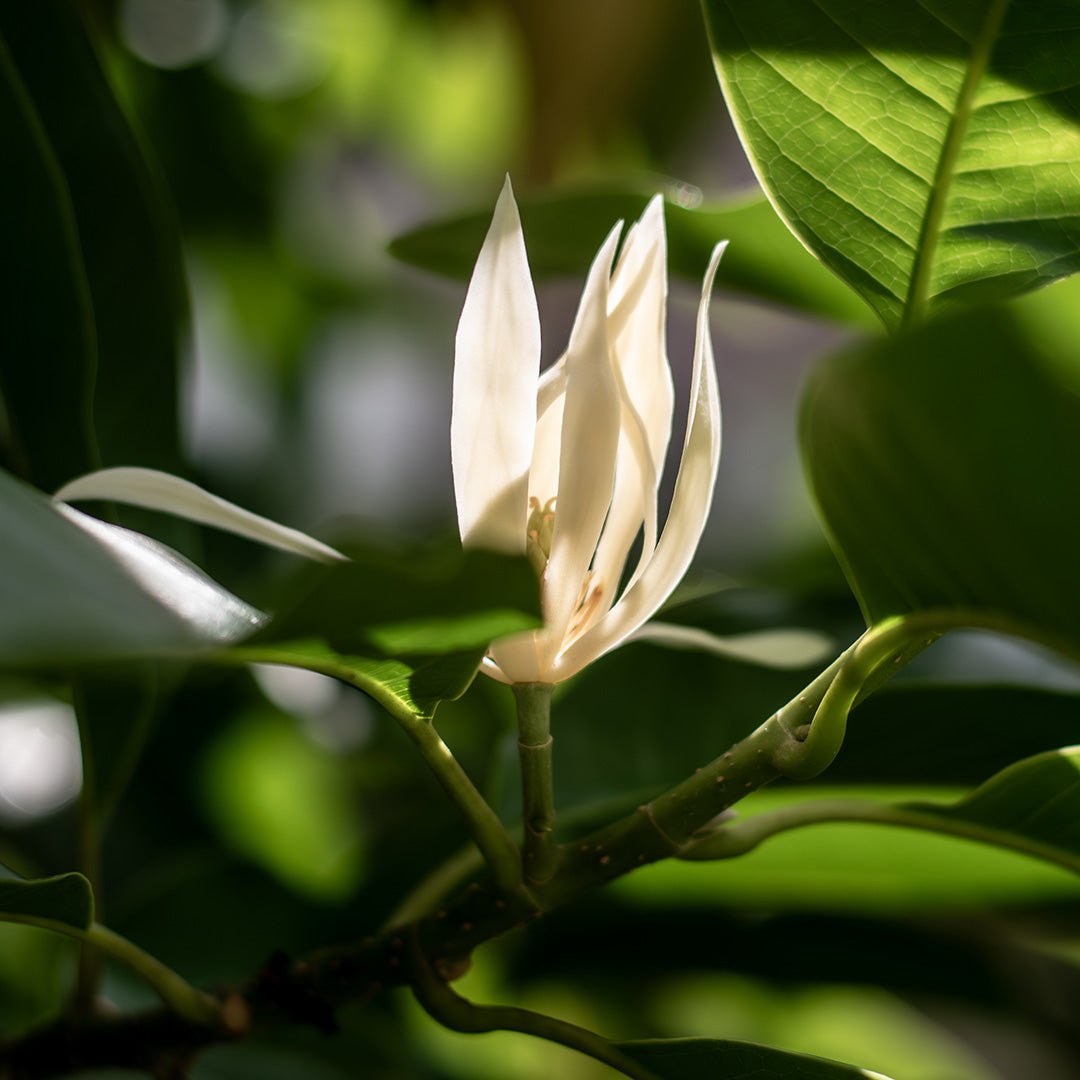
Dense, creamy, many times sweeter and thicker than pomelo blossom. It takes up space in the air in a way pomelo blossom cannot.
When the petals start to turn yellow, an almost faecal note appears. That is indole, and it signals that the flower is changing stage, not that it is spoiling. Anyone who knows this will not throw away a flower at its best moment.
That is the paradox of the floral family: what makes a flower memorable is often the most unpleasant thing in it. Take the indole out of white champaca and you are left with an anonymous sweetness any synthetic fragrance could produce.
How to smell it
Hold a white champaca flower in a loosely closed palm, wait two minutes for the warmth of your hand to release the oil, then open your hand and smell. Smell the same flower again at the end of the day when the petals have turned yellow — the difference between the two is the indole coming through.
Why this one is hard
The faecal note makes it hard for people to accept that it is part of the beauty. The barrier here is psychological, not olfactory: the nose picks it up immediately; only the mind refuses.
Don’t confuse with
This entry
White champaca
Floral family
Two quite different trees despite their similar names. White champaca is clean and clear; ylang-ylang is fatty, with a ripe-banana note, and lasts much longer.
Scientific note
White champaca belongs to the genus Michelia in the magnolia family — one of the oldest surviving families of flowering plants. Flowers of this family are pollinated by beetles, and their structure reflects that. The carpels are thick and tough enough to withstand beetle jaws. The perianth is not divided into separate sepals and petals. And the scent is heavy, suited to a beetle’s sense of smell more than a bee’s.
A claim is often repeated: that magnolias appeared before bees evolved. The claim circulates widely, but the dates do not support it — fossils identifiable as the magnolia family are around 95 million years old, while the oldest known bee fossils are older still. We leave it here as an example: a plausible claim, repeated everywhere, that still does not stand up when checked against the dates.
What is certain is simpler: the flower structure and scent of this family are adapted to beetles, and that does not depend on who came first.
In Vietnamese life
White champaca is planted in pagoda courtyards and the yards of old houses throughout the north and centre. The flowers are usually placed in a dish of water on the family altar rather than in a vase — that keeps them fresh longer and lets the scent spread more slowly.