Reference point
Jasminum sambac flowers picked late in the evening, just as the buds open.
Do this before you read on. An entry only works when you have just smelled the thing.
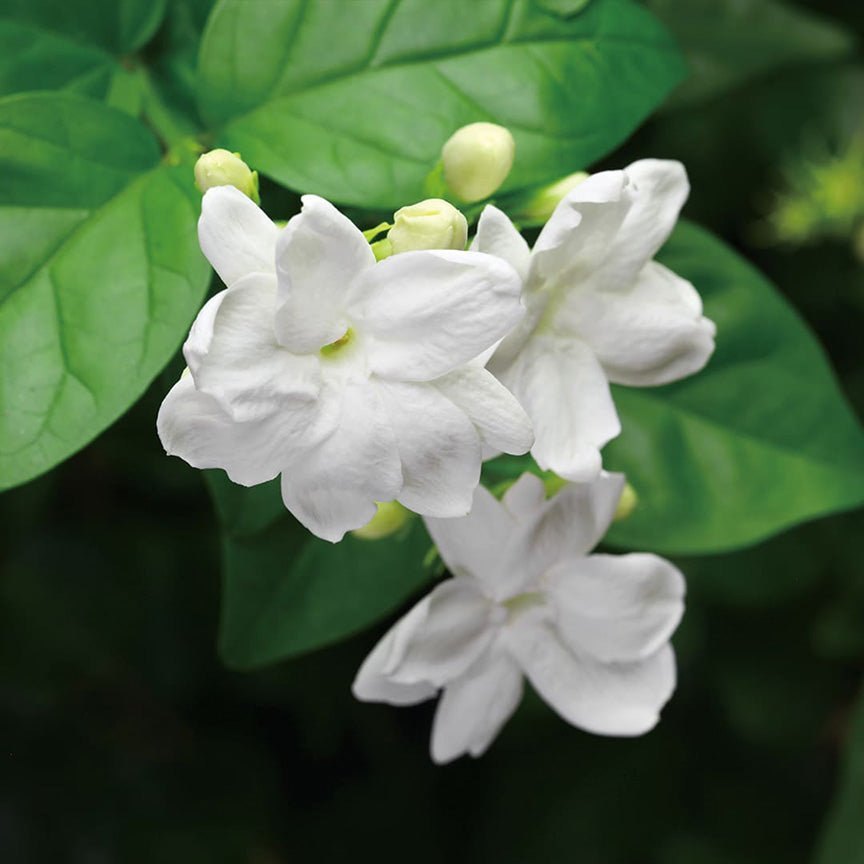
Sweet, waxy, and always with an indolic layer that beginners describe as slightly dirty. That dirty layer is what sets jasmine apart from every other white flower.
The plant releases its oil on a day–night rhythm, and the picking hour has to match the species. Vietnamese jasmine — Jasminum sambac — peaks at night, so it is picked at night or before dawn. The jasmine used in Grasse is a different species, Jasminum grandiflorum, and that one is picked at dawn. Pick at the wrong hour and most of the oil is lost, which is one of the reasons jasmine absolute is expensive.
On how the scent is captured, it is worth being accurate. Jasmine can be distilled — the yield is just so low that nobody does it commercially, and what comes out of the condenser is badly out of proportion with the living flower. The commercial product closest to the flower is the absolute, made by solvent extraction.
But an absolute is not the only way to keep the scent of jasmine. Enfleurage captures it, and was the main method before solvents. Scenting tea captures it too, only it yields a scented base rather than an extract. The methods pages cover all three.
If you see a jasmine oil that is cheap and water-clear, what you are holding is almost certainly not jasmine.
How to smell it
Pick jasmine late in the evening, when the buds are just opening rather than fully out. This timing applies to Jasminum sambac — the species you find in Vietnamese gardens and markets. Smell it right there in the garden. Take a flower home, leave it in a closed room overnight and smell it again the next morning — the indolic note will be much clearer, and that is the best chance to get to know it.
Why this one is hard
Because most Vietnamese people first meet the smell of jasmine through tea, and tea gives a very different version from the fresh flower. During scenting and drying the light part evaporates and the indolic part is almost entirely lost — what remains is a cleaner, gentler and much more agreeable version.
That is not a misunderstanding to correct. The tea version is a real slice of the same flower, and for many people it is easier to love than the original. But if you hold a fresh flower expecting it to smell like the tea, you will find the real flower headier, more complex, and with an almost dirty layer the tea does not have.
Smelling the fresh flower and then the tea is the best exercise for seeing what a method takes away.
Don’t confuse with
This entry
Jasmine
Floral family
Both have an indolic layer. Jasmine is finer and has a tea-like note; white champaca is thick and fatty, close to ripe banana — heavy esters that jasmine lacks.
Scientific note
At high concentration indole smells faecal; at low concentration it gives a warm, skin-like white-flower feel. Very few molecules reverse their character so strongly with concentration. That is why perfumers say dosage decides not only the intensity of a smell but its very nature.
In Vietnamese life
Scenting jasmine tea in Hanoi requires the flowers to be picked at exactly the right time and layered with the tea overnight, over several rounds. It is one of the most sophisticated aromatic techniques still practised in Vietnam — and it survives in the tea trade, not the perfume trade.