Reference point
Squeeze a Vietnamese lime and smell the peel, not the juice.
Do this before you read on. An entry only works when you have just smelled the thing.
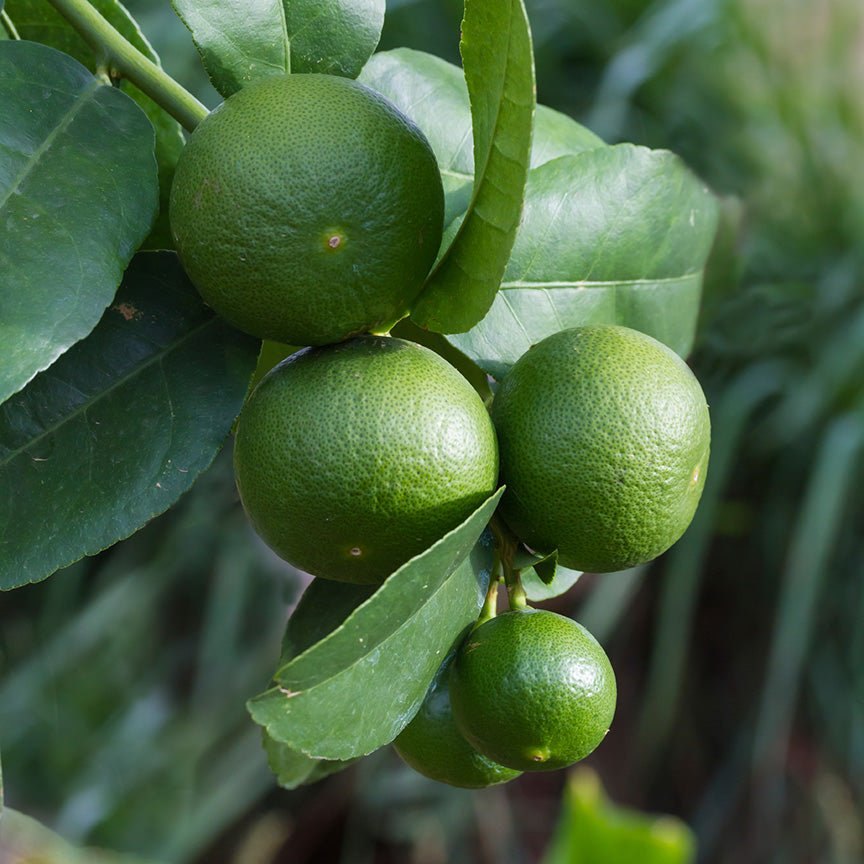
Sharp, thin, almost edged. It comes in very fast and leaves very fast, with no tail. Compared with pomelo peel it lacks the sweet lining behind, and that lack is exactly what makes it useful.
This is the calibration point for the whole citrus family. Smell it first whenever you work with this group: it is the zero line, and every other citrus smell placed after it will show its own surplus. Pomelo peel will reveal its sweetness. Kumquat will reveal its flowers. Lemongrass will reveal its green.
Don’t confuse it with lime juice. The juice is sour but has almost no smell; the fragrance is in the peel. This is one of the places where everyday language lumps taste and smell together, and separating the two is the first step in learning to smell.
How to smell it
Cut a Vietnamese lime in half. Ignore the juice. Take a piece of peel, fold it inside out with the green side facing outwards, and squeeze so the oil sprays up. Smell at once. Then wash your hands, wait a minute, and do the same with pomelo peel. The gap between the two smells is the lesson of the session.
Why this one is hard
Beginners tend to describe lime peel as sour. Sour is a taste, not a smell — lime juice is sour, but lime peel is zesty and bright. Fixing this one word fixes an error that spreads to every other entry in the family.
Don’t confuse with
This entry
Vietnamese lime peel
Citrus family
Fruit peel is sharp and fast; the leaf is green, slightly metallic and clings to the hand for a long time.
This entry
Vietnamese lime peel
Citrus family
Same citrus family, but years apart. Fresh peel is bright and fast; aged tangerine peel is dry, warm, bitter and has almost no sourness left.
Scientific note
How readily a compound evaporates depends on its vapour pressure at room temperature, which in turn depends on molecular weight and on its ability to form hydrogen bonds. Limonene has no polar functional group, so nothing holds it back. That is why the citrus family vanishes so quickly. Its base stage can therefore only be made by processing — salted lime and candied pomelo peel both need months, or many changes of boiling water, to strip out the light part.
In Vietnamese life
The Vietnamese lime (chanh ta) differs from the thin-skinned key lime and entirely from the lemon in the smell of its peel, even though all three are sold simply as chanh. That ambiguity of names is part of why the Vietnamese fragrance trade finds it hard to standardise local raw materials.