Essential oils · Gourmand family
Benzoin essential oil
Styrax tonkinensis
Nhựa bồ đề · Styracaceae
Sweet, warm, close to vanilla and almond, with a soft resinous layer underneath. It is gentle and round, without a single edge.
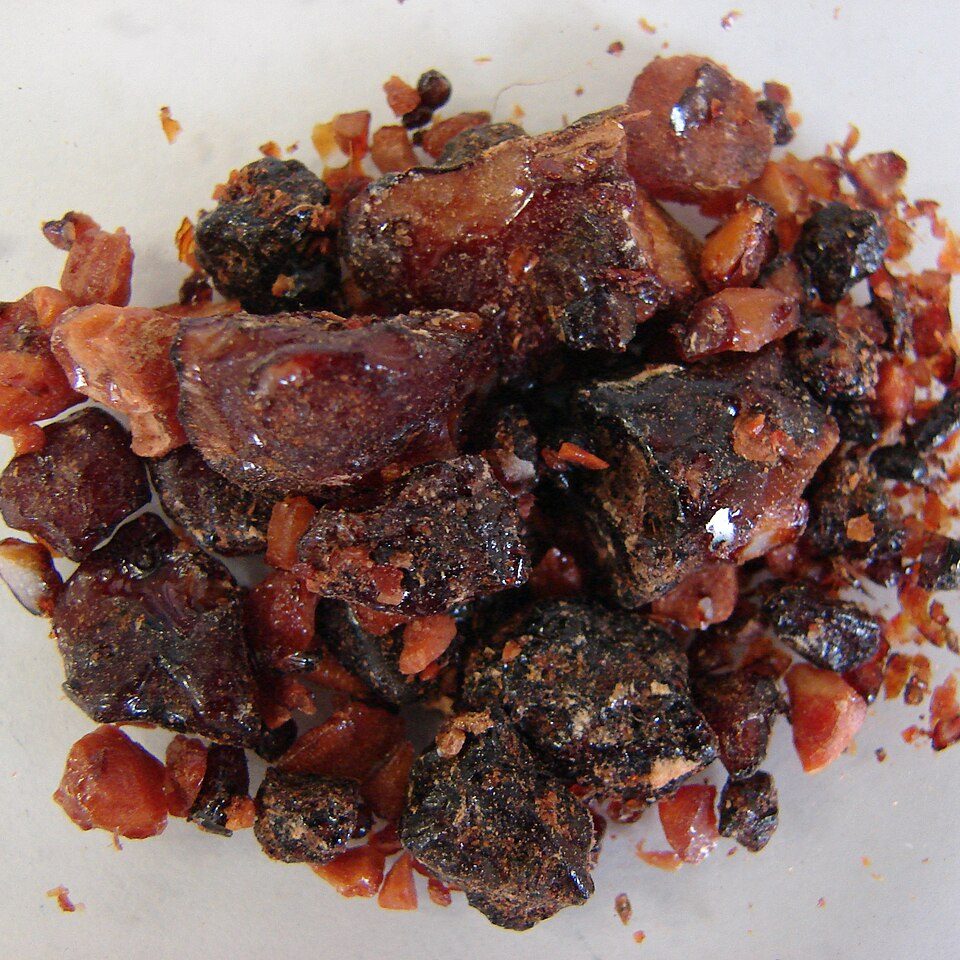
This is Siam benzoin, the resin of the benzoin tree, Styrax tonkinensis. It is not distilled; the resin is dissolved in a solvent, so the product is a thick syrup rather than a liquid essential oil.
In blending it is rarely the main character. It slows down fast-evaporating smells and adds a warm sweetness at the base. The tree also grows in northern Vietnam, but according to FAO the commercial resin today comes mainly from Laos.
- Plant part
- Resin
- Method
- Solvent extraction
- Vietnamese name
- Nhựa bồ đề
- Scent family
- Gourmand
- Plant family
- Styracaceae
- Lots published
- —
 Resin
Siam benzoin
Benzoin is the resin of trees of the genus Styrax. The kind known as Siam benzoin comes from Styrax tonkinensis, called cây bồ đề or cánh kiến trắng in Vietnamese. “Siam” is simply an old trade name, not the place of production. The bark is cut so the resin flows out and hardens into ivory to yellow-brown lumps.
The tree grows in northern Vietnam, but according to the 2011 FAO/JECFA assessment, Laos is considered the major producer, if not the only one at present, mainly from its northern provinces. These documents do not name Vietnam as a commercial source.
Composition
FAO/JECFA evaluated Siam benzoin as a food additive and set specifications for it (the 2014 version replacing the tentative 2011 one):
| Compound | Specification | Measured in samples (2011) |
|---|---|---|
| Benzoic acid | 15–45% | 17.5–46.3% (mean 27.3%) |
| Coniferyl benzoate | 15–60% | about 15–57% |
| Vanillin | under 5% | 0.7–3.5% (mean 1.8%) |
| Benzyl benzoate | under 2% | 0.8–2.4% (mean 1.5%) |
Minor constituents include p-coumaryl benzoate and several triterpene acids.
Coniferyl benzoate and benzoic acid make up most of the resin but smell very faintly. Benzoin’s clear vanilla note comes from vanillin, even though it is only a few per cent. It is an example of how trace constituents shape character.
Siam and Sumatra benzoin
Sumatra benzoin comes from Styrax benzoin and Styrax paralleloneurum in Indonesia. Its main constituents are cinnamic acid and its esters, so it smells warm, resinous and slightly cinnamon-like, less sweet. The JECFA specification uses exactly this to tell them apart: genuine Siam benzoin must contain no cinnamic acid.
Benzoin in blending
Benzoin is not distilled; it is dissolved in a solvent to make a resinoid, a thick syrup. In perfume it is one of the three pillars of the amber accord, softening and fixing fast-evaporating smells.
Vanillin and benzyl benzoate are both on the EU list of cosmetic ingredients that must be labelled above a threshold, so a product containing a lot of benzoin may have to name them.
Sources
- FAO/JECFA (2011). Benzoe tonkinensis: Chemical and Technical Assessment. 74th JECFA. fao.org
- FAO JECFA Monographs 16 (2014). Benzoe tonkinensis: specifications.
Buy Benzoin
Benzoin oil: no lot has been brought in yet, so it is not on sale. Message us if you need it.
Further reading
Close to Benzoin
Also from the resin Copaiba · Elemi · Frankincense sacra · Labdanum · Myrrh · Opopanax
Same method: solvent extraction Jasmine sambac · Labdanum · Night jasmine · Pomelo blossom · Rose absolute · Vanilla
Quick answers
What does benzoin essential oil smell like?
Sweet, warm, close to vanilla and almond, with a soft resinous layer underneath. It is gentle and round, without a single edge.
What is the botanical name of benzoin oil?
The plant is Styrax tonkinensis, in the Styracaceae family. In Vietnamese it is called nhựa bồ đề.
How is benzoin oil produced?
From the resin of the plant, by solvent extraction. See the method for what that does to the oil.
Last updated