Essential oils · Floral family
Jasmine sambac essential oil
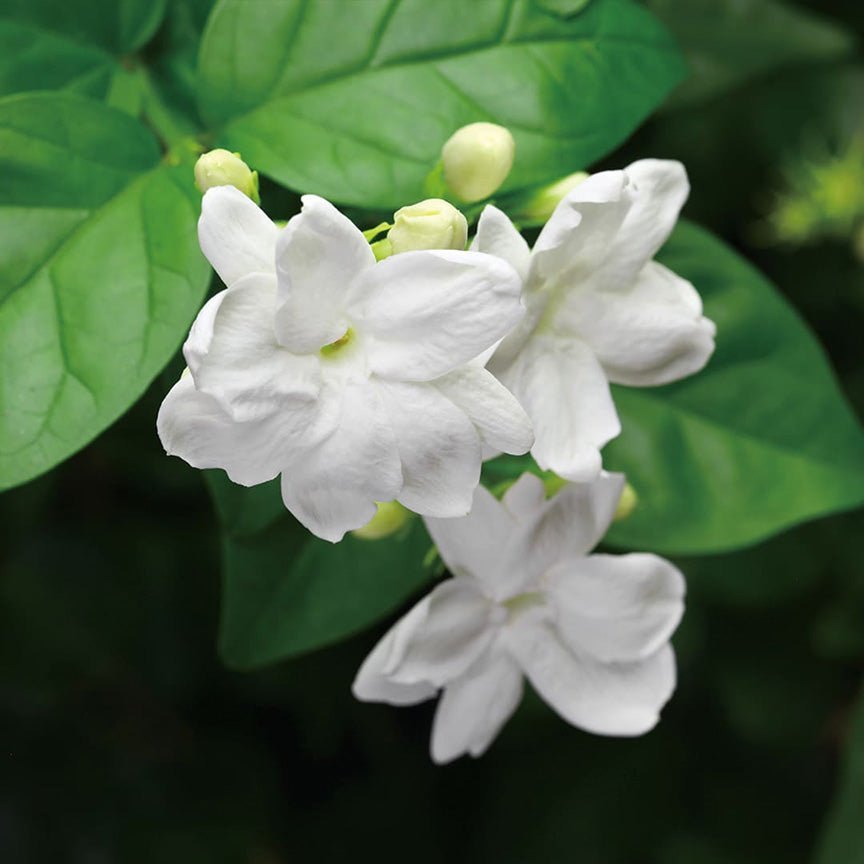
Jasminum sambac
Hoa nhài · Oleaceae
Sweet, waxy, and usually with an indolic layer that beginners describe as slightly dirty. That layer is what sets jasmine apart from every other white flower; take it away and all that is left is an anonymous sweetness.
Arabian jasmine opens in the evening. In one study in India, the flowers were left to open until about 7–8 pm before extraction. The flowers do not survive the still, so real jasmine scent comes from a solvent-extracted absolute, a laborious process.
So if you see a “jasmine oil” at an unusually low price, ask whether it is an absolute or a fragrance.
- Plant part
- Flowers
- Method
- Solvent extraction
- Vietnamese name
- Hoa nhài
- Scent family
- Floral
- Plant family
- Oleaceae
- Lots published
- —
 Flowers
Composition profile
The published composition from the article, read as structure: 7 compounds adding up to about 81 % of the sample. Figures are printed as the source gives them — one sample, not a species average.
| Compound | Level | Class | Note |
|---|---|---|---|
| Benzyl acetate | 23.7 % | Esters | Middle |
| α-Farnesene | 15.9 % | Sesquiterpenes | Base |
| Indole | 13.1 % | Other compounds | Base |
| Linalool EU | 10.6 % | Alcohols | Middle |
| Benzyl alcohol | 7.7 % | — | — |
| Methyl anthranilate | 5.0 % | Esters | Base |
| (Z)-3-Hexenyl benzoate | 4.9 % | — | — |
By chemical class
- Esters28.7 %
- Sesquiterpenes15.9 %
- Other compounds13.1 %
- Unclassified12.6 %
- Alcohols10.6 %
By note
- Middle34.3 %
- Base34.0 %
- Unclassified12.6 %
Group totals use the upper bound of each range and only the compounds the article lists; bars are relative to the identified total.
Put it beside another oil in the Compare tool Which other oils are rich in Benzyl acetate?
From flower to bottle: concrete and absolute
Jasmine flowers do not survive the still: heat and water destroy most of the smell, and the yield is far too low. The article on why jasmine cannot be distilled covers this in detail. Real jasmine is therefore almost always obtained with a solvent, in two steps:
- Fresh flowers are steeped in a non-polar solvent such as hexane, which is then evaporated. What remains is the concrete: a soft, waxy mass holding both the scent and the waxes of the petals.
- The concrete is taken up in alcohol, chilled so the waxes set, filtered, and the alcohol evaporated. What remains is the absolute.
So a cheap bottle of “jasmine oil” deserves a question: is it an absolute, a diluted absolute, or a synthetic fragrance?
The flower smells different from the bottle
In 2008 a study in European Food Research and Technology analysed Arabian jasmine (Jasminum sambac) grown in Egypt in two ways: the vapour rising from the concrete, and the absolute itself. Some of the main compounds:
| Compound | Concrete headspace | Absolute |
|---|---|---|
| Benzyl acetate | 23.7% | 14.2% |
| α-Farnesene (E,E) | 15.9% | 13.1% |
| Indole | 13.1% | 13.4% |
| Linalool | 10.6% | 6.3% |
| Benzyl alcohol | 7.7% | 8.4% |
| Methyl anthranilate | 5.0% | 4.7% |
| (Z)-3-Hexenyl benzoate | 4.9% | 9.4% |
Benzyl acetate and linalool, two light compounds, take a much larger share of the vapour. That is the part the nose catches first when leaning into the flower. By contrast, (Z)-3-hexenyl benzoate, a heavy ester, nearly doubles in the absolute. The percentages in an analysis depend on what was analysed. When comparing two reports, the first thing to check is whether they measured the same thing.
India and China: absolutes differ by region
A 2012 study in Natural Product Communications analysed 15 Arabian jasmine absolutes: 7 made from flowers in interior Tamil Nadu (India), 1 from buds, 4 Indian commercial absolutes and 3 Chinese commercial absolutes. The flowers were left to open, extracted with n-hexane into a concrete, then taken through alcohol to an absolute:
| Compound | Tamil Nadu (7) | India, commercial (4) | China (3) |
|---|---|---|---|
| Benzyl acetate | 6.6–11.6% | 8.0–15.7% | 10.1–11.7% |
| α-Farnesene | 11.1–15.6% | 12.0–14.6% | 7.3–7.9% |
| Benzyl alcohol | 7.4–14.1% | 3.2–10.7% | 6.2–11.0% |
| Linalool | 2.6–5.0% | 6.2–8.4% | 8.0–9.2% |
| Methyl anthranilate | 5.0–7.5% | 6.3–9.1% | 6.4–12.0% |
| (Z)-3-Hexenyl benzoate | 4.7–5.9% | 5.3–7.4% | 9.9–16.9% |
| Indole | 4.1–9.7% | 1.0–3.9% | 0.2–5.0% |
The Chinese samples had methyl salicylate at 1.2–1.3%, against 0.1–0.2% in the Indian ones. The authors judged the Chinese absolutes “flatter”, less rich, with a wintergreen note, and very reminiscent of jasmine tea. They caution that the number of Chinese samples is too small for a firm conclusion.
Indole is the most striking point: the 2008 Egyptian sample had about 13%, while the 15 samples in 2012 had only 0.2–9.7%. The 2012 authors call the older division of Arabian jasmine into “indole-rich” and “indole-poor” types “at least questionable”, and suggest that other factors, such as manufacturing, may decide the indole level.
Arabian jasmine and Spanish jasmine
In Western perfumery, “jasmine” usually means Jasminum grandiflorum, the five-petalled species that, according to the 2012 study, is grown for absolute mainly in India, Egypt and Morocco. The jasmine used to scent tea in Vietnam is Jasminum sambac. A 2026 study in Scientific Reports compared the two species grown in Egypt: J. grandiflorum absolute is rich in diterpenes (phytol, isophytol), up to 34.78% in total, against 9.98% in Arabian jasmine absolute; cis-jasmone was present in J. grandiflorum concrete and absolute but not found in Arabian jasmine. A label that says only “jasmine”, without the species, does not tell you what you are buying. The article on species names says more about this.
Safety
In the EU, oils and extracts of Jasminum grandiflorum and J. officinale are on the list of fragrance allergens that must be named on cosmetic labels (above 0.001% in leave-on and 0.01% in rinse-off products). Arabian jasmine is not named, but its absolute contains benzyl alcohol, linalool and benzyl benzoate, all of which are on the list. Always dilute before use on skin.
Sources
- Edris A.E., Chizzola R., Franz C. (2008). Isolation and characterization of the volatile aroma compounds from the concrete headspace and the absolute of Jasminum sambac (L.) Ait. (Oleaceae) flowers grown in Egypt. European Food Research and Technology 226, 621–626. doi:10.1007/s00217-007-0623-y
- Braun N.A., Sim S. (2012). Jasminum sambac flower absolutes from India and China – geographic variations. Natural Product Communications 7(5), 645–650. doi:10.1177/1934578X1200700526
- Yassen M.S. et al. (2026). Comparative analysis of flower volatiles from four Jasminum species growing in Egypt using multivariate analysis. Scientific Reports 16, 8947. doi:10.1038/s41598-026-39688-w
- Regulation (EU) 2023/1545 on the labelling of fragrance allergens.
Buy Jasmine sambac
Jasmine sambac oil: no lot has been brought in yet, so it is not on sale. Message us if you need it.
In the scent dictionary: Jasmine — a description of the smell, the compounds behind it, and how to smell it for yourself.
Where you may already have smelled it
According to the analyses cited above, this oil contains up to 23.7 % benzyl acetate. It is also the leading compound in the scenes below from the scent dictionary. Smelling one of those scenes again is a way to get to know it without opening a bottle. A shared compound does not mean the oil smells exactly like the scene.
Further reading
Close to Jasmine sambac
Same plant family: Oleaceae Jasmine grandiflorum · Osmanthus
Also from the flowers Clary sage · German chamomile · Jasmine grandiflorum · Lavandin · Lavender · Linden blossom · Lotus · Neroli
Same method: solvent extraction Benzoin · Jasmine grandiflorum · Labdanum · Lotus · Rose absolute · Vanilla
Quick answers
What does jasmine sambac essential oil smell like?
Sweet, waxy, and usually with an indolic layer that beginners describe as slightly dirty. That layer is what sets jasmine apart from every other white flower; take it away and all that is left is an anonymous sweetness.
What is the botanical name of jasmine sambac oil?
The plant is Jasminum sambac, in the Oleaceae family. In Vietnamese it is called hoa nhài.
How is jasmine sambac oil produced?
From the flowers of the plant, by solvent extraction. See the method for what that does to the oil.
What are the main compounds of jasmine sambac oil?
From the composition data on this page, the oil is led by Benzyl acetate, α-Farnesene and Indole. Proportions vary with origin, harvest and method; a lot analysis is the only answer for a given bottle.
Last updated