Essential oils · Floral family
Pomelo blossom essential oil
Citrus maxima
Hoa bưởi · Rutaceae
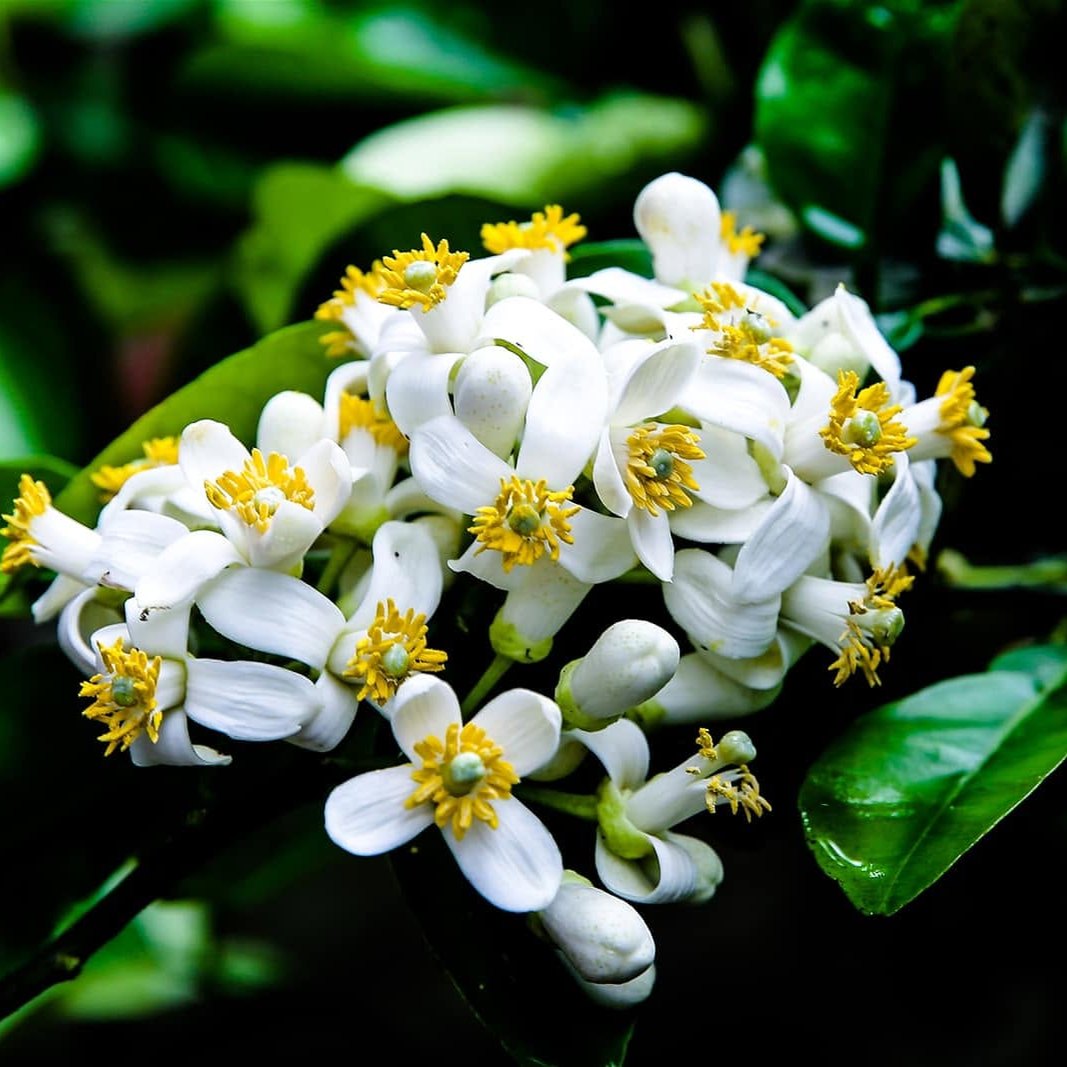
White flowers, sweet and waxy, with a green edge of citrus peel. It is close to neroli, but rounder and sweeter.
The scent on the branch is mainly linalool, with indole. Distilled into oil, the composition can change completely, so only the lot analysis shows how close a bottle is to the flower.
Vietnamese people know this smell from tea and tapioca flour scented with pomelo blossom. It is one of the very few flower scents Vietnamese people use to perfume food, so the memory of it lives on the tongue as well as in the nose.
- Plant part
- Flowers
- Method
- Solvent extraction
- Vietnamese name
- Hoa bưởi
- Scent family
- Floral
- Plant family
- Rutaceae
- Lots published
- —
 Flowers
Composition profile
The published composition from the article, read as structure: 4 compounds adding up to about 66 % of the sample. Figures are printed as the source gives them — one sample, not a species average.
| Compound | Level | Class | Note |
|---|---|---|---|
| Linalool EU | 54.41 % | Alcohols | Middle |
| Indole | 4.79 % | Other compounds | Base |
| Nerolidol | 3.57 % | Alcohols | Base |
| Limonene EU | 3.32 % | Monoterpenes | Top |
By chemical class
- Alcohols58.0 %
- Other compounds4.8 %
- Monoterpenes3.3 %
By note
- Top3.3 %
- Middle54.4 %
- Base8.4 %
Group totals use the upper bound of each range and only the compounds the article lists; bars are relative to the identified total.
Compare with the 2 chemically closest oils Which other oils are rich in Linalool?
Pomelo blossom
The pomelo (Citrus maxima, synonym Citrus grandis) bears white, strongly scented flowers in spring. In Vietnam, pomelo blossom is used to scent tea, one of the few flower scents Vietnamese people use with food and drink. See also the pomelo blossom entry in the scent dictionary.
The scent on the branch: linalool and indole
A 2013 study in the International Journal of Molecular Sciences measured the scent (headspace) given off by fresh flowers of 9 citrus types in Zhejiang (China), including two pomelo cultivars, Yuhuanyou (YHY) and Zaoxiangyou (ZXY), at three stages of opening. Some of the main compounds, at the bud and fully open stages:
| Compound | YHY bud | YHY open | ZXY bud | ZXY open |
|---|---|---|---|---|
| Linalool | 54.41% | 21.59% | 36.44% | 48.43% |
| Indole | 4.79% | 8.84% | 8.16% | 7.88% |
| Nerolidol | 3.57% | <1% | 6.94% | 8.75% |
| Limonene | 3.32% | 3.68% | 4.92% | 3.32% |
Linalool is the main compound in the scent of pomelo blossom in both cultivars, along with indole and nerolidol. The paper also records (E)-ocimene and methyl anthranilate at some stages, but its tables disagree with each other on these two compounds, so we do not give figures. The authors note that pomelo is the exception among the 9 types: in the others, fully open flowers give off the most scent compounds, but not in pomelo.
How the scent changes with opening also differs between the cultivars: in Yuhuanyou, linalool falls from 54.41% in the bud to 21.59% in the fully open flower; in Zaoxiangyou, linalool rises from 36.44% to 48.43%. So it cannot be said in general that open flowers always smell a particular way.
When extracted as oil
A 2010 study in Sains Malaysiana analysed pomelo flowers by three methods (hydrodistillation, Soxhlet extraction and solid-phase microextraction), separating buds and open flowers. The main compounds reported were β-myrcene, limonene, ocimene, linalool and caryophyllene. By hydrodistillation, the open flowers had linalool 15.93% and ocimene 7.37%, higher than the buds; by Soxhlet extraction, the buds had limonene 27.25%, ocimene 5.55% and linalool 2.97%.
A 2025 study in Current Issues in Molecular Biology steam-distilled (for 18 hours) the flowers of Huazhou pomelo (Citrus grandis ‘Tomentosa’, Guangdong), with a yield of 0.92%, and identified 43 compounds. The main ones were nerolidol 14.8%, β-caryophyllene 11.42%, γ-terpinene 9.23%, myrcene 8.93%, germacrene D 7.40%, farnesol 5.52% and linalool 5.35%; methyl anthranilate was 3.23%. This is a single batch of a cultivar used medicinally, but it shows that oil distilled from the flowers can be very different from the scent on the branch: linalool drops from the main role to a few per cent.
Pomelo blossom and pomelo peel
Pomelo peel oil is an entirely different product: peel oil is mostly limonene (about 70–90%) and smells of peel, not flowers. When buying, check the plant part on the label.
Safety
Linalool, limonene, β-caryophyllene and farnesol are all on the EU list of fragrance allergens that must be named on cosmetic labels (above 0.001% in leave-on and 0.01% in rinse-off products). Always dilute before use on skin.
Sources
- Azam M., Song M., Fan F. et al. (2013). Comparative analysis of flower volatiles from nine Citrus at three blooming stages. International Journal of Molecular Sciences 14(11), 22346–22367. doi:10.3390/ijms141122346
- Zarina Zakaria, Suhana Zakaria, Mohd Azlan Mohd Ishak (2010). Analysis of major fragrant compounds from Citrus grandis flowers extracts. Sains Malaysiana 39(4), 565–569. ukm.my
- Yan D., Wen S., Chen M. et al. (2025). Analysis of pharmacological activities and mechanisms of essential oil in flowers of Citrus grandis ‘Tomentosa’ by GC-MS/MS and network pharmacology. Current Issues in Molecular Biology 47(7), 541. doi:10.3390/cimb47070541
- Regulation (EU) 2023/1545 on the labelling of fragrance allergens.
Buy Pomelo blossom
Pomelo blossom oil: no lot has been brought in yet, so it is not on sale. Message us if you need it.
In the scent dictionary: Pomelo blossom — a description of the smell, the compounds behind it, and how to smell it for yourself.
Where you may already have smelled it
According to the analyses cited above, this oil contains up to 54.4 % linalool. It is also the leading compound in the scenes below from the scent dictionary. Smelling one of those scenes again is a way to get to know it without opening a bottle. A shared compound does not mean the oil smells exactly like the scene.
Chemically close
The oils whose published composition is closest to this one, compared across every compound we could read. Close in composition does not mean the scent is identical or that one can replace the other.
Further reading
Close to Pomelo blossom
Same plant family: Rutaceae Bergamot · Cold-pressed lemon peel · Kaffir lime leaf · Neroli · Petitgrain · Pomelo peel · Red mandarin
Also from the flowers Jasmine sambac · Moroccan blue chamomile · Neroli · Osmanthus · Roman chamomile · Saffron · Tagetes · Tuberose
Same method: solvent extraction Champaca · Jasmine grandiflorum · Jasmine sambac · Labdanum · Osmanthus · Rose absolute
Quick answers
What does pomelo blossom essential oil smell like?
White flowers, sweet and waxy, with a green edge of citrus peel. It is close to neroli, but rounder and sweeter.
What is the botanical name of pomelo blossom oil?
The plant is Citrus maxima, in the Rutaceae family. In Vietnamese it is called hoa bưởi.
How is pomelo blossom oil produced?
From the flowers of the plant, by solvent extraction. See the method for what that does to the oil.
Last updated