Essential oils · Floral family
Night jasmine essential oil
Cestrum nocturnum
Dạ hương · Solanaceae
Sweet, heady, so dense it is almost suffocating. This is the smell of a night-blooming jasmine bush after dark, which many people love and many cannot stand.
The plant releases its scent only at night, and the smell is strongest in the first few hours after sunset. In daytime the flowers are nearly scentless. It is a clear example of a plant releasing aromatic compounds on a rhythm, as jasmine does.
Night jasmine absolute is very rare, and so little has been published about it that this description has had to rely mostly on the smell of the living plant. When a real lot arrives, this section will be rewritten from that lot.
- Plant part
- Flowers
- Method
- Solvent extraction
- Vietnamese name
- Dạ hương
- Scent family
- Floral
- Plant family
- Solanaceae
- Lots published
- —
 Flowers
Composition profile
The published composition from the article, read as structure: 6 compounds adding up to about 88 % of the sample. Figures are printed as the source gives them — one sample, not a species average.
| Compound | Level | Class | Note |
|---|---|---|---|
| Benzaldehyde | 32.40 % | — | — |
| Phenylacetaldehyde | 26.91 % | — | — |
| Benzyl acetate | 23.07 % | Esters | Middle |
| A farnesene isomer | 5.25 % | — | — |
| (E)-3-Hexenyl acetate | 0.42 % | — | — |
| Linalool EU | 0.25 % | Alcohols | Middle |
By chemical class
- Unclassified65.0 %
- Esters23.1 %
- Alcohols0.3 %
By note
- Middle23.3 %
- Unclassified65.0 %
Group totals use the upper bound of each range and only the compounds the article lists; bars are relative to the identified total.
What night-blooming jessamine is
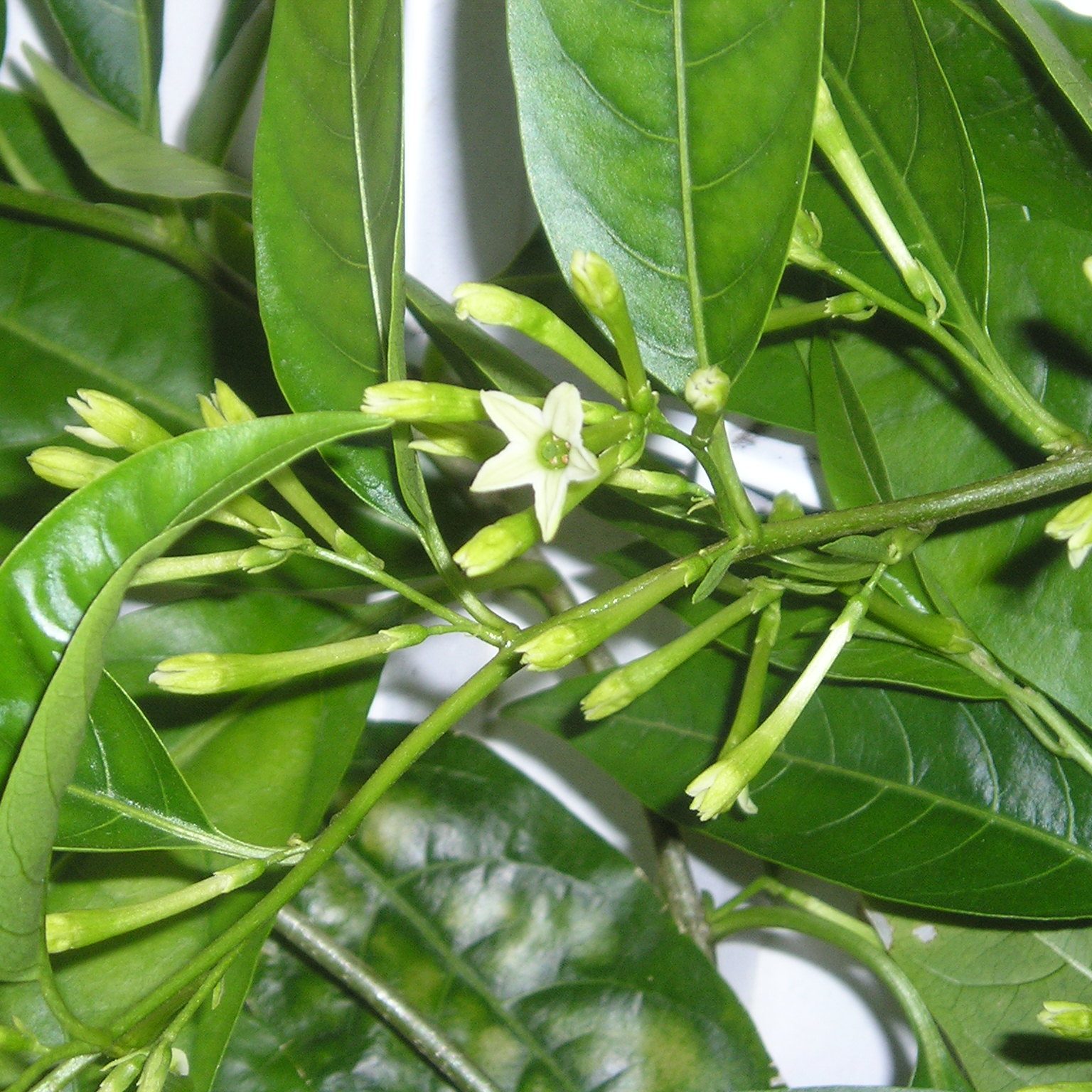
Night-blooming jessamine (Cestrum nocturnum), dạ hương or dạ lý hương in Vietnamese, is a shrub of the nightshade family with small, tubular, greenish-white flowers in clusters. By day the flowers barely smell; after dark the whole shrub releases a scent so sweet and heady that it fills a lane. Despite the English name, it is not a jasmine and is unrelated to jasmine.
Scent by the hour
A 2025 study in Scientific Reports measured the scent emitted by the flowers every two hours from 18:00 to 06:00 and identified 22 compounds, 12 of them phenylpropanoids. The main compounds, at their peak:
| Compound | Share | Time |
|---|---|---|
| Benzaldehyde | 32.40% | 24:00 |
| Phenylacetaldehyde | 26.91% | 24:00 |
| Benzyl acetate | 23.07% | 24:00 |
| A farnesene isomer | 5.25% | 22:00 |
| (E)-3-Hexenyl acetate | 0.42% | 04:00 |
| Linalool | 0.25% | 22:00 |
Total emission peaked at midnight and was lowest at 06:00, a difference of nearly fourteenfold. Phenylpropanoids peaked at midnight, terpenes earlier, at 22:00. The petals open gradually between 18:00 and 22:00, are fully open from 22:00 to 02:00, then close towards morning.
It is a clear example of how smell is a process, not a state: the plant does not hold a ready store of scent, but produces it on a day–night rhythm.
Why the scent feels “stifling”
The three main compounds explain the feeling. Benzaldehyde smells of bitter almond, sweet and sharp. Phenylacetaldehyde gives a rich sweet floral note, a little like honey and hyacinth, and at high concentration becomes almost unpleasant. Benzyl acetate is a sweet floral compound also abundant in jasmine. All three peak at midnight, outdoors in still air, so the scent thickens.
Night jessamine products
Night jessamine absolute is very rare on the market, and we have not read any published analysis of a commercial absolute. Most products named after this flower are fragrance blends. The study above measured living flowers, not an extract.
The plant is toxic
According to the poisonous plant page of Children’s Health Queensland (Australia), all parts of the plant are toxic, especially the fruit. Symptoms include raised temperature, rapid pulse, excess salivation and gastritis. The same source notes that the night fragrance can cause breathing difficulty in some people. It is best not planted right outside a young child’s bedroom window, and children and pets should not eat the berries.
Sources
- Qiao S., Ding A., Liu T. et al. (2025). Unraveling the mechanism of fragrance release in Cestrum nocturnum through transcriptome and volatile compound profiling. Scientific Reports 15, 15376. doi:10.1038/s41598-025-99542-3
- Children’s Health Queensland. Poisonous plant: night-blooming jessamine (Cestrum nocturnum). childrens.health.qld.gov.au
Buy Night jasmine
Night jasmine oil: no lot has been brought in yet, so it is not on sale. Message us if you need it.
Where you may already have smelled it
According to the analyses cited above, this oil contains up to 23.1 % benzyl acetate. It is also the leading compound in the scenes below from the scent dictionary. Smelling one of those scenes again is a way to get to know it without opening a bottle. A shared compound does not mean the oil smells exactly like the scene.
Further reading
Close to Night jasmine
Also from the flowers Everlasting Madagascar · Hops · Immortelle Madagascar · Jasmine grandiflorum · Pomelo blossom · Rose otto · Spike lavender · Tagetes
Same method: solvent extraction Benzoin · Champaca · Jasmine sambac · Osmanthus · Pomelo blossom · Rose absolute
Quick answers
What does night jasmine essential oil smell like?
Sweet, heady, so dense it is almost suffocating. This is the smell of a night-blooming jasmine bush after dark, which many people love and many cannot stand.
What is the botanical name of night jasmine oil?
The plant is Cestrum nocturnum, in the Solanaceae family. In Vietnamese it is called dạ hương.
How is night jasmine oil produced?
From the flowers of the plant, by solvent extraction. See the method for what that does to the oil.
What are the main compounds of night jasmine oil?
From the composition data on this page, the oil is led by Benzyl acetate and Linalool. Proportions vary with origin, harvest and method; a lot analysis is the only answer for a given bottle.
Last updated