Essential oils · Woody & Resinous family
Frankincense sacra essential oil
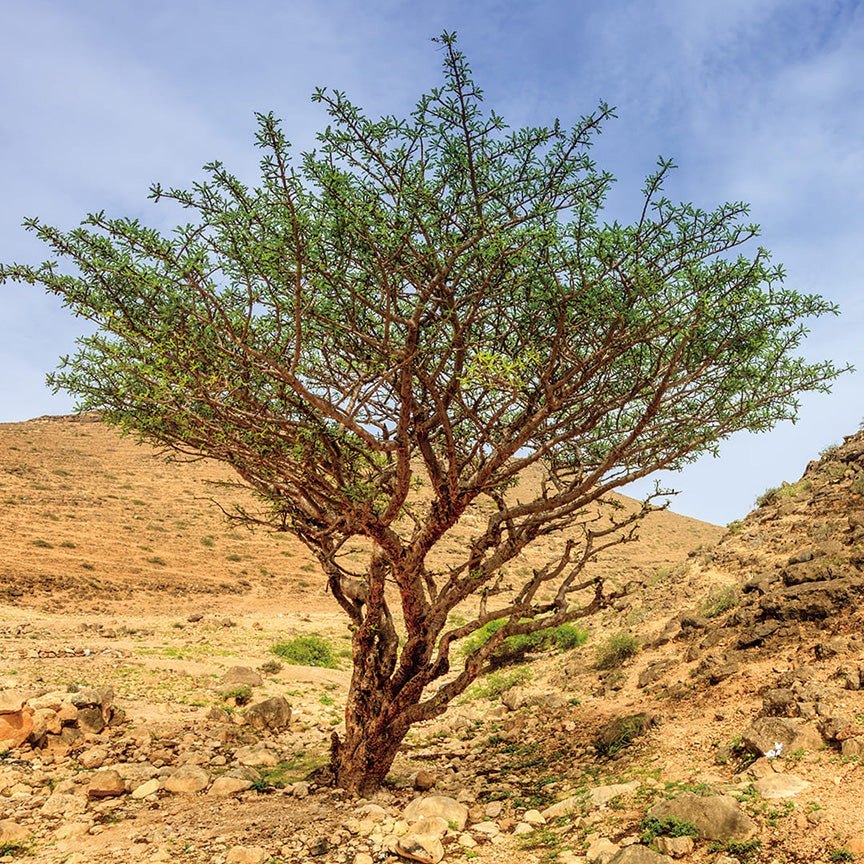
Boswellia sacra
Nhũ hương Sacra · Burseraceae
Bright resin, lemon and pine, with a warm, slightly spicy layer beneath. It is rounder and more balanced than carterii frankincense.
Boswellia sacra is the frankincense of Oman and Yemen, source of the famous ancient incense trade. Many sources treat it as the same species as Somalia’s B. carterii; both oils are rich in α-pinene.
Sacra resin is graded by colour and clarity, the top grade being pale green. Grade affects price but not always the oil’s composition; only the analysis can say.
- Plant part
- Resin
- Vietnamese name
- Nhũ hương Sacra
- Scent family
- Woody & Resinous
- Plant family
- Burseraceae
- Lots published
- —
 Resin
Composition profile
The published composition from the article, read as structure: 3 compounds adding up to about 87 % of the sample. Figures are printed as the source gives them — one sample, not a species average.
| Compound | Level | Class | Note |
|---|---|---|---|
| α-Pinene EU | 78.45 % | Monoterpenes | Top |
| Limonene EU | 5.55 % | Monoterpenes | Top |
| Myrcene | 2.56 % | Monoterpenes | Top |
By chemical class
- Monoterpenes86.6 %
By note
- Top86.6 %
Group totals use the upper bound of each range and only the compounds the article lists; bars are relative to the identified total.
Compare with the 2 chemically closest oils Which other oils are rich in α-Pinene?
What Boswellia sacra is
Boswellia sacra is the frankincense of Oman and Yemen. The resin is collected by cutting the bark and letting it seep out and harden into tears; the oil is distilled from that resin. The frankincense page covers the group as a whole; this page focuses on what sets sacra apart.
Composition: one Omani sample, four fractions
A 2012 study distilled Hougari-grade sacra resin from Hasik, east of Salalah, collecting oil at different stages of distillation:
| Compound | Fraction I (0–2 h) | Fraction IV (11–12 h, 100 °C) |
|---|---|---|
| α-Pinene | 78.45% | 59.40% |
| Limonene | 5.55% | 8.99% |
| Myrcene | 2.56% | 5.36% |
Across all four fractions, β-pinene was 2.16–2.38%, sabinene 1.11–3.63% and α-thujene 0.87–1.02%. α-Pinene dominates, and it falls as distillation goes on: the lightest molecules come over first. The same batch of resin can give different oils depending on distillation time.
Compared with other species
A 2019 study brought together data on several species (mean, with range in brackets):
| Species, chemotype | α-Pinene | α-Thujene | Limonene | Myrcene |
|---|---|---|---|---|
| B. sacra Oman, type 1 | 68.5% (46.8–79.6) | 0.6% | 5.8% | 2.8% |
| B. sacra Oman, type 2 | 48.6% (24.7–67.9) | 17.5% | 1.7% | 0.2% |
| B. carteri Somalia, type 1 | 36.3% (15.6–48.9) | 2.3% | 11.4% | 14.7% |
| B. carteri, type 3 | 26.1% | 3.2% | 34.3% | 2.8% |
| B. carteri, type 4 | 7.5% | 43.0% | 2.1% | 1.5% |
The Omani sacra figures in that paper are labelled as unpublished data. The overall picture: Omani sacra is usually very rich in α-pinene, while Somali carteri is far more varied, with limonene-rich and α-thujene-rich types. Other species differ again: Ethiopian B. papyrifera is rich in octyl acetate (57.1–65.7%), and Frereana and Serrata frankincense have profiles of their own.
Its smell
With α-pinene at around 70%, sacra opens with bright, clean pine resin; limonene adds a lemony note. Late fractions, with less α-pinene and more limonene and myrcene, give a rounder, warmer oil.
A question of origin
Two 2019 studies found that some frankincense sold as B. carteri is actually B. occulta, identified by the compound 1-methoxydecane (26.6–47.9% in B. occulta oil). Methoxydecane was present in 9 of 13 commercial oils tested, including 4 of 5 certified-organic samples. Organic certification does not confirm species; only an analysis can.
Two commercial sacra oils of unknown origin in the same work had only 18.3% and 22.5% α-pinene, far below the Omani samples. For an oil labelled “sacra”, check the α-pinene figure and ask whether methoxydecane is present. Always dilute before use on skin; α-pinene-rich oils oxidise quickly, so keep the bottle tightly closed.
Sources
- Ni X., Suhail M.M., Yang Q. et al. (2012). Frankincense essential oil prepared from hydrodistillation of Boswellia sacra gum resins induces human pancreatic cancer cell death in cultures and in a xenograft murine model. BMC Complementary and Alternative Medicine 12, 253. doi:10.1186/1472-6882-12-253
- Johnson S., DeCarlo A., Satyal P. et al. (2019). The Chemical Composition of Boswellia occulta Oleogum Resin Essential Oils. Natural Product Communications 14(7). doi:10.1177/1934578X19866307
- Johnson S., DeCarlo A., Satyal P. et al. (2019). Organic Certification is Not Enough: The Case of the Methoxydecane Frankincense. Plants 8(4), 88. doi:10.3390/plants8040088
- Bekana D., Kebede T., Assefa M. et al. (2014). Comparative Phytochemical Analyses of Resins of Boswellia Species (B. papyrifera (Del.) Hochst., B. neglecta S. Moore, and B. rivae Engl.) from Northwestern, Southern, and Southeastern Ethiopia. ISRN Analytical Chemistry 2014, 374678. doi:10.1155/2014/374678
Buy Frankincense sacra
Frankincense sacra oil: no lot has been brought in yet, so it is not on sale. Message us if you need it.
Where you may already have smelled it
According to the analyses cited above, this oil contains up to 78.5 % α-pinene. It is also the leading compound in the scenes below from the scent dictionary. Smelling one of those scenes again is a way to get to know it without opening a bottle. A shared compound does not mean the oil smells exactly like the scene.
Chemically close
The oils whose published composition is closest to this one, compared across every compound we could read. Close in composition does not mean the scent is identical or that one can replace the other.
Further reading
Close to Frankincense sacra
Same plant family: Burseraceae Elemi · Frankincense · Frankincense serrata · Opopanax · Palo santo
Also from the resin Benzoin · Copaiba · Frankincense serrata · Labdanum · Myrrh · Peru balsam
Same method: direct steam distillation Clary sage · Cypress · Frankincense serrata · Helichrysum · Nutmeg · Opopanax · Peru balsam · Rosemary ct camphor
Quick answers
What does frankincense sacra essential oil smell like?
Bright resin, lemon and pine, with a warm, slightly spicy layer beneath. It is rounder and more balanced than carterii frankincense.
What is the botanical name of frankincense sacra oil?
The plant is Boswellia sacra, in the Burseraceae family. In Vietnamese it is called nhũ hương sacra.
How is frankincense sacra oil produced?
From the resin of the plant, by direct steam distillation. See the method for what that does to the oil.
Last updated