Essential oils · Woody & Resinous family
Labdanum essential oil
Cistus ladanifer
Nhựa labdanum · Cistaceae
Amber, leather, dark honey and an almost animal note. It is thick, warm and very long-lasting.
Labdanum is the resin exuded on the leaves and twigs of the rockrose (Cistus ladanifer) around the Mediterranean. In Spain it is extracted from the leafy twigs with alkaline water or boiling water.
Labdanum is a core part of the “amber” accord in perfumery. Cistus oil, distilled from the same plant, is a different product, with a composition quite unlike the resin.
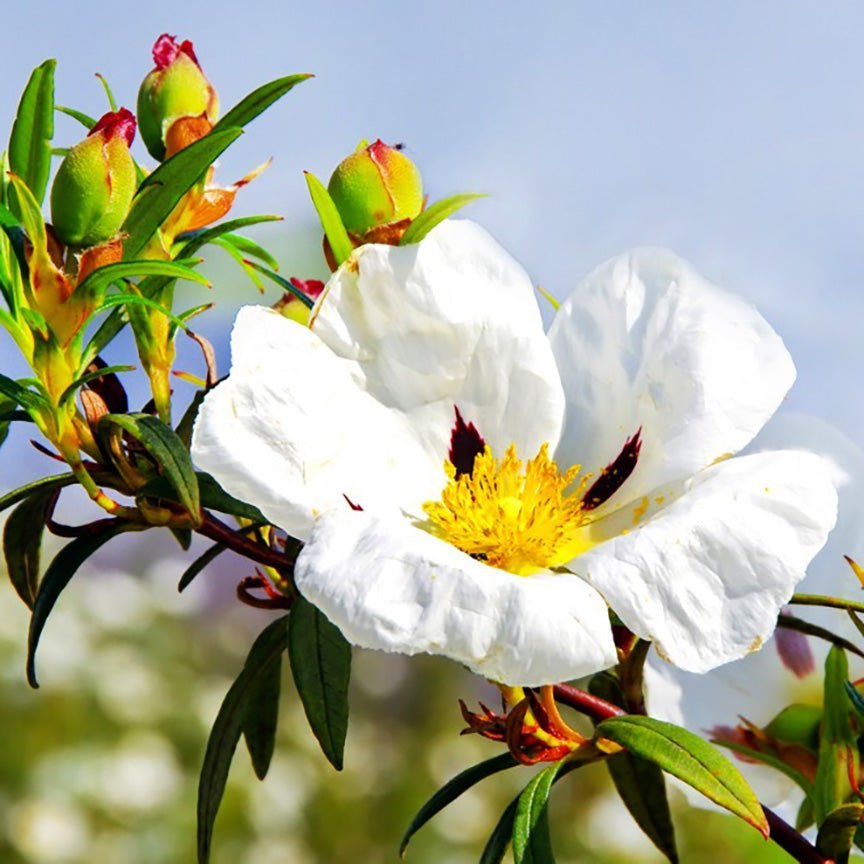
- Plant part
- Resin
- Method
- Solvent extraction
- Vietnamese name
- Nhựa labdanum
- Scent family
- Woody & Resinous
- Plant family
- Cistaceae
- Lots published
- —
 Resin
Composition profile
The published composition from the article, read as structure: 5 compounds adding up to about 62 % of the sample. Figures are printed as the source gives them — one sample, not a species average.
| Compound | Level | Class | Note |
|---|---|---|---|
| Viridiflorol | 24.13 % | — | — |
| α-Pinene EU | 19.27 % | Monoterpenes | Top |
| Ledol | 6.94 % | — | — |
| Camphene | 6.66 % | Monoterpenes | Top |
| Bornyl acetate | 5.01 % | — | — |
By chemical class
- Unclassified36.1 %
- Monoterpenes25.9 %
By note
- Top25.9 %
- Unclassified36.1 %
Group totals use the upper bound of each range and only the compounds the article lists; bars are relative to the identified total.
What labdanum is
Labdanum is the resin exuded on the leaves and young shoots of rockrose (Cistus ladanifer), a Mediterranean shrub; the studies cited on this page all sampled plants in Spain.
The same plant gives several different products, and they are often confused: labdanum gum extracted from the branches and leaves, labdanum absolute made from the gum, and cistus essential oil distilled with steam. This page deals mainly with the gum and the oil, the two for which we have read figures.
The gum: alkaline water or boiling water
According to a 2025 review in Molecules, Andalusia extracts the gum with alkaline water, while Zamora, Leon and Salamanca use boiling water, with a lower yield. The gum consists mainly of labdane-type diterpenes and methylated flavonoids. Those diterpenes are absent from the distilled oil, at least at levels above 4.5%. In other words, gum and oil are two quite different mixtures even though they come from the same plant.
Composition of cistus oil
A 2021 study in Molecules steam-distilled crown biomass (branches up to 50 mm with twigs, leaves and fruits) from two regions of Spain, each sample pooled from at least 10 plants:
| Compound | Cerezal, Zamora | Andevalo, Huelva |
|---|---|---|
| α-Pinene | 19.27% | 42.50% |
| Viridiflorol | 24.13% | 13.36% |
| Ledol | 6.94% | 4.06% |
| Camphene | 6.66% | 2.15% |
| Bornyl acetate | 5.01% | 4.16% |
A 2023 study in Chemistry & Biodiversity hydrodistilled dried aerial parts from four wild populations in north-west Extremadura, collected in August 2018 at fruit maturity, 12 plots in all. Here viridiflorol led (17.68–22.51%), followed by ledol (8.27–11.28%), while α-pinene was only 2.49–6.63%. Oil yield was low: 0.19–0.42 mL per 100 g of dry plant.
Three regions, three profiles: α-pinene can be close to half the oil or only a few per cent. The lot analysis is what to check.
Labdanum in perfumery
The role of labdanum in the amber accord, the leather note and the tobacco accord is covered in separate articles.
Reading the label
When buying, ask clearly whether the product is gum, absolute or cistus oil, and ask for the analysis. As the figures above show, the distilled oil lacks the diterpenes characteristic of the gum.
Safe use
We have not read safety data specific to labdanum. Regulation (EU) 2023/1545 has no entry for Cistus, but it does have an entry for pinene (α- and β-pinene) on the list of fragrance allergens that must be declared on cosmetic labels. Always dilute before use on skin.
Sources
- Gago C., Bakchiche B., Djekhioua T., da Graca Miguel M. (2025). Cistus ladanifer L.: Essential Oils, Volatiles, By-Products, and Their Biological Properties. Molecules 30(22), 4425. doi:10.3390/molecules30224425
- Xavier V., Finimundy T.C., Heleno S.A. et al. (2021). Chemical and bioactive characterization of the essential oils obtained from three Mediterranean plants. Molecules 26(24), 7472. doi:10.3390/molecules26247472
- Perez-Izquierdo C., Jordan Bueso M.J., Rodriguez-Molina M.d.C., Pulido F. (2023). Spatial variation in yield, chemical composition, and phytotoxic activity of Cistus ladanifer essential oils. Chemistry & Biodiversity 20(11), e202300995. doi:10.1002/cbdv.202300995
- Regulation (EU) 2023/1545 on the labelling of fragrance allergens.
Buy Labdanum
Labdanum oil: no lot has been brought in yet, so it is not on sale. Message us if you need it.
Where you may already have smelled it
According to the analyses cited above, this oil contains up to 19.3 % α-pinene. It is also the leading compound in the scenes below from the scent dictionary. Smelling one of those scenes again is a way to get to know it without opening a bottle. A shared compound does not mean the oil smells exactly like the scene.
Further reading
Close to Labdanum
Also from the resin Copaiba · Elemi · Frankincense · Frankincense serrata · Mastic · Opopanax
Same method: solvent extraction Jasmine grandiflorum · Night jasmine · Osmanthus · Pomelo blossom · Rose absolute · Vanilla
Quick answers
What does labdanum essential oil smell like?
Amber, leather, dark honey and an almost animal note. It is thick, warm and very long-lasting.
What is the botanical name of labdanum oil?
The plant is Cistus ladanifer, in the Cistaceae family. In Vietnamese it is called nhựa labdanum.
How is labdanum oil produced?
From the resin of the plant, by solvent extraction. See the method for what that does to the oil.
Last updated