Cold-pressed lemon peel essential oil
Citrus limon
Vỏ chanh ép lạnh · Rutaceae
Bright citrus peel, with a sour edge and green at the rim. It fades fast — after an hour only a faint waxy note remains.
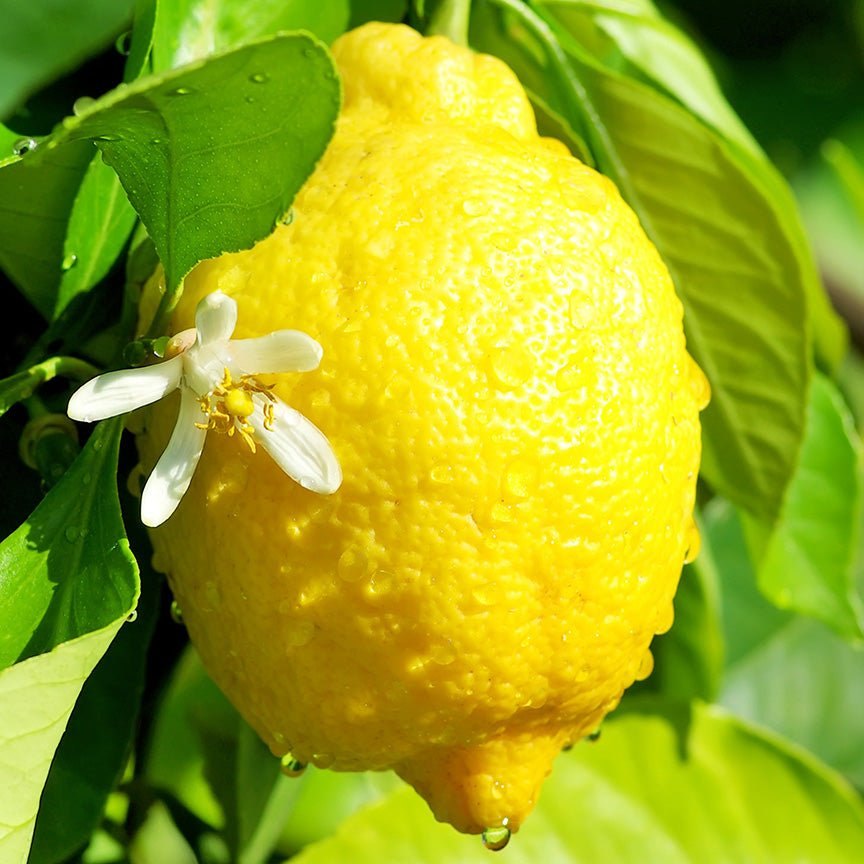
- Plant part
- Fruit peel
- Method
- Cold pressing
- Vietnamese name
- Vỏ chanh ép lạnh
- Plant family
- Rutaceae
- Lots published
- —
 Fruit peel
Composition profile
The published composition from the article, read as structure: 7 compounds adding up to about 100 % of the sample. Figures are printed as the source gives them — one sample, not a species average.
| Compound | Level | Class | Note |
|---|---|---|---|
| Limonene EU | 61.2–66.7 % | Monoterpenes | Top |
| β-Pinene EU | 11.0–16.8 % | Monoterpenes | Top |
| γ-Terpinene | 7.66–11.5 % | Monoterpenes | Middle |
| α-Pinene EU | 2.23–3.63 % | Monoterpenes | Top |
| Sabinene | 1.41–2.65 % | Monoterpenes | Top |
| Geranial EU | 0.65–2.08 % | Aldehydes | Middle |
| Neral EU | 0.39–1.43 % | Aldehydes | Middle |
By chemical class
- Monoterpenes100.0 %
- Aldehydes3.5 %
By note
- Top89.8 %
- Middle15.0 %
Group totals use the upper bound of each range and only the compounds the article lists; bars are relative to the identified total.
Compare with the 2 chemically closest oils Which other oils are rich in Limonene?
Main compounds
No real lot has been published yet. The figures below come from the sample lot — built to show how an analysis is read, not the result of a measurement.
What cold-pressed means
Citrus oils are not steam-distilled like most other essential oils. The oil glands lie just under the coloured layer of the peel, and the oil is taken by pressing or rasping the peel and separating the oil from the juice, without heat. Hence “cold-pressed”. The cold-pressing page describes each step.
With no heat, the oil keeps the freshness of a peel just broken. And because there is no heat and no distillation step, the oil also carries non-volatile compounds that a distilled oil lacks. The two go together.
Composition
| Compound | EFSA specification (from ISO 855) | 10 batches (EFSA, 2021) | One cold-pressed oil (2024) |
|---|---|---|---|
| Limonene | 60–73% | 61.2–66.7% | 60.7% |
| β-Pinene | 9–18% | 11.0–16.8% | 12.6% |
| γ-Terpinene | 6–12% | 7.66–11.5% | 10.3% |
| α-Pinene | 1.3–3.0% | 2.23–3.63% | 2.6% |
| Sabinene | 0.3–3.0% | 1.41–2.65% | 2.4% |
| Geranial | 0.1–2.0% | 0.65–2.08% | 2.2% |
| Neral | 0.1–1.8% | 0.39–1.43% | – |
The first two columns come from a 2021 assessment by the European Food Safety Authority (EFSA); EFSA’s specification is based on ISO 855:2003, confirmed in 2025, converted to chromatographic area per cent. A dash means it was not reported. Unlike sweet orange oil, which is almost all limonene, lemon oil has only about 60–70% limonene; the rest is β-pinene, γ-terpinene and the citral group (geranial plus neral) that gives the bright sourness.
What distilled oil does not have: furocoumarins
Those non-volatile compounds include the furocoumarins, among them bergapten. Furocoumarins make the skin sensitive to UV light: apply the oil, go out in the sun, and the result can be a sunburn-like reaction that leaves dark marks for a long time. IFRA places cold-pressed lemon oil among the citrus oils restricted for phototoxicity, and caps total bergapten in leave-on products for sun-exposed skin at 0.0015 per cent, or 15 parts per million. The limit does not apply to rinse-off products. The bergapten content of lemon oil varies greatly with origin: EFSA measured a mean of 23.6 mg/kg across 10 batches, only 3.9–5.8 mg/kg in batches from Argentina, Brazil and South Africa but 7.5–75.4 mg/kg in Mediterranean batches.
Smelling, diffusing or scenting a room has nothing to do with this. It matters only when the oil is on the skin and the skin meets the sun. The phototoxicity page explains further.
Lemon or lime
The oil on this page is pressed from the peel of lemon, Citrus limon. Lime peel (Citrus aurantifolia) is a different species, greener and sharper, and since it is also cold-pressed it is also phototoxic. The main component of both is limonene, but the proportions of the rest, especially citral, set them apart.
Why lemon oil fades fast and ages fast
Limonene boils at about 176–178 °C, far lower than the compounds in wood oils. That is why lemon peel smells strong when the bottle opens and fades after about an hour on a smelling strip, as the description at the top of the page says.
Limonene also oxidises easily. In contact with air it forms hydroperoxides that are far stronger skin sensitisers than limonene itself. Lemon oil should therefore be tightly capped, kept cool and out of the light, and used within a shorter time than wood oils. The storage page gives details.
Sources
- IFRA Standards, Amendment 49 (2020): Citrus oils and other furocoumarins containing essential oils.
- EFSA FEEDAP Panel (2021). EFSA Journal 19(4), e06548. doi:10.2903/j.efsa.2021.6548
- ISO 855:2003. Oil of lemon, obtained by expression; confirmed 2025.
- Kacaniova M. et al. (2024). Plants 13(4), 524. doi:10.3390/plants13040524
- PubChem. D-Limonene (CID 440917).
- Tisserand and Young (2014). Essential Oil Safety, 2nd edition. Churchill Livingstone.
Published lots
Buy Cold-pressed lemon peel
No bottles of this oil yet. The data above is complete — message us if you would like to know when it is in stock.
Where you may already have smelled it
According to the analyses cited above, this oil contains up to 66.7 % limonene. It is also the leading compound in the scenes below from the scent dictionary. Smelling one of those scenes again is a way to get to know it without opening a bottle. A shared compound does not mean the oil smells exactly like the scene.
- Crushed pomelo peelSqueeze a piece of Nam Roi pomelo peel hard, so the oil sprays out
- Ripe kumquat peelLightly squeeze the peel of a ripe yellow kumquat
- Buddha’s handTake a ripe yellow Buddha’s hand and lightly scratch the peel with a fingernail
- Vietnamese lime peelSqueeze a Vietnamese lime and smell the peel, not the juice
Chemically close
The oils whose published composition is closest to this one, compared across every compound we could read. Close in composition does not mean the scent is identical or that one can replace the other.
- Pomelo peel Citrus maxima shared: Limonene, γ-Terpinene · closeness 0.97 · compare
- Mandarin peel Citrus reticulata shared: Limonene, γ-Terpinene · closeness 0.97 · compare
- Red mandarin Citrus reticulata shared: Limonene, γ-Terpinene · closeness 0.97 · compare
Further reading
Worth knowing before you buy
These lots are not identical. Compound ratios shift with the season, the altitude and the time of harvest, and you will smell the difference. If you need a scent that is exactly the same every time you buy, what you need is a compounded fragrance, not an essential oil.
We do not say what this oil does for your body. This page only describes what it is and what is in it. Read about the limits of testing
Quick answers
What does cold-pressed lemon peel essential oil smell like?
Bright citrus peel, with a sour edge and green at the rim. It fades fast — after an hour only a faint waxy note remains.
What is the botanical name of cold-pressed lemon peel oil?
The plant is Citrus limon, in the Rutaceae family. In Vietnamese it is called vỏ chanh ép lạnh.
How is cold-pressed lemon peel oil produced?
From the fruit peel of the plant, by cold pressing. See the method for what that does to the oil.
What are the main compounds of cold-pressed lemon peel oil?
From the composition data on this page, the oil is led by Limonene, β-Pinene and γ-Terpinene. Proportions vary with origin, harvest and method; a lot analysis is the only answer for a given bottle.
Is there anything to watch out for with cold-pressed lemon peel oil?
Cold-pressed from the peel, so it still contains furocoumarins — compounds that make skin sensitive to sunlight. Applying it and then going into the sun can leave dark marks that take a long time to fade.
Last updated