Essential oils · Citrus family
Pomelo peel essential oil
Citrus maxima
Vỏ bưởi · Rutaceae
Citrus, but bitter at the edges, with a powdery note sweet orange does not have.
The bitterness comes from the white pith. The deeper the pressing, the more bitter the oil, so how bitter a bottle is tells you how hard it was pressed. Like every peel oil, it fades fast and leaves a little coolness.
This is one of the few citrus smells many people recognise long before they know its trade name: pomelo peel squeezed in the hand, the pot of herbal water for washing hair, the Mid-Autumn Festival. It was there long before anyone called it an essential oil.
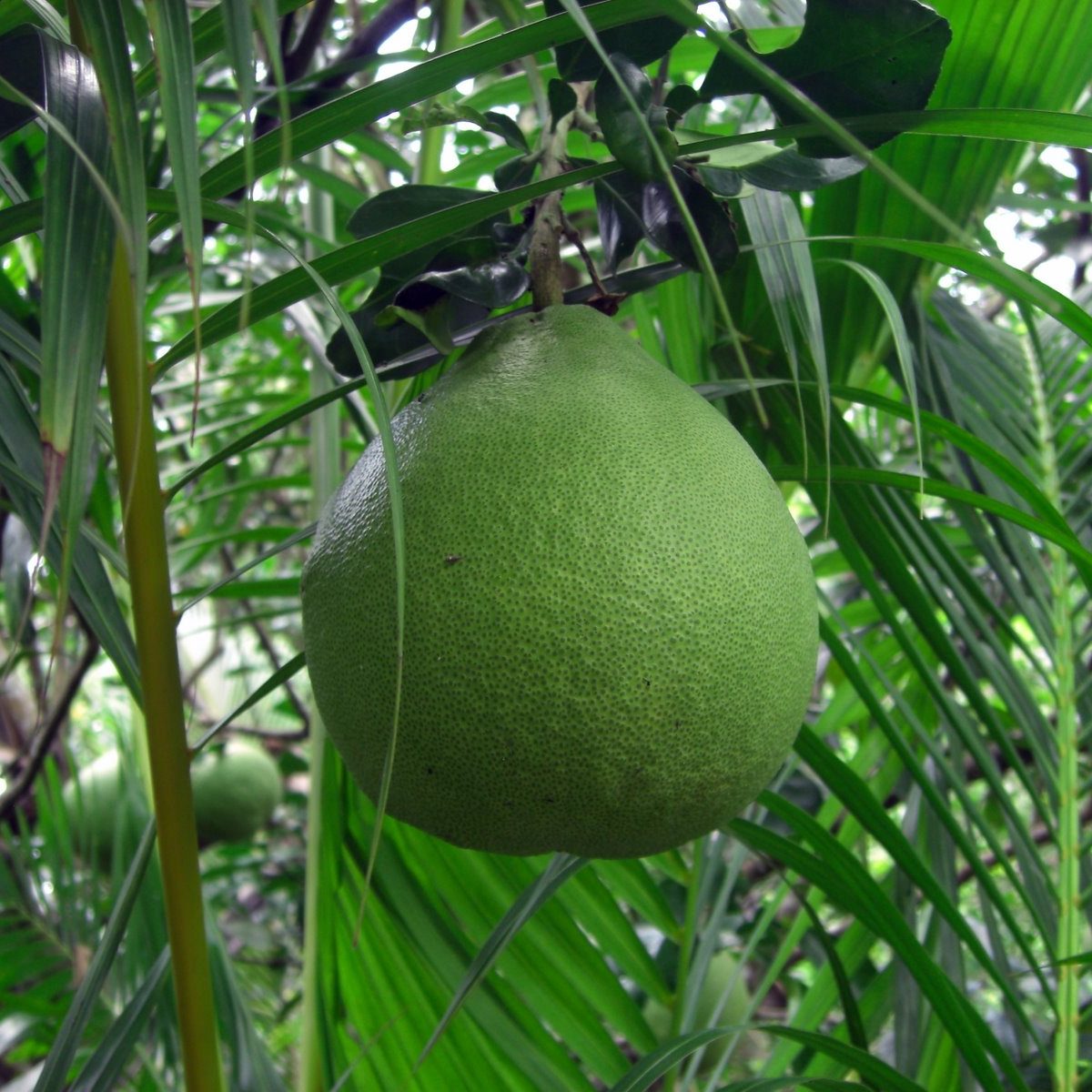
- Plant part
- Fruit peel
- Method
- Cold pressing
- Vietnamese name
- Vỏ bưởi
- Scent family
- Citrus
- Plant family
- Rutaceae
- Lots published
- —
 Fruit peel
Composition profile
The published composition from the article, read as structure: 6 compounds adding up to about 92 % of the sample. Figures are printed as the source gives them — one sample, not a species average.
| Compound | Level | Class | Note |
|---|---|---|---|
| Limonene EU | 71.77 % | Monoterpenes | Top |
| γ-Terpinene | 12.85 % | Monoterpenes | Middle |
| Myrcene | 2.67 % | Monoterpenes | Top |
| α-Pinene EU | 2.66 % | Monoterpenes | Top |
| β-Pinene EU | 1.19 % | Monoterpenes | Top |
| Oil yield | 0.88 % | — | — |
By chemical class
- Monoterpenes91.1 %
- Unclassified0.9 %
By note
- Top78.3 %
- Middle12.9 %
- Unclassified0.9 %
Group totals use the upper bound of each range and only the compounds the article lists; bars are relative to the identified total.
Compare with the 2 chemically closest oils Which other oils are rich in Limonene?
Pomelo and grapefruit
In Vietnam, tinh dầu bưởi almost always means oil from the peel of the local pomelo, Citrus maxima: the Nam Roi, Da Xanh, Dien and Phuc Trach varieties. Grapefruit, Citrus × paradisi, is a different species. The two oils differ in both smell and quality standards: Vietnam has a standard for expressed grapefruit oil, TCVN 11423:2016 (adopting ISO 3053:2004), but none yet for pomelo oil. A label saying “grapefruit” means grapefruit, not pomelo.
Cold-pressed or distilled
Pomelo peel oil is obtained in two ways, and buyers should know which one they are holding.
- Cold-pressed oil keeps the freshness and the bitter note of a peel just broken. This is the kind described at the top of this page. Like every cold-pressed citrus oil, it also carries the non-volatile compounds of the peel.
- Distilled oil is also very common, including in Vietnamese studies. It lacks the non-volatile compounds and smells less fresh than pressed oil.
Composition: two Vietnamese pomelo varieties
Two 2021 studies analysed oil distilled from the peel of two Vietnamese pomelo varieties:
| Compound | Nam Roi | Da Xanh |
|---|---|---|
| Limonene | 71.77% | 91.19% |
| γ-Terpinene | 12.85% | – |
| Myrcene | 2.67% | 2.92% |
| α-Pinene | 2.66% | 1.19% |
| β-Pinene | 1.19% | 0.04% |
| Linalool | – | 0.26% |
| Oil yield | 0.88% | 1.90% |
The Nam Roi sample was green peel bought at Thu Duc market (Ho Chi Minh City), hydrodistilled; the study identified 10 compounds making up 94.11% of the oil, including α-phellandrene at 2.98%. The Da Xanh sample was peel bought in Can Tho with the white pith removed, steam-distilled in three replicate runs; the study identified 25 compounds. In the Da Xanh sample the terpinene group was only about 0.1%, but the Greek letters in the copy we read were corrupted, so we do not enter it in the γ-terpinene column. A dash means it was not reported.
A 2022 study in Bangladesh shows that pomelo peel oil can differ further: oils from white- and red-fleshed pomelo had limonene 67.58% and 73.82%, linalool 7.53% and 5.42%, neral 6.61% and 4.11%, and nootkatone 4.98% and 1.78%.
Reading the table
As with orange, most of a bottle of pomelo oil is limonene, but limonene ranges from about 70% to over 90% depending on variety and distillation. The biggest difference between the two Vietnamese samples is γ-terpinene: nearly 13% in Nam Roi, almost none in Da Xanh. Linalool, neral and nootkatone, the compounds behind the floral, lemony and characteristic grapefruit-like notes, were very low or not reported in the two Vietnamese samples, while the Bangladeshi samples had several per cent. In other words, two bottles both labelled pomelo oil can smell clearly different.
About using it on hair
Many people look for pomelo oil to use on their hair. We have not found any controlled clinical trial in people showing that pomelo peel oil makes hair grow. So we do not say it does.
What is more certain is how to use it safely on the scalp:
- Limonene oxidises into sensitisers. A bottle of pomelo oil opened long ago and kept somewhere warm is more likely to irritate than a fresh one. The storage page explains how to keep oil.
- Always dilute it and test first on a small patch of skin. The dilution page gives the figures.
- With cold-pressed oil, do not apply it to skin about to be in the sun. IFRA lists cold-pressed grapefruit oil among the phototoxic citrus oils. Pomelo oil is not on that list. However, a 2015 study in PLOS ONE places pomelo among the ancestral citrus taxa that synthesise large amounts of furocoumarins, with higher levels in the peel. We have not found any measurement of furocoumarins in cold-pressed pomelo oil, so the same caution as with other cold-pressed oils is sensible.
Sources
- Product diversification from pomelo peel: essential oil, pectin and semi-dried pomelo peel (2021). Polish Journal of Chemical Technology 23(4), 17–25. doi:10.2478/pjct-2021-0033
- Chemical composition and antimicrobial activity of essential oil extracted from pomelo (Citrus maxima (Burm.) Merr.) (2021). Hue University Journal of Science: Natural Science 130(1C), 75–83. doi:10.26459/hueunijns.v130i1C.6247
- Das S.C., Hossain M., Hossain M.Z., Jahan N., Uddin M.A. (2022). Chemical analysis of essential oil extracted from pomelo sourced from Bangladesh. Heliyon 8(12), e11843. doi:10.1016/j.heliyon.2022.e11843
- Dugrand-Judek A., Olry A., Hehn A., Costantino G., Ollitrault P., Froelicher Y., Bourgaud F. (2015). PLOS ONE 10(11), e0142757. doi:10.1371/journal.pone.0142757
- TCVN 11423:2016 (ISO 3053:2004). Oil of grapefruit (Citrus × paradisi Macfad.), obtained by expression.
- IFRA Standards, Amendment 49 (2020): Citrus oils and other furocoumarins containing essential oils.
Buy Pomelo peel
Pomelo peel oil: no lot has been brought in yet, so it is not on sale. Message us if you need it.
Where you may already have smelled it
According to the analyses cited above, this oil contains up to 71.8 % limonene. It is also the leading compound in the scenes below from the scent dictionary. Smelling one of those scenes again is a way to get to know it without opening a bottle. A shared compound does not mean the oil smells exactly like the scene.
- Crushed pomelo peelSqueeze a piece of Nam Roi pomelo peel hard, so the oil sprays out
- Ripe kumquat peelLightly squeeze the peel of a ripe yellow kumquat
- Buddha’s handTake a ripe yellow Buddha’s hand and lightly scratch the peel with a fingernail
- King orange peelSqueeze a piece of dark-green, knobbly king orange peel
Chemically close
The oils whose published composition is closest to this one, compared across every compound we could read. Close in composition does not mean the scent is identical or that one can replace the other.
- Red mandarin Citrus reticulata shared: Limonene, γ-Terpinene · closeness 1.00 · compare
- Yuzu Citrus junos shared: Limonene, γ-Terpinene · closeness 1.00 · compare
- Mandarin peel Citrus reticulata shared: Limonene, γ-Terpinene · closeness 1.00 · compare
Further reading
- Fruity notes in perfume: why they are almost always built
- Why essential oils have a shelf life
- Checking essential oils with GC/MS: how to read the report a seller gives you
- Part VI. Vietnamese essential oils: composition and chemotypes · research
- Appendix A3. Facts on Vietnamese essential oils · research
Close to Pomelo peel
Same plant family: Rutaceae Cold-pressed lemon peel · King mandarin peel · Lime peel · Mandarin peel · Neroli · Sweet orange · Yuzu
Also from the fruit peel Blood orange · Cold-pressed lemon peel · Grapefruit · King mandarin peel · Lime peel · Mandarin peel
Same method: cold pressing Blood orange · Cold-pressed lemon peel · Grapefruit · King mandarin peel · Lime peel · Mandarin peel
Quick answers
What does pomelo peel essential oil smell like?
Citrus, but bitter at the edges, with a powdery note sweet orange does not have.
What is the botanical name of pomelo peel oil?
The plant is Citrus maxima, in the Rutaceae family. In Vietnamese it is called vỏ bưởi.
How is pomelo peel oil produced?
From the fruit peel of the plant, by cold pressing. See the method for what that does to the oil.
What are the main compounds of pomelo peel oil?
From the composition data on this page, the oil is led by Limonene, γ-Terpinene and Myrcene. Proportions vary with origin, harvest and method; a lot analysis is the only answer for a given bottle.
Last updated