Essential oils · Citrus family
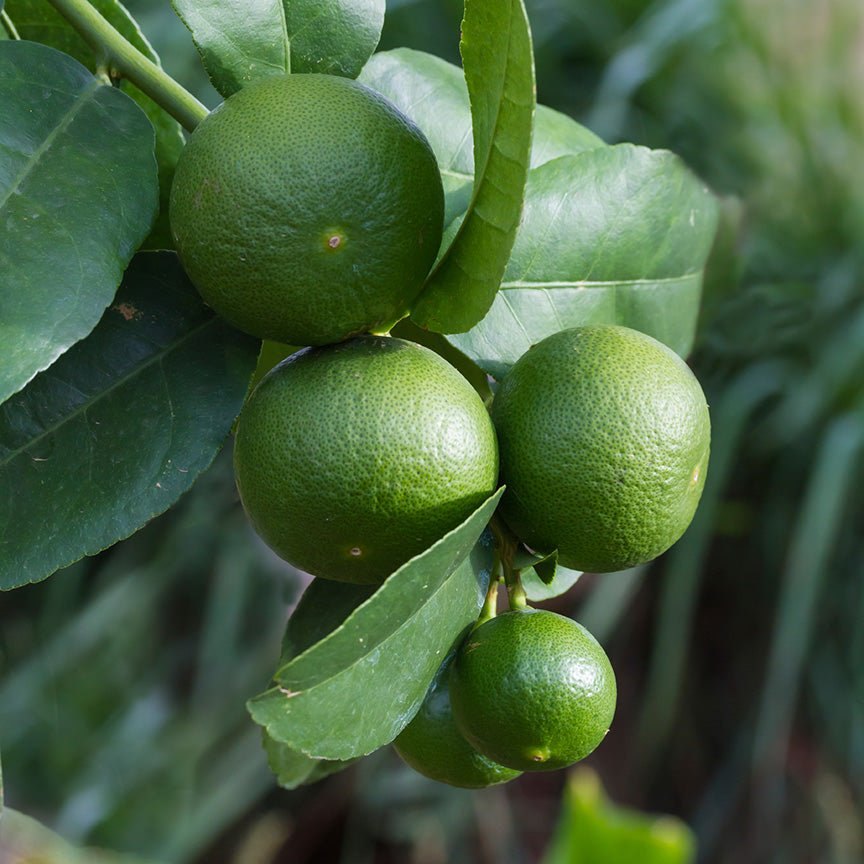
Lime peel essential oil
Citrus aurantifolia
Vỏ chanh ta · Rutaceae
Sharp, green, so pointed it almost cuts. Compared with lemon it is more pointed and fades faster.
Cold pressing keeps that sharpness; distillation does not. The distilled oil is rounder and softer, and loses exactly what makes a Vietnamese lime.
This is the easiest oil to check with your bare hands: squeeze a lime, smell the peel, then smell the bottle. If the bottle is rounder and sweeter than the real fruit, what you are holding is not cold-pressed, whatever the label says.
- Plant part
- Fruit peel
- Method
- Cold pressing
- Vietnamese name
- Vỏ chanh ta
- Scent family
- Citrus
- Plant family
- Rutaceae
- Lots published
- —
 Fruit peel
Composition profile
The published composition from the article, read as structure: 5 compounds adding up to about 71 % of the sample. Figures are printed as the source gives them — one sample, not a species average.
| Compound | Level | Class | Note |
|---|---|---|---|
| Limonene EU | 37.0 % | Monoterpenes | Top |
| γ-Terpinene | 14.5 % | Monoterpenes | Middle |
| Terpinolene EU | 9.89 % | Monoterpenes | Middle |
| α-Terpineol EU | 9.49 % | Alcohols | Middle |
| β-Caryophyllene EU | 0.44 % | Sesquiterpenes | Base |
By chemical class
- Monoterpenes61.4 %
- Alcohols9.5 %
- Sesquiterpenes0.4 %
By note
- Top37.0 %
- Middle33.9 %
- Base0.4 %
Group totals use the upper bound of each range and only the compounds the article lists; bars are relative to the identified total.
Compare with the 2 chemically closest oils Which other oils are rich in Limonene?
Two kinds of lime oil
Key lime (Citrus aurantifolia), also called Mexican lime, gives two quite different essential oils:
- Expressed (cold-pressed) oil from the peel. It smells close to freshly zested lime: sharp, green, bright.
- Distilled oil, usually from the whole fruit: the limes are pressed and the resulting liquid is distilled. It smells rounder and sweeter, closer to lime juice than to lime peel.
The two differ not only in smell but also in composition and safety, so the label should state which it is.
Composition of distilled lime oil
The 2021 scientific opinion of the European Food Safety Authority (EFSA) assessed distilled lime oil and compared five batches with the ISO specification:
| Compound | ISO specification | Mean of 5 batches |
|---|---|---|
| Limonene | 45–52% | 37.0% |
| γ-Terpinene | 10–14% | 14.5% |
| Terpinolene | 5.5–10.5% | 9.89% |
| α-Terpineol | 6–8% | 9.49% |
| β-Caryophyllene | 0.2–0.8% | 0.44% |
The means are GC-MS peak areas; measured by GC-FID, the limonene of these batches was 46.8–47.4%, within specification. It is a small example of why area percentage is not weight percentage, and why two instruments measuring the same sample can give two numbers.
High α-terpineol and terpinolene are the fingerprint of distilled oil. They bring a lilac-like, slightly piney note and the smell of ready-made lime drinks, unlike the sharpness of fresh peel.
Expressed oil and sunlight
Expressed lime oil contains furocoumarins, compounds that make the skin sensitive to ultraviolet light. Applied to the skin before going out in the sun, it can cause burning and dark marks. IFRA therefore has a dedicated standard for expressed lime oil (Amendment 49, 2020): in many leave-on product categories, including fine fragrance, the maximum is 0.70% in the finished product. For concentrated or terpene-reduced qualities the limit is lower, in proportion to the degree of concentration.
The standard does not apply to distilled oil. That is a practical reason to know which kind you have before using it on skin.
Checking with your nose
Squeeze a lime, smell the peel, then smell the bottle. Genuine expressed oil will be close to the fresh peel: sharp and quick to fade. If the bottle is round, sweet and suggests bottled lime soda more than lime peel, it is very likely distilled oil, whatever the label says. See also the lime peel entry in the scent dictionary.
Sources
- EFSA FEEDAP Panel (2021). Safety and efficacy of feed additives consisting of expressed lemon oil and its fractions from Citrus limon (L.) Osbeck and of lime oil from Citrus aurantiifolia (Christm.) Swingle for use in all animal species. EFSA Journal 19(4), e06548. doi:10.2903/j.efsa.2021.6548
- IFRA Standard: Lime oil expressed. Amendment 49, 2020. ifrafragrance.org
Buy Lime peel
Lime peel oil: no lot has been brought in yet, so it is not on sale. Message us if you need it.
In the scent dictionary: Vietnamese lime peel — a description of the smell, the compounds behind it, and how to smell it for yourself.
Where you may already have smelled it
According to the analyses cited above, this oil contains up to 37 % limonene. It is also the leading compound in the scenes below from the scent dictionary. Smelling one of those scenes again is a way to get to know it without opening a bottle. A shared compound does not mean the oil smells exactly like the scene.
- Ripe kumquat peelLightly squeeze the peel of a ripe yellow kumquat
- King orange peelSqueeze a piece of dark-green, knobbly king orange peel
- Crushed pomelo peelSqueeze a piece of Nam Roi pomelo peel hard, so the oil sprays out
- Buddha’s handTake a ripe yellow Buddha’s hand and lightly scratch the peel with a fingernail
Chemically close
The oils whose published composition is closest to this one, compared across every compound we could read. Close in composition does not mean the scent is identical or that one can replace the other.
- Mandarin peel Citrus reticulata shared: Limonene, γ-Terpinene · closeness 0.94 · compare
- Red mandarin Citrus reticulata shared: Limonene, γ-Terpinene · closeness 0.93 · compare
- Yuzu Citrus junos shared: Limonene, γ-Terpinene · closeness 0.93 · compare
Further reading
Close to Lime peel
Same plant family: Rutaceae Bergamot · Cold-pressed lemon peel · Grapefruit · Kaffir lime leaf · Lemon · Mandarin peel · Yuzu
Also from the fruit peel Cold-pressed lemon peel · Grapefruit · Mandarin peel · Red mandarin · Sweet orange · Yuzu
Same method: cold pressing Cold-pressed lemon peel · Grapefruit · Mandarin peel · Red mandarin · Sweet orange · Yuzu
Quick answers
What does lime peel essential oil smell like?
Sharp, green, so pointed it almost cuts. Compared with lemon it is more pointed and fades faster.
What is the botanical name of lime peel oil?
The plant is Citrus aurantifolia, in the Rutaceae family. In Vietnamese it is called vỏ chanh ta.
How is lime peel oil produced?
From the fruit peel of the plant, by cold pressing. See the method for what that does to the oil.
What are the main compounds of lime peel oil?
From the composition data on this page, the oil is led by Limonene, γ-Terpinene and Terpinolene. Proportions vary with origin, harvest and method; a lot analysis is the only answer for a given bottle.
Is there anything to watch out for with lime peel oil?
Cold-pressed from the peel, so it still contains furocoumarins — compounds that make skin sensitive to sunlight. Applying it and then going into the sun can leave dark marks that take a long time to fade.
Last updated