Essential oils · Citrus family
Mandarin peel essential oil
Citrus reticulata
Vỏ quýt · Rutaceae
Sweeter than orange, softer, with a slightly dark floral layer beneath the peel. That layer is what makes mandarin sound like mandarin rather than a small orange.
As with every peel oil, most of the bottle is limonene. What belongs to mandarin alone is a nitrogen-containing compound that makes up less than one percent, giving an impression close to orange blossom and ripe grapes. Without it, mandarin is just a pale orange.
Dried mandarin peel is trần bì in the traditional medicine cabinet, and the older it is, the more it is prized. Trần bì smells much deeper and less bright than fresh peel, so don’t expect a cold-pressed oil to smell like a packet of it.
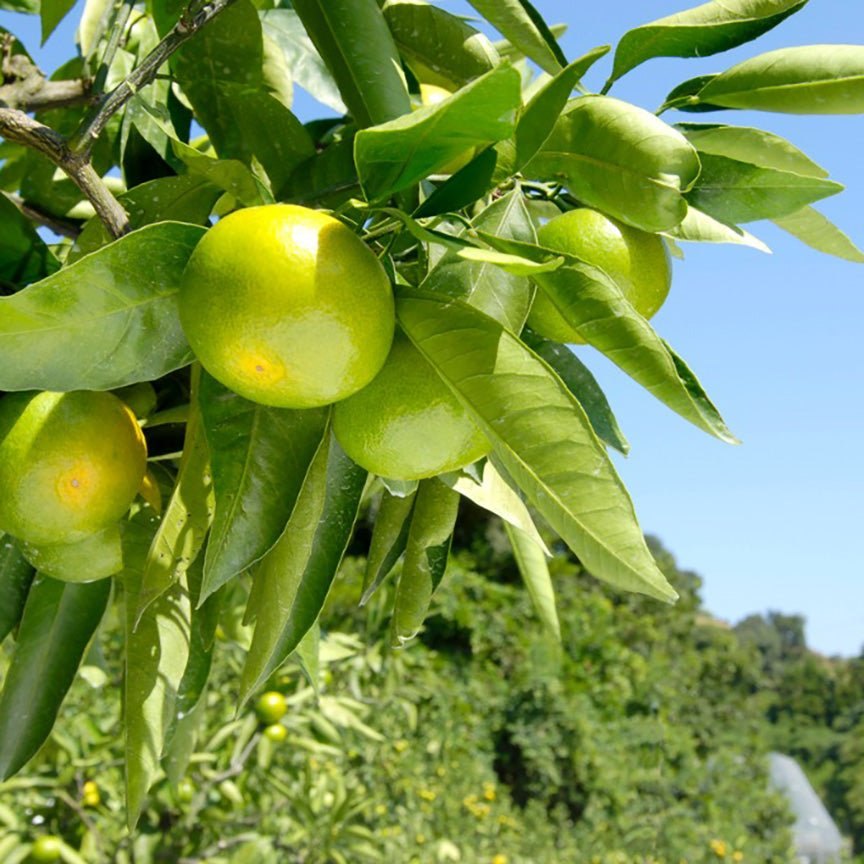
- Plant part
- Fruit peel
- Method
- Cold pressing
- Vietnamese name
- Vỏ quýt
- Scent family
- Citrus
- Plant family
- Rutaceae
- Lots published
- —
 Fruit peel
Composition profile
The published composition from the article, read as structure: 6 compounds adding up to about 100 % of the sample. Figures are printed as the source gives them — one sample, not a species average.
| Compound | Level | Class | Note |
|---|---|---|---|
| Limonene EU | 65–80 % | Monoterpenes | Top |
| γ-Terpinene | 13–22 % | Monoterpenes | Middle |
| α-Pinene EU | 1.0–3.5 % | Monoterpenes | Top |
| Myrcene | 1.0–2.0 % | Monoterpenes | Top |
| β-Pinene EU | 1.0–2.0 % | Monoterpenes | Top |
| Methyl N-methylanthranilate | 0.15–0.7 % | — | — |
By chemical class
- Monoterpenes100.0 %
- Unclassified0.7 %
By note
- Top87.5 %
- Middle22.0 %
- Unclassified0.7 %
Group totals use the upper bound of each range and only the compounds the article lists; bars are relative to the identified total.
Compare with the 2 chemically closest oils Which other oils are rich in Limonene?
Mandarin peel oil by the standard
Mandarin peel oil (Citrus reticulata) is cold-pressed from the fruit peel, like orange and lemon. The international standard for it is ISO 3528:2012, built on Italian mandarin oil. The 2021 scientific opinion of the European Food Safety Authority (EFSA) on mandarin oil as a feed additive uses the ranges from that standard:
| Compound | ISO 3528 range |
|---|---|
| Limonene | 65–80% |
| γ-Terpinene | 13–22% |
| α-Pinene | 1.0–3.5% |
| Myrcene | 1.0–2.0% |
| β-Pinene | 1.0–2.0% |
| Methyl N-methylanthranilate | 0.15–0.7% |
These six compounds account for about 96% of the oil’s chromatographic area. All ten batches analysed by EFSA fell within these ranges.
The compound under one per cent
On paper, mandarin is almost orange: mostly limonene. What makes mandarin smell like mandarin sits in the last row, methyl N-methylanthranilate, at only 0.15–0.7%. It is a nitrogen-containing compound related to methyl anthranilate, with an orange-blossom and grape smell. A compound below one per cent that changes the character of the whole bottle is a clear example of a trace constituent at work.
The table also gives an identifying sign: mandarin oil is rich in γ-terpinene, 13–22%, while sweet orange oil is almost all limonene.
Each cultivar its own type
Not every fruit called a mandarin gives the same oil. A 2025 study in Turkey cold-pressed the peel of seven cultivars:
| Cultivar | Limonene | γ-Terpinene |
|---|---|---|
| Yerli Apireno | 77.3–78.2% | 13.6–14.3% |
| Batem Incisi | 89.4–90.2% | 4.5–4.9% |
| Clementine Fina | 95.5–96.1% | not reported |
| Fortune | 95.3–95.4% | 0.4–0.5% |
The traditional mandarin type has high γ-terpinene, close to the ISO range. Clementine-type hybrids are almost pure limonene and smell closer to orange. When buying mandarin oil, the cultivar and origin matter as much as the name.
Chenpi is not fresh peel oil
Mandarin peel dried and aged for years is chenpi, trần bì in Vietnamese herbal medicine. During drying and ageing, much of the light terpene fraction such as limonene evaporates or oxidises, so chenpi smells deeper, warmer and far less bright than fresh peel. See the chenpi entry in the scent dictionary.
Safety
Many cold-pressed citrus peel oils contain furocoumarins that cause photosensitivity. For mandarin oil, EFSA lists 8-methoxypsoralen as a substance of concern, but in all ten batches analysed it was below the limit of detection. EFSA also notes that mandarin oil irritates skin, eyes and the respiratory tract and may sensitise the skin, so it still needs dilution. Limonene is on the EU list of cosmetic ingredients that must be labelled above a threshold.
Sources
- EFSA FEEDAP Panel (2021). Safety and efficacy of a feed additive consisting of expressed mandarin oil from the fruit peels of Citrus reticulata Blanco for use in all animal species. EFSA Journal 19(6), 6625. doi:10.2903/j.efsa.2021.6625
- Golukcu M., Bozova B., Giuffre A.M. (2025). The physico-chemical characteristics of peel essential oils of mandarin cultivars grown in Turkiye. AIMS Agriculture and Food 10(3), 679–697. doi:10.3934/agrfood.2025034
Buy Mandarin peel
Mandarin peel oil: no lot has been brought in yet, so it is not on sale. Message us if you need it.
Where you may already have smelled it
According to the analyses cited above, this oil contains up to 78.2 % limonene. It is also the leading compound in the scenes below from the scent dictionary. Smelling one of those scenes again is a way to get to know it without opening a bottle. A shared compound does not mean the oil smells exactly like the scene.
- Ripe kumquat peelLightly squeeze the peel of a ripe yellow kumquat
- Crushed pomelo peelSqueeze a piece of Nam Roi pomelo peel hard, so the oil sprays out
- King orange peelSqueeze a piece of dark-green, knobbly king orange peel
- Buddha’s handTake a ripe yellow Buddha’s hand and lightly scratch the peel with a fingernail
Chemically close
The oils whose published composition is closest to this one, compared across every compound we could read. Close in composition does not mean the scent is identical or that one can replace the other.
Further reading
Close to Mandarin peel
Same plant family: Rutaceae Bergamot · Blood orange · Grapefruit · Neroli · Pomelo peel · Sweet orange · Yuzu
Also from the fruit peel Bergamot · Grapefruit · King mandarin peel · Lemon · Sweet orange · Yuzu
Same method: cold pressing Bergamot · Grapefruit · King mandarin peel · Lemon · Sweet orange · Yuzu
Quick answers
What does mandarin peel essential oil smell like?
Sweeter than orange, softer, with a slightly dark floral layer beneath the peel. That layer is what makes mandarin sound like mandarin rather than a small orange.
What is the botanical name of mandarin peel oil?
The plant is Citrus reticulata, in the Rutaceae family. In Vietnamese it is called vỏ quýt.
How is mandarin peel oil produced?
From the fruit peel of the plant, by cold pressing. See the method for what that does to the oil.
What are the main compounds of mandarin peel oil?
From the composition data on this page, the oil is led by Limonene and γ-Terpinene. Proportions vary with origin, harvest and method; a lot analysis is the only answer for a given bottle.
Is there anything to watch out for with mandarin peel oil?
Cold-pressed from the peel, so it still contains furocoumarins — compounds that make skin sensitive to sunlight. Applying it and then going into the sun can leave dark marks that take a long time to fade.
Last updated