Essential oils · Woody & Resinous family
Fokienia essential oil
Fokienia hodginsii
Pơ mu · Cupressaceae
Sweet, dry, warm wood, with a light fatty note close to nuts. It is softer than cedarwood and less resinous than pine.
People in the northern mountains know this smell from the wood rather than from a bottle. Pơ mu is used for house walls, chests and cupboards, and a pơ mu plank keeps its scent for decades. The essential oil is that smell concentrated, and on the international market it is sold as siam wood.
Pơ mu is a threatened species, so for this oil, where the wood in a lot came from matters as much as how it smells: salvaged stumps and roots, wood from dismantled old buildings, or living trees.
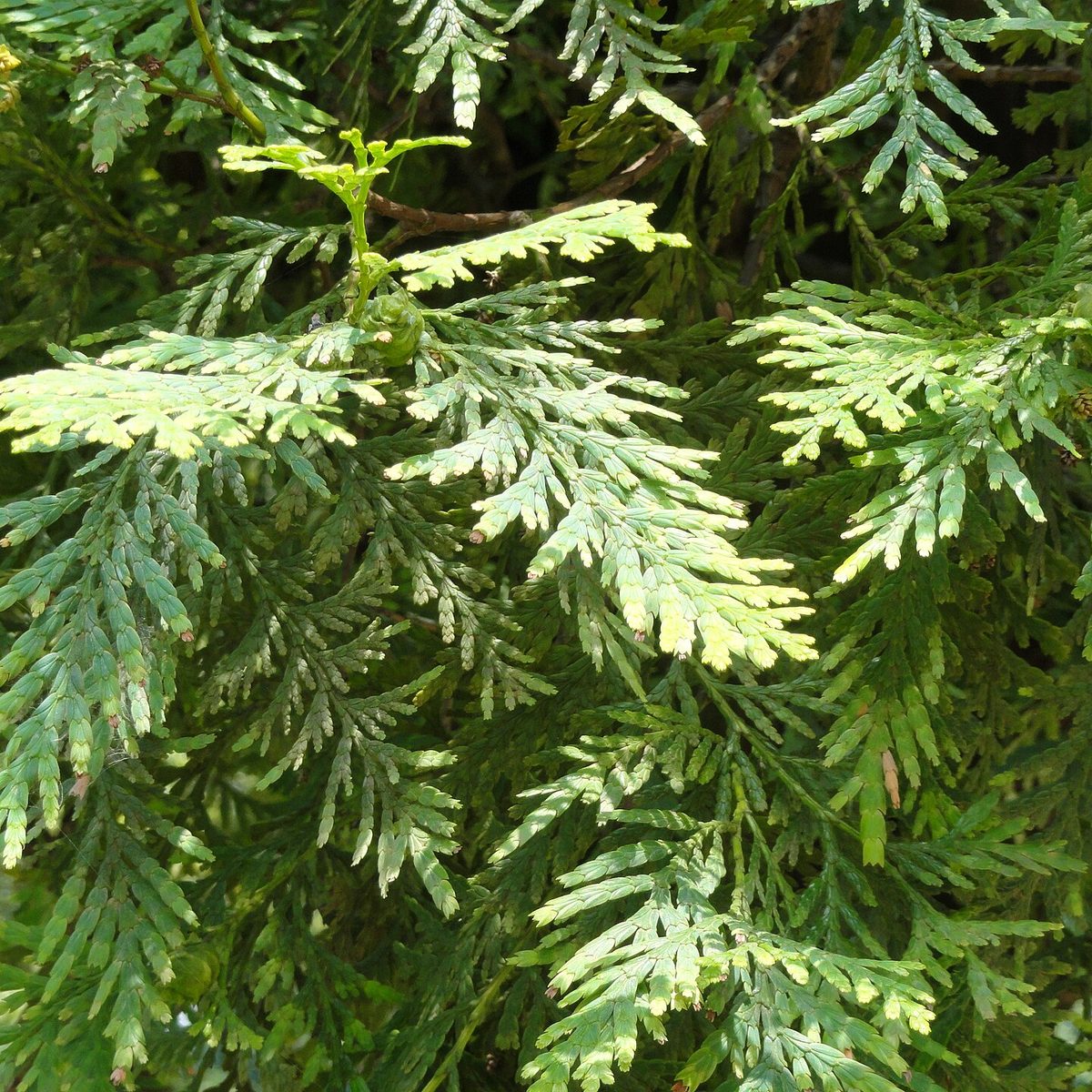
- Plant part
- Wood
- Vietnamese name
- Pơ mu
- Scent family
- Woody & Resinous
- Plant family
- Cupressaceae
- Lots published
- —
 Wood
What Fokienia is
Fokienia (Fokienia hodginsii), pơ mu in Vietnamese, is a conifer of the cypress family (Cupressaceae) growing high in the mountains of Vietnam, Laos and southern China. The wood is yellow-brown, fine-grained, very durable and long-scented. In the northern highlands it is used for house walls, chests and cabinets; a Fokienia board can keep its scent for decades. On the international market its essential oil is called siam wood or pemou.
A threatened species
According to the Threatened Conifers of the World database of the Royal Botanic Garden Edinburgh, Fokienia is listed as Vulnerable on the IUCN Red List. Illegal logging is the most serious threat, and mature trees are still being felled in national parks such as Bidoup and Chu Yang Sin. According to PROSEA, the oil is distilled from old wood, and the species is endangered and merits protection.
So with Fokienia oil, the first question is not smell but origin. A responsible lot must be able to show where the wood came from: salvaged stumps and roots of dead trees, wood from dismantled old buildings, or living trees. A seller who cannot answer that is a signal to stop.
Composition: leaf and wood are two different oils
We have not read any peer-reviewed study that gives the share of each compound in Fokienia wood or root oil. We have not been able to read the full text of the analysis of Vietnamese Fokienia root oil by GC, GC-MS and carbon-13 nuclear magnetic resonance (Flavour and Fragrance Journal, 2006). Two studies by Chinese teams have readable abstracts, and they show that leaf and wood give two oils with no main compound in common:
| Plant part | Main compounds reported |
|---|---|
| Leaves (trees aged 15–40, 2022) | α-Pinene, 1-octen-3-ol, β-pinene, myrcene, junenol, β-caryophyllene, limonene |
| Leaves (14 provenances, 2023) | α-Pinene about 50% |
| Heartwood and root (2022) | γ- and α-muurolene; γ-, δ- and α-cadinene; α-cadinol |
The 2022 study analysed leaves, heartwood and roots of trees aged 15, 20, 30, 35 and 40 years, steam-distilled: the leaf oil had 51 compounds; heartwood and root oils shared 39 compounds; heartwood gave more oil than root, and yield rose with tree age. The 2023 study compared the leaves of 14 provenances grown in the same trial forest in Anxi county (Fujian): leaf oil yield was 0.252%, and 17 main compounds made up 86–92% of the oil.
Reading the table
Fokienia leaf oil is a pinene oil, close to other conifer needle oils. The wood oil leans towards heavy sesquiterpenes such as cadinene and cadinol, which evaporate slowly. A bottle labelled Fokienia whose analysis is mostly α-pinene is probably leaf oil, not wood oil.
Suppliers of Vietnamese siam wood oil often describe the wood oil as rich in nerolidol and fokienol. The two studies above do not list these among the main compounds. We have no peer-reviewed figures to confirm or refute this, so the analysis of each lot is what to check.
Under the site’s data standard, where no readable source exists we leave the field empty rather than copy numbers we cannot check. The share of each compound in the wood oil will be added once we can read the original research.
The smell of Fokienia wood
Fokienia wood smells sweet, dry and warm, with a light, almost nutty fattiness; softer than cedar and less resinous than pine. To know the smell without buying the oil, an old piece of Fokienia furniture is a good reference and contributes nothing to new felling.
The article on sassafras, hoang dan and bach xanh wood covers other rare Vietnamese scented woods and why the name on a bag of scented wood is not proof.
Safety
We have not found an IFRA standard specific to Fokienia oil. The leaf oil is rich in pinene and limonene, both on the EU list of fragrance allergens that must be named on cosmetic labels. Store the oil tightly closed in a cool, dark place, and always dilute before use on skin.
Sources
- Royal Botanic Garden Edinburgh. Threatened Conifers of the World: Fokienia hodginsii. threatenedconifers.rbge.org.uk
- PROSEA. Fokienia hodginsii. Plant Resources of South-East Asia. Pl@ntUse
- Huang Xia, Chen Qian, Rong Jundong et al. (2022). Analysis on ingredient and content of essential oil in different parts of Fokienia hodginsii. Journal of Southwest Forestry University 42(2), 83–94. doi:10.11929/j.swfu.202012017 (abstract read)
- Chen Meixuan, Huang Xia, Li Bingjun et al. (2023). Yield and ingredient analysis of essential oil in different provenances of Fokienia hodginsii leaves. Chemistry and Industry of Forest Products 43(6), 33–42. doi:10.3969/j.issn.0253-2417.2023.06.005 (abstract read)
- Analysis of the root oil of Fokienia hodginsii (Dunn) Henry et Thomas by GC, GC-MS and ¹³C-NMR (2006). Flavour and Fragrance Journal 21(1), 171–174. doi:10.1002/ffj.1557 (full text not read)
- Regulation (EU) 2023/1545 on the labelling of fragrance allergens.
Buy Fokienia
Fokienia oil: no lot has been brought in yet, so it is not on sale. Message us if you need it.
Further reading
Close to Fokienia
Same plant family: Cupressaceae Blue cypress · Cypress · Thuja · Utah juniper · Virginian cedarwood
Also from the wood Agarwood · Atlas cedarwood · Blue cypress · Himalayan cedarwood · Palo santo · Virginian cedarwood
Same method: direct steam distillation Baeckea · Bergamot mint · Ceylon cinnamon · Chinese cassia · Coriander seed · Hyssop ct 1,8-cineole · Indian bay leaf · White spruce
Quick answers
What does fokienia essential oil smell like?
Sweet, dry, warm wood, with a light fatty note close to nuts. It is softer than cedarwood and less resinous than pine.
What is the botanical name of fokienia oil?
The plant is Fokienia hodginsii, in the Cupressaceae family. In Vietnamese it is called pơ mu.
How is fokienia oil produced?
From the wood of the plant, by direct steam distillation. See the method for what that does to the oil.
Last updated