Essential oils · Woody & Resinous family
Virginian cedarwood essential oil
Juniperus virginiana
Tuyết tùng Virginia · Cupressaceae
Dry, clean wood, slightly sweet, and almost everyone names the same thing at once: a freshly sharpened pencil.
Botanically it is not a cedar but a juniper, Juniperus virginiana, and it carries the cedar name only by trade habit.
The oil is rich in cedrene, thujopsene and cedrol, a woody sesquiterpene alcohol. The cedrol level varies between lots, so the analysis is worth checking.
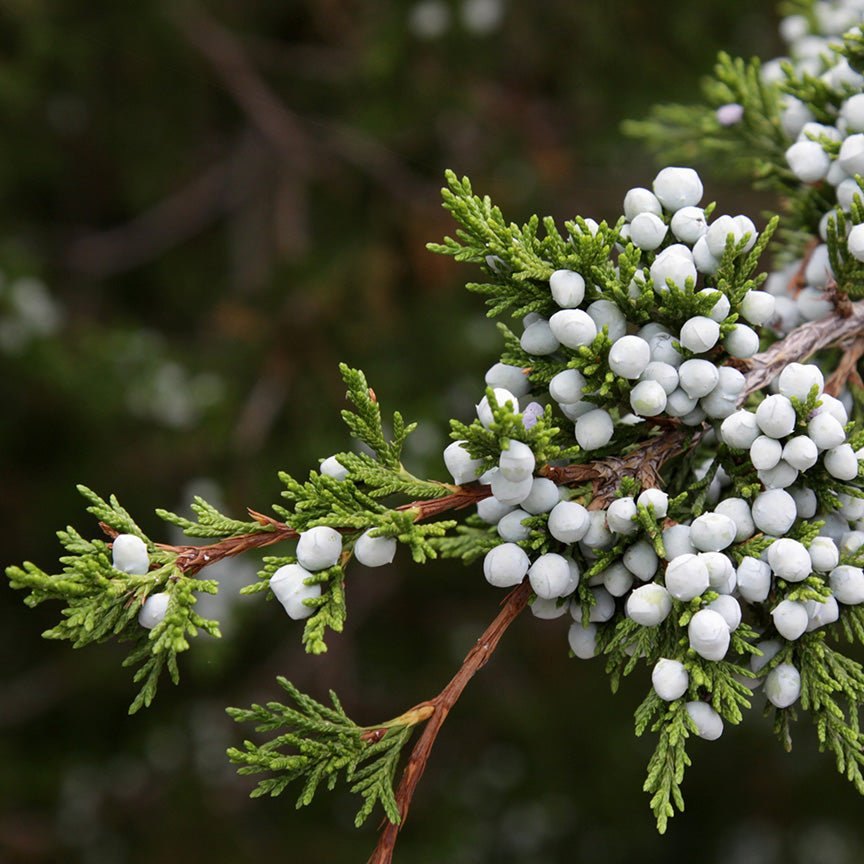
- Plant part
- Wood
- Vietnamese name
- Tuyết tùng Virginia
- Scent family
- Woody & Resinous
- Plant family
- Cupressaceae
- Lots published
- —
 Wood
Composition profile
The published composition from the article, read as structure: 6 compounds adding up to about 83 % of the sample. Figures are printed as the source gives them — one sample, not a species average.
| Compound | Level | Class | Note |
|---|---|---|---|
| α-Cedrene | 31.8 % | Sesquiterpenes | Base |
| Thujopsene | 19.4 % | — | — |
| Cedrol | 13.4 % | Alcohols | Base |
| Widdrol | 11.1 % | — | — |
| β-Cedrene | 5.8 % | — | — |
| Cuparene | 1.2 % | — | — |
By chemical class
- Unclassified37.5 %
- Sesquiterpenes31.8 %
- Alcohols13.4 %
By note
- Base45.2 %
- Unclassified37.5 %
Group totals use the upper bound of each range and only the compounds the article lists; bars are relative to the identified total.
Put it beside another oil in the Compare tool Which other oils are rich in α-Cedrene?
A cedarwood that is not a cedar
“Virginian cedarwood” oil is distilled from the wood of Juniperus virginiana, a juniper native to the eastern United States. Botanically it is not a true cedar (Cedrus), like Atlas cedar or Himalayan cedar. A 2026 review in Plants of “cedarwood” oils groups it with many other trees called “cedar” that do not belong to the genus Cedrus.
Composition: cedrene, thujopsene, cedrol
Three sources of figures for J. virginiana wood oil:
| Compound | 56 commercial oils (2026) | NTP lot (2016) | Bastrop, Texas (1987) |
|---|---|---|---|
| α-Cedrene | 31.8% | 27.01% | 27.2% |
| β-Cedrene | 5.8% | 6.05% | 7.7% |
| Thujopsene | 19.4% | 19.64% | 27.6% |
| Cedrol | 13.4% | 21.83% | 15.8% |
| Widdrol | 11.1% | – | 1.0% |
| Cuparene | 1.2% | 0.96% | 6.3% |
The first column is the mean of 56 commercial oils analysed in the authors’ laboratory. The middle column is the commercial lot used by the US National Toxicology Program (NTP) in its 2016 toxicity study. The last column is a 1987 study in Economic Botany: heartwood with bark and sapwood removed, steam-distilled for 20 hours, the mean of 9 samples collected near Bastrop (Texas), with a yield of 3.18% on dry wood. A dash means it was not reported.
Virginia and Texas: two American “cedarwood” oils
The same 1987 study analysed J. ashei, the source of “Texas cedarwood” oil, from 10 samples collected at Ozona and Junction (Texas): α-cedrene only 1.8% and β-cedrene 1.6%, but thujopsene 60.4% and cedrol 19.0%; the yield was 4.04%. Both are sold as “cedarwood oil” but differ clearly: Virginian oil balances cedrene and thujopsene, while Texas oil is dominated by thujopsene.
Cedrol
Cedrol is a sesquiterpene alcohol. The 1987 study cites earlier work showing that the “cedarwax” that often precipitated from Texas oil was in fact crystalline cedrol, and notes that cedrol was sold separately at a higher price than the oil (in 1986). The author also suggests that a commercial Virginian oil reported in 1960 with only 4% cedrol may have had cedrol removed. However, cedrol also varies naturally (13.4% to 21.83% in the table above), so low cedrol is only a reason to ask questions, not proof.
Reading the label
When buying “cedarwood” oil, three questions are worth asking:
- Which species? Juniperus virginiana, J. ashei or Cedrus atlantica. The analysis tells them apart: himachalenes mean Cedrus; cedrol and cedrene mean Juniperus.
- Which plant part? All the figures above are for wood oil.
- How much cedrol and widdrol? Compare with the ranges above to see whether a lot is unusual.
Safety
Under Regulation (EU) 2023/1545, Juniperus virginiana oil is on the list of fragrance allergens that must be named on cosmetic labels (above 0.001% in leave-on and 0.01% in rinse-off products), under the label name “Juniperus Virginiana Oil”. In the NTP’s 14-week study, applying the oil to the skin of rats and mice caused dose-related skin lesions at the application site, from a concentration of 6.25%. Always dilute before use on skin.
Sources
- Setzer W.N., Satyal P. (2026). Cedarwood oils: the wood essential oil compositions from trees known as “cedar”. Plants 15(4), 659. doi:10.3390/plants15040659
- National Toxicology Program (2016). NTP technical report on the toxicity studies of cedarwood oil (Virginia) (CASRN 8000-27-9) administered dermally to F344/N rats and B6C3F1/N mice. Toxicity Report 86. doi:10.22427/NTP-TOX-86
- Adams R.P. (1987). Investigation of Juniperus species of the United States for new sources of cedarwood oil. Economic Botany 41(1), 48–54. doi:10.1007/BF02859346
- Regulation (EU) 2023/1545 on the labelling of fragrance allergens.
In the car
The main compounds of this oil boil above 250 °C, so it is among the oils that hold up when a car is parked in the sun. Which essential oils can take a hot car explains why. We are measuring a hanging scented wood for the car, vacuum-infused with essential oil.
Buy Virginian cedarwood
Virginian cedarwood oil: no lot has been brought in yet, so it is not on sale. Message us if you need it.
Further reading
Close to Virginian cedarwood
Same plant family: Cupressaceae Blue cypress · Cupressus · Juniper berry · Thuja · Utah juniper
Also from the wood Agarwood · Blue cypress · Cupressus · Ho wood · Rosewood · Sandalwood
Same method: direct steam distillation East Indian lemongrass · Engelmann spruce · Ginger · Melissa · Nutmeg · Perilla · Sitka spruce · Star anise
Quick answers
What does Virginian cedarwood essential oil smell like?
Dry, clean wood, slightly sweet, and almost everyone names the same thing at once: a freshly sharpened pencil.
What is the botanical name of Virginian cedarwood oil?
The plant is Juniperus virginiana, in the Cupressaceae family. In Vietnamese it is called tuyết tùng virginia.
How is Virginian cedarwood oil produced?
From the wood of the plant, by direct steam distillation. See the method for what that does to the oil.
Last updated