Essential oils · Woody & Resinous family
Atlas cedarwood essential oil
Cedrus atlantica
Tuyết tùng Atlas · Pinaceae
Sweet, warm, slightly waxy wood, with a resinous note underneath. Rounder and softer than people usually expect of a conifer.
The name “cedarwood” covers at least three species on the market that are not closely related. Atlas and Himalayan are true cedars, genus Cedrus, while Virginian cedarwood is actually a juniper. The Virginian oil is dry and instantly recalls a pencil case.
So if you smell a bottle of “cedarwood” and get freshly sharpened pencil, it is not Atlas. Atlas is sweeter, heavier, and lasts much longer.
- Plant part
- Wood
- Vietnamese name
- Tuyết tùng Atlas
- Scent family
- Woody & Resinous
- Plant family
- Pinaceae
- Lots published
- —
 Wood
Composition profile
The published composition from the article, read as structure: 3 compounds adding up to about 56 % of the sample. Figures are printed as the source gives them — one sample, not a species average.
| Compound | Level | Class | Note |
|---|---|---|---|
| β-Himachalene | 28.99 % | Sesquiterpenes | Base |
| α-Himachalene | 14.43 % | — | — |
| Longifolene | 12.2 % | Sesquiterpenes | Base |
By chemical class
- Sesquiterpenes41.2 %
- Unclassified14.4 %
By note
- Base41.2 %
- Unclassified14.4 %
Group totals use the upper bound of each range and only the compounds the article lists; bars are relative to the identified total.
Compare with the 1 chemically closest oil Which other oils are rich in β-Himachalene?
A tree of the Atlas mountains
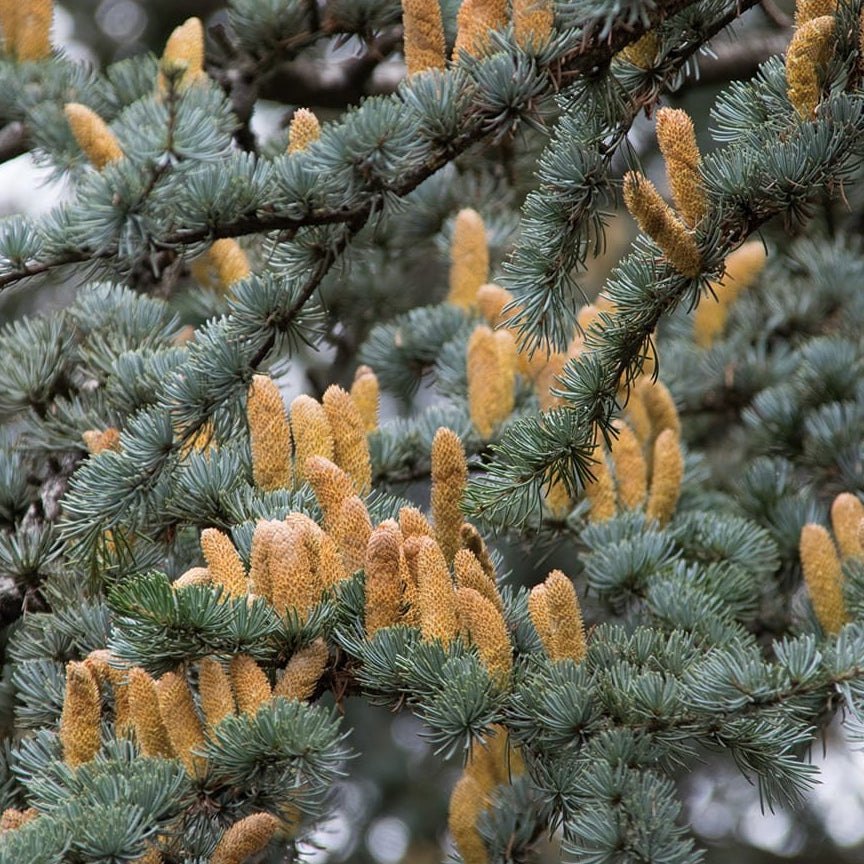
Atlas cedar (Cedrus atlantica), according to a 2023 study in Molecules, grows in the Rif and Middle Atlas mountains of Morocco. Its genus also includes Himalayan cedar (C. deodara).
The oil is distilled from the wood, not the needles. The Moroccan studies used dried wood or heartwood sawdust.
Composition: the himachalenes
Three wood oil samples from the Middle Atlas:
| Compound | Azrou (2023) | Itzer sawdust (2021) | Senoual sawdust (2021) |
|---|---|---|---|
| β-Himachalene | 28.99% | 27.67% | 44.23% |
| α-Himachalene | 14.43% | 12.2% | 16.69% |
| Longifolene | 12.2% | – | – |
The 2023 sample was wood from wild trees in the Azrou area, hydrodistilled for 3 hours in a Clevenger apparatus; the study identified 30 compounds, with sesquiterpene hydrocarbons at 77.9%. The 2021 samples (Arabian Journal of Chemistry) were sawdust from the Itzer and Senoual forests, with yields of 3.51% and 5.98%. The same study also distilled oil from the wood tar (a product of pyrolysing wood at about 500 °C) of the two forests, with β-himachalene at about 24%. A dash means it was not reported.
Reading the table
β-Himachalene is the main compound in all three samples, but it ranges from about 28% to 44%. Nor does every Atlas oil follow this profile: a 2016 study in Maderas. Ciencia y Tecnologia, which distilled heartwood sawdust from the Azrou area (yield about 3.4%), reported the atlantones as the main group, including (E)-γ-atlantone 19.73% and (E)-α-atlantone 16.86%, with β-himachalene only 0.79%. Some of the compounds identified in that paper are unusual for Cedrus, so we cite it only as an example of variation. The lot analysis tells you more than the species name.
“Cedarwood” is a loose name
In the trade, “cedarwood” covers at least two groups of trees that are not closely related:
| Trade name | Genus (family) | Characteristic compounds |
|---|---|---|
| Atlas and Himalayan cedar | Cedrus (Pinaceae) | Himachalenes |
| Virginia and Texas “cedar” | Juniperus (Cupressaceae) | Cedrol, α-cedrene, thujopsene |
Virginia cedarwood actually comes from a juniper (Juniperus virginiana). The analysis is the quickest way to tell which group a bottle of “cedarwood” belongs to: himachalenes mean Cedrus; cedrol and cedrene mean Juniperus. The EU allergen labelling rules also list the two as separate entries.
Safe use
Under Regulation (EU) 2023/1545, Cedrus atlantica oil and extract are on the list of fragrance allergens that must be named on cosmetic labels (above 0.001% in leave-on and 0.01% in rinse-off products), under the label name “Cedrus Atlantica Oil/Extract”. Always dilute and test on a small patch of skin before use.
Sources
- El Hachlafi N. et al. (2023). Antioxidant, Volatile Compounds; Antimicrobial, Anti-Inflammatory, and Dermatoprotective Properties of Cedrus atlantica (Endl.) Manetti Ex Carriere Essential Oil: In Vitro and In Silico Investigations. Molecules 28(15), 5913. doi:10.3390/molecules28155913
- Jaouadi I., Cherrad S., Bouyahya A., Koursaoui L., Satrani B., Ghanmi M., Chaouch A. (2021). Chemical variability and antioxidant activity of Cedrus atlantica Manetti essential oils isolated from wood tar and sawdust. Arabian Journal of Chemistry 14, 103441. doi:10.1016/j.arabjc.2021.103441
- Fidah A., Salhi N., Rahouti M. et al. (2016). Natural durability of Cedrus atlantica wood related to the bioactivity of its essential oil against wood decaying fungi. Maderas. Ciencia y Tecnologia 18(4), 567–576. doi:10.4067/S0718-221X2016005000049
- Regulation (EU) 2023/1545 on the labelling of fragrance allergens.
Buy Atlas cedarwood
Atlas cedarwood oil: no lot has been brought in yet, so it is not on sale. Message us if you need it.
Where you may already have smelled it
According to the analyses cited above, this oil contains up to 12.2 % longifolene. It is also the leading compound in the scenes below from the scent dictionary. Smelling one of those scenes again is a way to get to know it without opening a bottle. A shared compound does not mean the oil smells exactly like the scene.
Chemically close
The oils whose published composition is closest to this one, compared across every compound we could read. Close in composition does not mean the scent is identical or that one can replace the other.
- Himalayan cedarwood Cedrus deodara shared: β-Himachalene, α-Himachalene · closeness 0.86 · compare
Further reading
Close to Atlas cedarwood
Same plant family: Pinaceae Black spruce · Engelmann spruce · Himalayan cedarwood · Scots pine · Siberian fir · Sitka spruce · White spruce
Also from the wood Blue cypress · Camphor ct camphor · Himalayan cedarwood · Ho wood · Sandalwood · Virginian cedarwood
Same method: direct steam distillation Frankincense sacra · Helichrysum · Himalayan cedarwood · Ho wood · Melissa · Perilla · Rosemary ct verbenone · Virginian cedarwood
Quick answers
What does Atlas cedarwood essential oil smell like?
Sweet, warm, slightly waxy wood, with a resinous note underneath. Rounder and softer than people usually expect of a conifer.
What is the botanical name of Atlas cedarwood oil?
The plant is Cedrus atlantica, in the Pinaceae family. In Vietnamese it is called tuyết tùng atlas.
How is Atlas cedarwood oil produced?
From the wood of the plant, by direct steam distillation. See the method for what that does to the oil.
What are the main compounds of Atlas cedarwood oil?
From the composition data on this page, the oil is led by β-Himachalene and Longifolene. Proportions vary with origin, harvest and method; a lot analysis is the only answer for a given bottle.
Last updated