Essential oils · Medicinal family
Baeckea essential oil
Baeckea frutescens
Dầu chổi · Myrtaceae
Fresh and airy, with a light camphor and a touch of pine. It is close to cajeput but sweeter and softer.
The Baeckea shrub grows on the sandy, barren hills of central Vietnam, and its oil is a long-standing product of Ha Tinh, Quang Binh and Hue. The compounds most often recorded in it are pinene and 1,8-cineole — the same two that make up the smell of pine and of cajeput.
People in central Vietnam have known this oil as a household staple for generations, long before anyone called it an essential oil. Outside that region it is almost unknown, and very little has been written about it internationally.
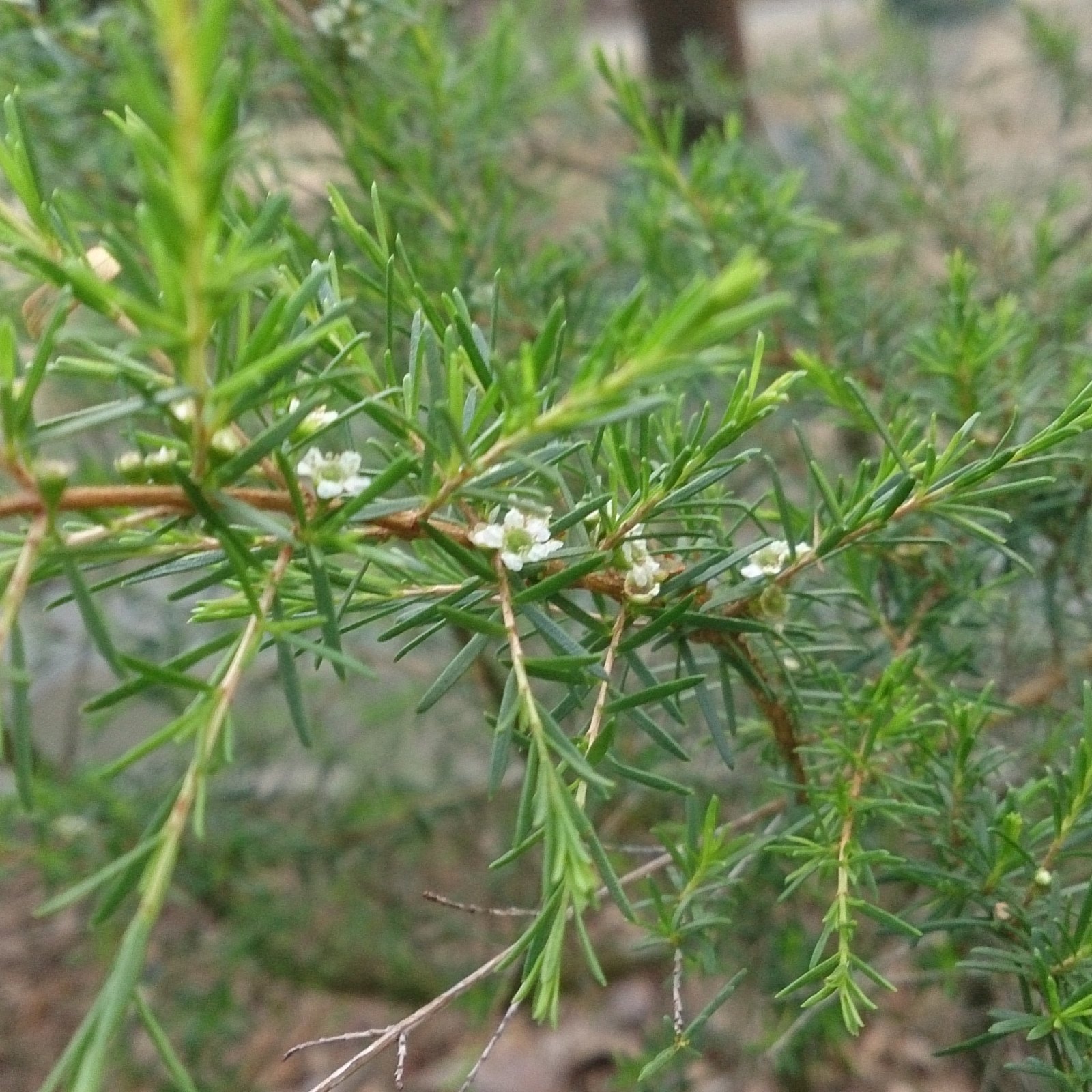
- Plant part
- Whole plant
- Vietnamese name
- Dầu chổi
- Scent family
- Medicinal
- Plant family
- Myrtaceae
- Lots published
- —
 Whole plant
Composition profile
The published composition from the article, read as structure: 7 compounds adding up to about 78 % of the sample. Figures are printed as the source gives them — one sample, not a species average.
| Compound | Level | Class | Note |
|---|---|---|---|
| β-Pinene EU | 19.0 % | Monoterpenes | Top |
| γ-Terpinene | 11.7 % | Monoterpenes | Middle |
| α-Pinene EU | 11.1 % | Monoterpenes | Top |
| 1,8-Cineole | 10.1 % | Oxides | Top |
| α-Humulene | 9.9 % | Sesquiterpenes | Base |
| p-Cymene | 8.9 % | Monoterpenes | Top |
| β-Caryophyllene EU | 7.1 % | Sesquiterpenes | Base |
By chemical class
- Monoterpenes50.7 %
- Sesquiterpenes17.0 %
- Oxides10.1 %
By note
- Top49.1 %
- Middle11.7 %
- Base17.0 %
Group totals use the upper bound of each range and only the compounds the article lists; bars are relative to the identified total.
Put it beside another oil in the Compare tool Which other oils are rich in β-Pinene?
The baeckea shrub
Baeckea oil, dầu chổi in Vietnamese, is distilled from Baeckea frutescens, also known locally as chổi sẻ or thanh hao: a myrtle-family shrub of the sandy coastal hills of central Vietnam. Its leaves are tiny and needle-like, fragrant when crushed. In Ha Tinh, Quang Binh and Thua Thien Hue, baeckea oil was a household staple long before anyone called it an essential oil. Its relatives in the myrtle family include tea tree, cajeput and the eucalypts.
Composition of Da Nang leaf oil
A 2020 study in Plants distilled fresh baeckea leaves from Da Nang, with a yield of 2.23%, and identified 88 compounds:
| Compound | Share |
|---|---|
| β-Pinene | 19.0% |
| γ-Terpinene | 11.7% |
| α-Pinene | 11.1% |
| 1,8-Cineole | 10.1% |
| α-Humulene | 9.9% |
| p-Cymene | 8.9% |
| (E)-Caryophyllene | 7.1% |
Monoterpene hydrocarbons make up 55.6% of the oil. That is why baeckea oil smells airy and bright: the two pinenes give pine resin, cineole a cool cajeput-like note, γ-terpinene and p-cymene a slightly lemony, woody note. Sesquiterpenes such as humulene and caryophyllene hold the warm part at the end.
Compared with cajeput or eucalyptus, baeckea oil has far less cineole, so it is softer and less “medicinal”.
Composition varies with origin
According to PROSEA, four baeckea oil samples from Malaysia fell into two types: three dominated by pinenes (40–55.5%) and one by γ-terpinene (34%), and one sample lacked 1,8-cineole altogether. Within one species, growing area and harvest time shift the proportions considerably.
Traditional use and caution
PROSEA records that baeckea oil is used for massage in Southeast Asian folk medicine. Those records describe custom, not clinical evidence, and this page makes no therapeutic recommendation.
Baeckea oil contains cineole and pinenes, so, like other myrtle-family oils, it should not be used near the faces of young children and should always be diluted before use on skin.
Sources
- Mosquito Larvicidal Activity, Antimicrobial Activity, and Chemical Compositions of Essential Oils from Four Species of Myrtaceae from Central Vietnam (2020). Plants 9(4), 544. doi:10.3390/plants9040544
- PROSEA. Baeckea frutescens. Plant Resources of South-East Asia. Pl@ntUse
Buy Baeckea
Baeckea oil: no lot has been brought in yet, so it is not on sale. Message us if you need it.
Where you may already have smelled it
According to the analyses cited above, this oil contains up to 19 % β-pinene and up to 11.7 % γ-terpinene. Both are also part of, though not the lead in, the scenes below from the scent dictionary. Smelling one of those scenes again is a way to get to know them without opening a bottle. A shared compound does not mean the oil smells exactly like the scene.
- Pine woodFresh pine sawdust, just sawn
- Aged tangerine peelA piece of tangerine peel dried and aged for years, bought from a traditional medicine shop
- Vietnamese lime peelSqueeze a Vietnamese lime and smell the peel, not the juice
- Buddha’s handTake a ripe yellow Buddha’s hand and lightly scratch the peel with a fingernail
Further reading
Close to Baeckea
Same plant family: Myrtaceae Clove bud · Fragonia · Guava leaf · Honey myrtle · Kunzea · Lemon myrtle · Manuka
Also from the whole plant Basil ct linalool · Basil ct methyl chavicol · Clove basil · Holy basil (tulsi) · Mugwort · Rosemary ct camphor · Spearmint · Vietnamese balm
Same method: direct steam distillation Elemi · Fokienia · Fragonia · Ho wood · Hyssop ct 1,8-cineole · Mastic · Rosewood · White spruce
Quick answers
What does baeckea essential oil smell like?
Fresh and airy, with a light camphor and a touch of pine. It is close to cajeput but sweeter and softer.
What is the botanical name of baeckea oil?
The plant is Baeckea frutescens, in the Myrtaceae family. In Vietnamese it is called dầu chổi.
How is baeckea oil produced?
From the whole plant of the plant, by direct steam distillation. See the method for what that does to the oil.
What are the main compounds of baeckea oil?
From the composition data on this page, the oil is led by β-Pinene, γ-Terpinene and α-Pinene. Proportions vary with origin, harvest and method; a lot analysis is the only answer for a given bottle.
Last updated