Essential oils · Woody & Resinous family
Utah juniper essential oil
Juniperus osteosperma
Bách xù Utah · Cupressaceae
Dry pine resin, with camphor and a pencil-wood note. It is brighter than juniper oils distilled from the berries, with a clearer green-leaf element.
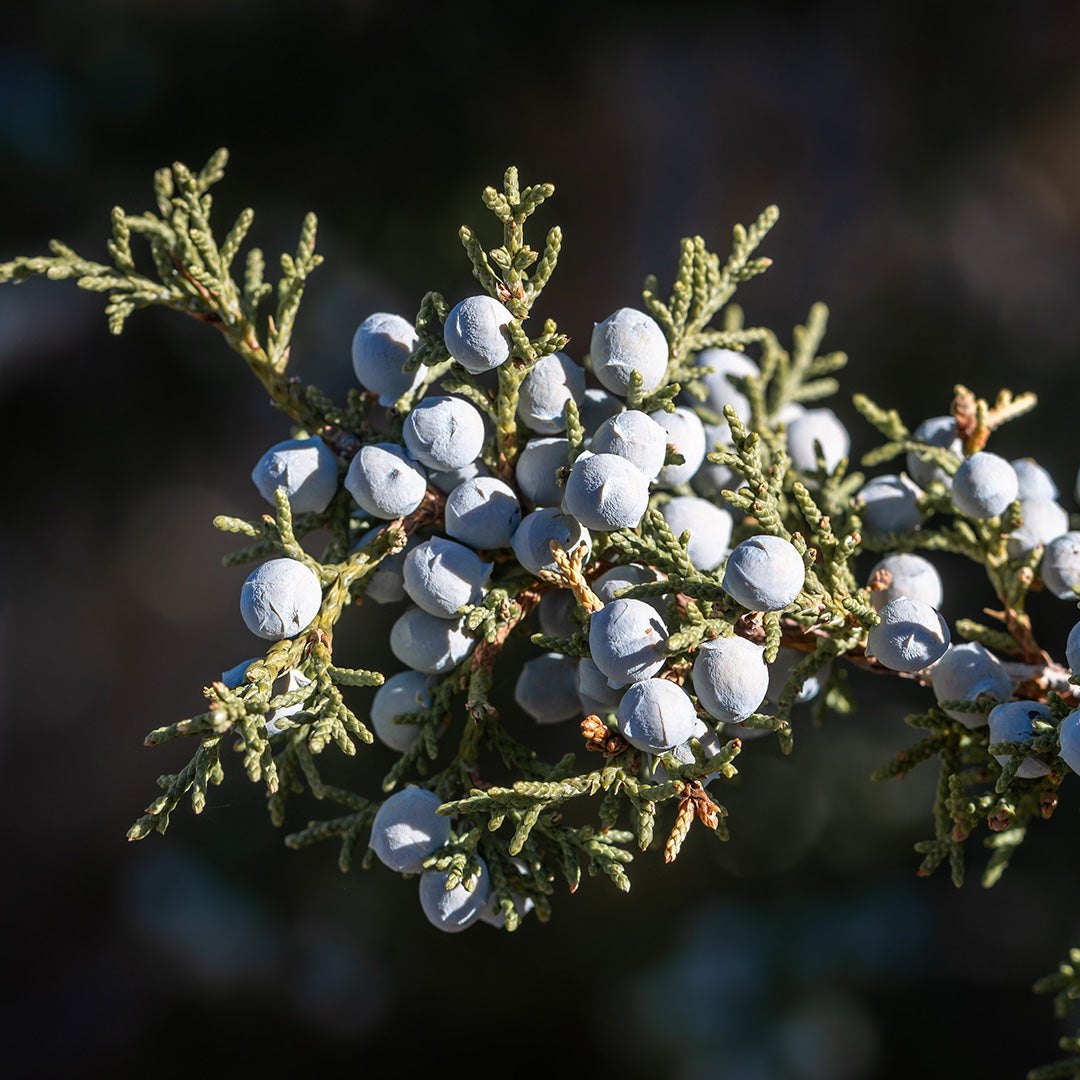
Utah juniper (Juniperus osteosperma) grows in the dry American West. The oil is distilled from the leafy twigs, so it is closer to the smell of a juniper woodland than to the berries in gin.
Its leaf oil revolves around camphor, bornyl acetate and terpinen-4-ol, but the proportions vary a great deal from tree to tree and place to place. So each lot’s analysis matters more than any general description.
- Plant part
- Leaves
- Vietnamese name
- Bách xù Utah
- Scent family
- Woody & Resinous
- Plant family
- Cupressaceae
- Lots published
- —
 Leaves
Composition profile
The published composition from the article, read as structure: 4 compounds adding up to about 55 % of the sample. Figures are printed as the source gives them — one sample, not a species average.
| Compound | Level | Class | Note |
|---|---|---|---|
| Camphor EU | 23.7 % | Ketones | Middle |
| Bornyl acetate | 16.6 % | — | — |
| Terpinen-4-ol | 8.3 % | Alcohols | Middle |
| Borneol | 6.0 % | Alcohols | Middle |
By chemical class
- Ketones23.7 %
- Unclassified16.6 %
- Alcohols14.3 %
By note
- Middle38.0 %
- Unclassified16.6 %
Group totals use the upper bound of each range and only the compounds the article lists; bars are relative to the identified total.
Compare with the 2 chemically closest oils Which other oils are rich in Camphor?
What Utah juniper is
Utah juniper (Juniperus osteosperma) is a juniper of the dry American West. The oil is distilled from the leaves and leafy twigs, not from the berries like the juniper used in gin. There are at least three peer-reviewed studies of its leaf oil, from 2012, 2019 and 2024.
Composition: a camphor and bornyl acetate type
A 2012 study steam-distilled fresh leaves from several populations and described Utah juniper leaf oil as a camphor/bornyl acetate type, unlike its close relatives.
| Compound | Nevada | Thistle, Utah | Oak Creek, Arizona |
|---|---|---|---|
| Camphor | 23.7% | 19.6% | 60.2% |
| Bornyl acetate | 16.6% | 19.7% | 0.4% |
| Terpinen-4-ol | 8.3% | 10.7% | 3.2% |
| Borneol | 6.0% | 4.3% | 3.0% |
The San Bernardino Mountains population (California) had camphor 25.6%, bornyl acetate 4.4%, terpinen-4-ol 12.6% and borneol 7.2%. The Arizona population is quite different, with camphor at 60%; the author suggests it is likely a Pleistocene relict.
Two newer studies
- 2019, 10 trees in Utah: leaves steam-distilled for 4 hours, yield 0.8%. Camphor 10.9–47.6% (mean 27.4%), bornyl acetate 3.0–27.7%. The study also distilled the whole tree, trunk and limbs: the wood gave oils rich in α-pinene (40.5% for the whole tree, 59.4% for the trunk, 85.3% for the limbs), with yields of only 0.1–0.3%.
- 2024, 7 trees: foliage distilled for 4 hours, yield 0.87–2.74%. Bornyl acetate 9.3–27.0%, camphor 3.9–31.1%, terpinen-4-ol 7.9–15.3%, sabinene 4.3–12.3%, α-pinene 3.9–9.6%, limonene 2.6–5.2%.
All three studies give the same picture: Utah juniper leaf oil revolves around camphor, bornyl acetate and terpinen-4-ol, with proportions that change a great deal from tree to tree and place to place.
Its smell
Camphor gives the sharp, cool part; bornyl acetate gives a soft, slightly sweet pine-needle note; terpinen-4-ol adds a spicy, slightly earthy touch. A camphor-rich batch is harsher and more medicinal; a bornyl acetate-rich batch is rounder and more like a pine forest.
Safety
Camphor, α-pinene and β-pinene are on the list of fragrance allergens that must be named on cosmetic labels under Regulation (EU) 2023/1545, above 0.001% in leave-on and 0.01% in rinse-off products. Camphor-rich oils should not be used for young children. Always dilute before use on skin.
Sources
- Adams R.P. (2012). Phytologia 94(1), 118–132.
- Wilson T.M., Poulson A., Packer C. et al. (2019). Phytologia 101(3), 188–193.
- Swor K., Poudel A., Satyal P., Setzer W.N. (2024). Journal of Essential Oil and Plant Composition 2(1), 59–70. doi:10.58985/jeopc.2024.v02i01.44
- Regulation (EU) 2023/1545 amending Annex III to Regulation (EC) No 1223/2009 on the labelling of fragrance allergens.
Buy Utah juniper
Utah juniper oil: no lot has been brought in yet, so it is not on sale. Message us if you need it.
Where you may already have smelled it
According to the analyses cited above, this oil contains up to 23.7 % camphor. It is also the leading compound in the scenes below from the scent dictionary. Smelling one of those scenes again is a way to get to know it without opening a bottle. A shared compound does not mean the oil smells exactly like the scene.
Chemically close
The oils whose published composition is closest to this one, compared across every compound we could read. Close in composition does not mean the scent is identical or that one can replace the other.
- Amomum Amomum villosum shared: Camphor, Bornyl acetate · closeness 0.77 · compare
- Blue tansy Tanacetum annuum shared: Camphor, Bornyl acetate · closeness 0.75 · compare
Further reading
Close to Utah juniper
Same plant family: Cupressaceae Blue cypress · Cupressus · Cypress · Fokienia · Thuja
Also from the leaves Eucalyptus dives · Eucalyptus globulus · Eucalyptus radiata · Geranium · Kunzea · Larch / Tamarack · Lemon eucalyptus · Petitgrain
Same method: direct steam distillation Basil ct methyl chavicol · Bergamot mint · Guava leaf · Hemlock spruce · Japanese mint · Lemongrass · Peppermint · Spearmint
Quick answers
What does Utah juniper essential oil smell like?
Dry pine resin, with camphor and a pencil-wood note. It is brighter than juniper oils distilled from the berries, with a clearer green-leaf element.
What is the botanical name of Utah juniper oil?
The plant is Juniperus osteosperma, in the Cupressaceae family. In Vietnamese it is called bách xù utah.
How is Utah juniper oil produced?
From the leaves of the plant, by direct steam distillation. See the method for what that does to the oil.
What are the main compounds of Utah juniper oil?
From the composition data on this page, the oil is led by Camphor, Terpinen-4-ol and Borneol. Proportions vary with origin, harvest and method; a lot analysis is the only answer for a given bottle.
Last updated