Essential oils · Woody & Resinous family
Himalayan cedarwood essential oil
Cedrus deodara
Tuyết tùng Himalaya · Pinaceae
Sweet, dry wood, slightly smoky, with a leathery note. It is close to Atlas cedarwood but usually drier and a little smokier.
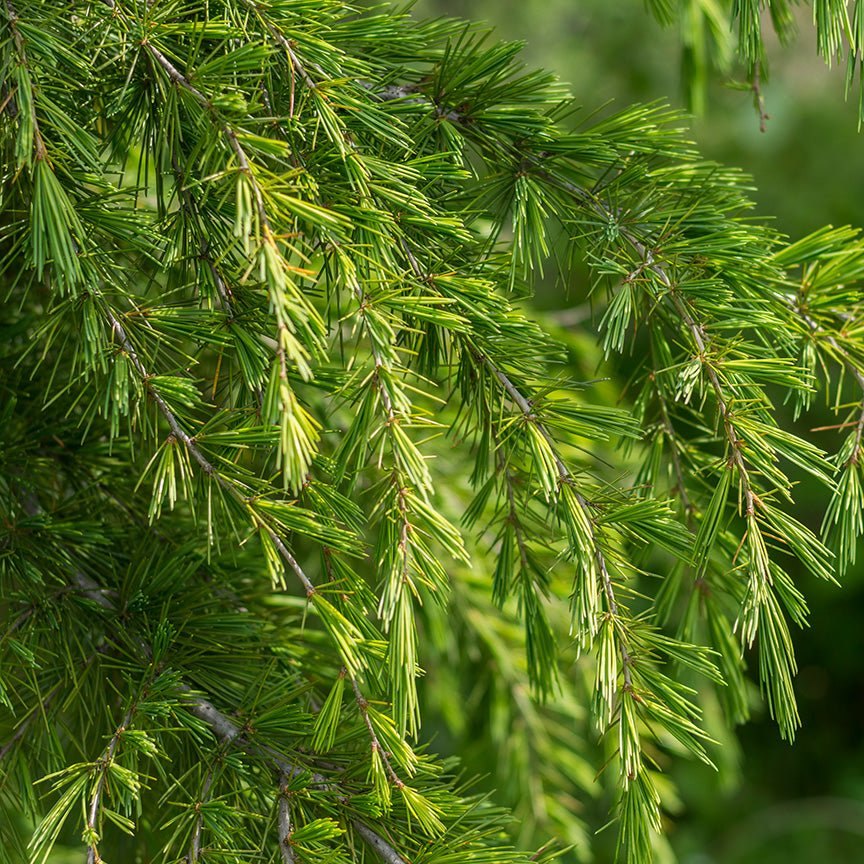
Himalayan cedar (deodar, Cedrus deodara) is a large timber tree of the Himalaya. Like Atlas cedarwood, its wood oil is dominated by the himachalenes, the fingerprint of the genus Cedrus.
Atlas and Himalayan are true Cedrus species; Virginian “cedarwood” is a juniper. Whether the analysis shows himachalenes or cedrol is a quick way to tell them apart.
- Plant part
- Wood
- Vietnamese name
- Tuyết tùng Himalaya
- Scent family
- Woody & Resinous
- Plant family
- Pinaceae
- Lots published
- —
 Wood
Composition profile
The published composition from the article, read as structure: 7 compounds adding up to about 80 % of the sample. Figures are printed as the source gives them — one sample, not a species average.
| Compound | Level | Class | Note |
|---|---|---|---|
| β-Himachalene | 34.8 % | Sesquiterpenes | Base |
| α-Himachalene | 13.6 % | — | — |
| (E)-α-Atlantone | 11.2 % | — | — |
| γ-Himachalene | 8.7 % | — | — |
| (E)-γ-Atlantone | 4.7 % | — | — |
| (Z)-γ-Atlantone | 4.0 % | — | — |
| (Z)-α-Atlantone | 2.5 % | — | — |
By chemical class
- Unclassified44.7 %
- Sesquiterpenes34.8 %
By note
- Base34.8 %
- Unclassified44.7 %
Group totals use the upper bound of each range and only the compounds the article lists; bars are relative to the identified total.
Compare with the 1 chemically closest oil Which other oils are rich in β-Himachalene?
What Himalayan cedarwood is
Himalayan cedar (deodar, Cedrus deodara) is one of the true cedars, genus Cedrus, in the pine family. The oil is distilled from the wood, usually from chips and sawdust. It is a close relative of Atlas cedarwood, and the two oils are so alike that an analysis is the surest way to tell them apart.
Composition: compared with Atlas cedar
A 2026 review in Plants analysed dozens of commercial oils and brought together published studies:
| Compound | Himalayan (43 samples) | Himalayan, India | Atlas (48 samples) |
|---|---|---|---|
| β-Himachalene | 34.8% | 38.3% | 40.3% |
| α-Himachalene | 13.6% | 17.1% | 15.3% |
| γ-Himachalene | 8.7% | 12.6% | 9.9% |
| (E)-α-Atlantone | 11.2% | 8.6% | 5.4% |
| (Z)-α-Atlantone | 2.5% | 1.4% | – |
| (E)-γ-Atlantone | 4.7% | 2.4% | 1.9% |
| (Z)-γ-Atlantone | 4.0% | 2.3% | – |
The 43- and 48-sample columns are means for commercial oils; the Indian sample (2009) was hydrodistilled from wood chips. A dash means it was not in the data cited.
Atlantones: the difference
The three himachalenes make up most of both oils. The difference lies in the atlantones, ketones with a sweet, dry, slightly leathery woodiness. The review notes that in Himalayan oil the atlantones “usually account for at least 20%”, and β-himachalene is generally below 40%. In the commercial Atlas samples, (E)-α-atlantone was only about 5%.
But this is not an absolute rule: the review also records some Moroccan Atlas samples with 19.7–28.8% (E)-α-atlantone. Plenty of atlantone suggests Himalayan, but does not prove it.
Not every “cedar” is a cedar
The name “cedarwood” is used for wood from several different genera. The 2026 review draws a clear line: true cedars (Cedrus, pine family) are dominated by himachalane and bisabolane compounds, while “cedars” of Juniperus and Cupressus are rich in cedrane and thujopsane compounds. For example, Virginian cedarwood (Juniperus virginiana), 56 commercial samples: α-cedrene 31.8%, cis-thujopsene 19.4%, cedrol 13.4%.
So whether an analysis shows himachalenes or cedrol is the quickest way to tell a true cedar from a juniper sold as cedar.
Safety
Atlas cedar oil is named on the EU list of fragrance allergens that must be labelled (Regulation 2023/1545); Himalayan cedar oil was not named in the text we read. Always dilute before use on skin.
Sources
- Setzer W.N., Satyal P. (2026). Cedarwood Oils: The Wood Essential Oil Compositions from Trees Known as “Cedar”. Plants 15(4), 659. doi:10.3390/plants15040659
- Chaudhary A., Kaur P., Singh B. et al. (2009). Chemical Composition of Hydrodistilled and Solvent Volatiles Extracted from Woodchips of Himalayan Cedrus: Cedrus deodara (Roxb.) Loud. Natural Product Communications 4(9). doi:10.1177/1934578X0900400920
- Regulation (EU) 2023/1545 amending Annex III to Regulation (EC) No 1223/2009 as regards labelling of fragrance allergens.
Buy Himalayan cedarwood
Himalayan cedarwood oil: no lot has been brought in yet, so it is not on sale. Message us if you need it.
Chemically close
The oils whose published composition is closest to this one, compared across every compound we could read. Close in composition does not mean the scent is identical or that one can replace the other.
- Atlas cedarwood Cedrus atlantica shared: β-Himachalene, α-Himachalene · closeness 0.86 · compare
Further reading
Close to Himalayan cedarwood
Same plant family: Pinaceae Black spruce · Engelmann spruce · Hemlock spruce · Pinyon pine · Sitka spruce · White fir · White spruce
Also from the wood Blue cypress · Fokienia · Palo santo · Rosewood · Sandalwood · Virginian cedarwood
Same method: direct steam distillation Engelmann spruce · Frankincense serrata · German chamomile · Melissa · Palo santo · Perilla · Pink pepper · Virginian cedarwood
Quick answers
What does Himalayan cedarwood essential oil smell like?
Sweet, dry wood, slightly smoky, with a leathery note. It is close to Atlas cedarwood but usually drier and a little smokier.
What is the botanical name of Himalayan cedarwood oil?
The plant is Cedrus deodara, in the Pinaceae family. In Vietnamese it is called tuyết tùng himalaya.
How is Himalayan cedarwood oil produced?
From the wood of the plant, by direct steam distillation. See the method for what that does to the oil.
What are the main compounds of Himalayan cedarwood oil?
From the composition data on this page, the oil is led by β-Himachalene. Proportions vary with origin, harvest and method; a lot analysis is the only answer for a given bottle.
Last updated