Lolot pepper leaf essential oil
Piper sarmentosum
Lá lốt · Piperaceae
Green, warm, slightly spicy, with a light peppery note. Lolot belongs to the same genus as black pepper, and the nose hears the family resemblance.
The smell most Vietnamese people remember is lolot leaf over fire, in beef grilled in lolot leaves. Heat changes the smell a great deal, so a raw leaf crushed in the hand and a grilled one are almost two different things. Steam-distilled oil is closer to the raw leaf.
Lolot oil is very rarely distilled commercially, and published descriptions of it are sparse. This section relies mainly on the living plant. When a real lot arrives, it will be rewritten from that lot.
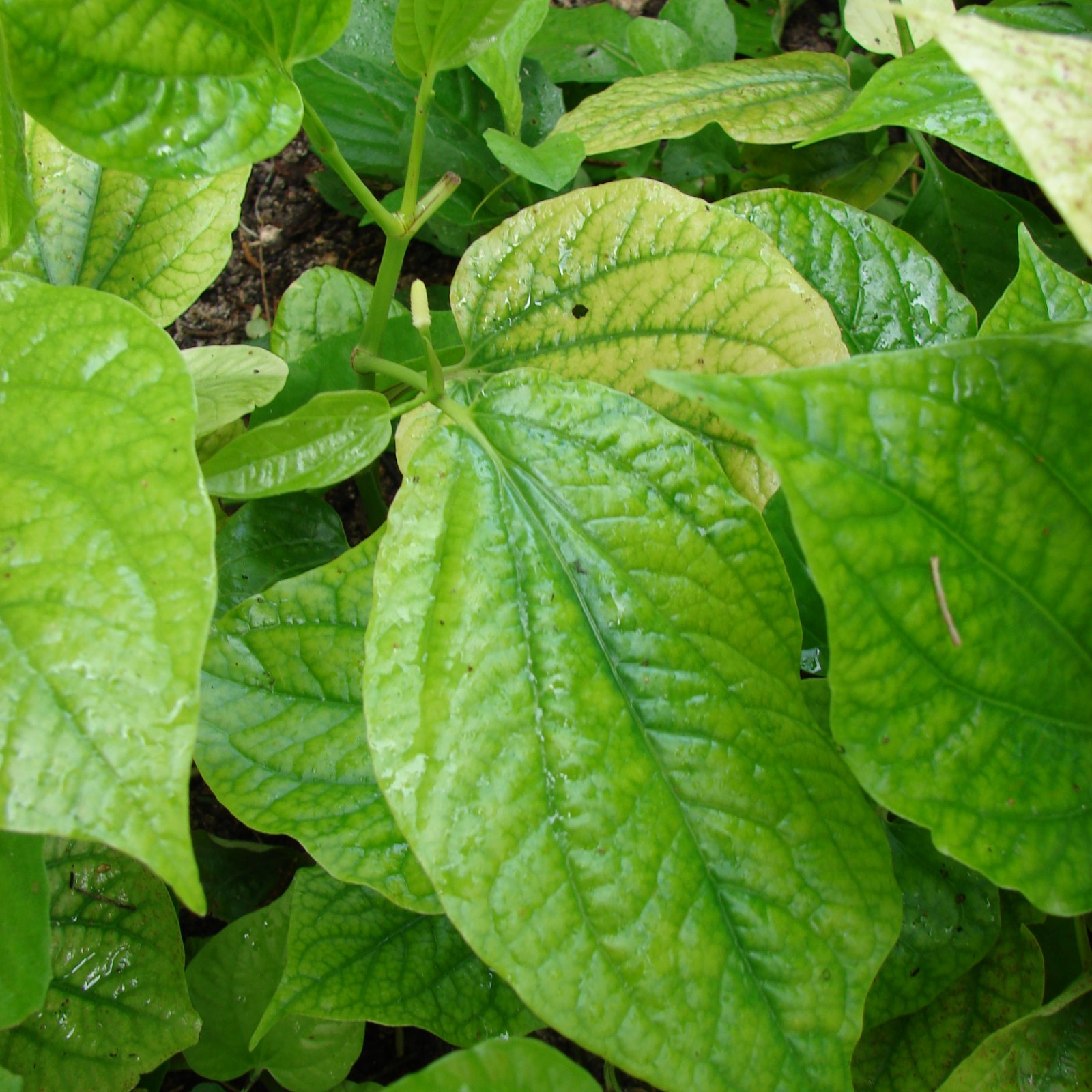
- Plant part
- Leaves
- Vietnamese name
- Lá lốt
- Scent family
- Green
- Plant family
- Piperaceae
- Lots published
- —
 Leaves
Composition profile
The published composition from the article, read as structure: 3 compounds adding up to about 79 % of the sample. Figures are printed as the source gives them — one sample, not a species average.
| Compound | Level | Class | Note |
|---|---|---|---|
| Myristicin | 72.70 % | — | — |
| β-Bisabolene | 3.59 % | Sesquiterpenes | Base |
| β-Caryophyllene EU | 2.63 % | Sesquiterpenes | Base |
By chemical class
- Unclassified72.7 %
- Sesquiterpenes6.2 %
By note
- Base6.2 %
- Unclassified72.7 %
Group totals use the upper bound of each range and only the compounds the article lists; bars are relative to the identified total.
Lolot and the pepper family
Lolot (lá lốt, Piper sarmentosum) belongs to the same genus as black pepper: a low creeping plant with glossy, heart-shaped leaves. Vietnamese cooks use the leaves to wrap grilled beef, in soups and stir-fries. Vietnamese scientific literature sometimes uses the name Piper lolot for this plant; we have not verified how the two names relate, so this page states the name each study uses. See the lolot entry in the scent dictionary.
Two Vietnamese samples, two very different oils
Lolot oil is rarely distilled commercially, and two studies on plants from central Vietnam gave almost opposite results:
| Compound | Sample A: leaves, Quang Nam–Da Nang | Sample B: leaves and stems, Da Nang |
|---|---|---|
| Myristicin | 72.70% | not detected |
| Asarone (isomers) | about 8.7% | – |
| β-Bisabolene | 3.59% | 40.3% |
| β-Caryophyllene | 2.63% | 5.5% |
| β-Pinene | – | 5.5% |
| Caryophyllene oxide | – | 5.1% |
Sample A is named Piper lolot (steam-distilled, yield 0.68%); sample B Piper sarmentosum (hydrodistilled). Study B also cites an earlier sample from Guangzhou, China, with 54.5% asaricin.
Myristicin has a warm, spicy smell; it also occurs in nutmeg oil. β-Bisabolene smells woody, resinous and warmly spicy. Two samples with the same name, one leaning towards spice and the other towards wood and resin: one of the clearest examples on this site of why a species name does not guarantee a smell.
Why an analysis is needed
With lolot, two questions need answers before the oil is used:
- Which type is this lot? The myristicin-rich and bisabolene-rich types smell different and suit different purposes.
- How much myristicin and asarone? These are substances monitored for safety at high doses, and neither study above assessed that aspect. We do not yet have a dedicated toxicology source for lolot oil, so we give no safety threshold here.
Until there is an analysis of the specific lot, the safest course is not to use concentrated lolot oil on skin, and not to take it internally.
Fresh and grilled leaves
The smell most Vietnamese people remember is lolot meeting fire. Heat changes the smell a great deal: the green part evaporates, the warm spicy part comes forward, and a smoky note forms as the leaf reacts to heat. Steam-distilled oil is closer to a fresh leaf crushed in the hand than to a plate of beef in lolot leaves.
Sources
- Chemical components and anti-acetylcholinesterase activity of Piper lolot leaves oil (2023). HPU2 Journal of Sciences: Natural Sciences and Technology 2(2), 41. vjol.info.vn
- Chemical Compositions and Mosquito Larvicidal Activities of Essential Oils from Piper Species Growing Wild in Central Vietnam (2019). Molecules 24(21), 3871. doi:10.3390/molecules24213871
Buy Lolot pepper leaf
Lolot pepper leaf oil: no lot has been brought in yet, so it is not on sale. Message us if you need it.
In the scent dictionary: Lolot leaf — a description of the smell, the compounds behind it, and how to smell it for yourself.
Further reading
Close to Lolot pepper leaf
Same plant family: Piperaceae Black pepper
Also from the leaves Cinnamon leaf · Green myrtle · Guava leaf · Lemon verbena · Palmarosa · Perilla · Red myrtle · Scots pine
Same method: direct steam distillation Amomum · Blue cypress · Cinnamon leaf · Green myrtle · Guava leaf · Immortelle Madagascar · Mastic · White pine
Quick answers
What does lolot pepper leaf essential oil smell like?
Green, warm, slightly spicy, with a light peppery note. Lolot belongs to the same genus as black pepper, and the nose hears the family resemblance.
What is the botanical name of lolot pepper leaf oil?
The plant is Piper sarmentosum, in the Piperaceae family. In Vietnamese it is called lá lốt.
How is lolot pepper leaf oil produced?
From the leaves of the plant, by direct steam distillation. See the method for what that does to the oil.
What are the main compounds of lolot pepper leaf oil?
From the composition data on this page, the oil is led by β-Bisabolene and β-Caryophyllene. Proportions vary with origin, harvest and method; a lot analysis is the only answer for a given bottle.
Last updated