Nutmeg essential oil
Myristica fragrans
Nhục đậu khấu · Myristicaceae
Warm spice, sweet, with an opening close to pine that few people expect from a spice.
That opening comes from sabinene and the pinenes, which make up most of the bottle. The “nutmeg” the nose recognises comes from myristicin and a few related compounds that make up only a small part. Once again the most abundant compound is not the one that gives the name.
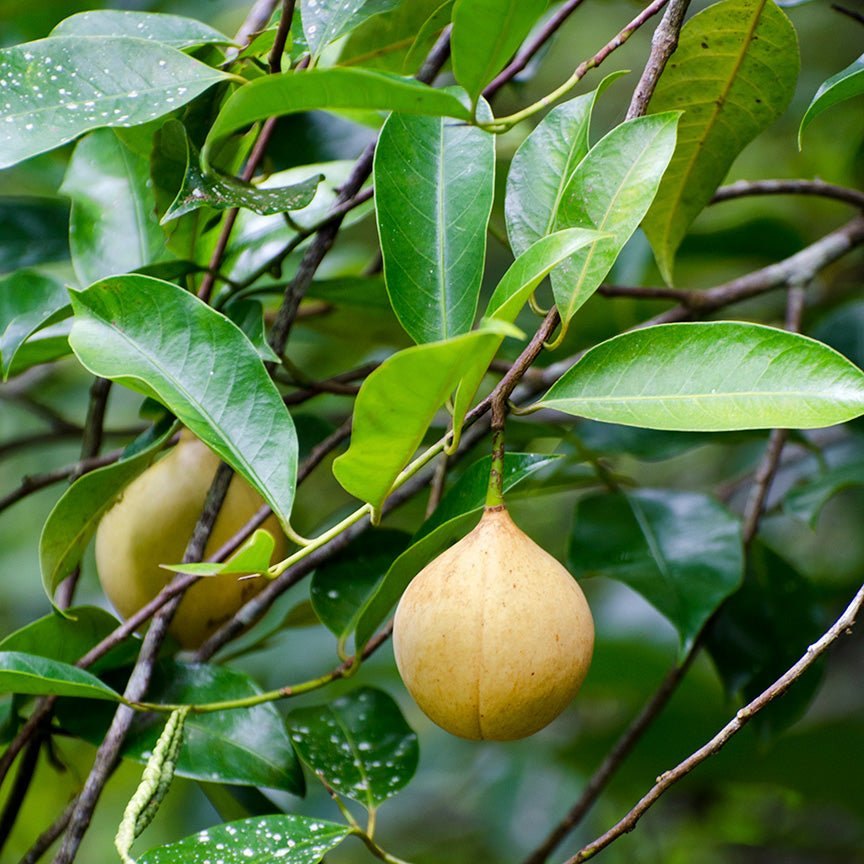
One fruit gives two spices. The seed is nutmeg, and the red aril wrapped around it is what English calls mace. Their oils are close but not identical, so the plant part on this page is the thing to check against the label.
- Plant part
- Seeds
- Vietnamese name
- Nhục đậu khấu
- Scent family
- Spicy
- Plant family
- Myristicaceae
- Lots published
- —
 Seeds
Composition profile
The published composition from the article, read as structure: 7 compounds adding up to about 100 % of the sample. Figures are printed as the source gives them — one sample, not a species average.
| Compound | Level | Class | Note |
|---|---|---|---|
| Sabinene | 14–29 % | Monoterpenes | Top |
| α-Pinene EU | 15–28 % | Monoterpenes | Top |
| β-Pinene EU | 13–18 % | Monoterpenes | Top |
| Myristicin | 5–12 % | — | — |
| Limonene EU | 2–7 % | Monoterpenes | Top |
| Terpinen-4-ol | 2–6 % | Alcohols | Middle |
| γ-Terpinene | 2–6 % | Monoterpenes | Middle |
By chemical class
- Monoterpenes88.0 %
- Unclassified12.0 %
- Alcohols6.0 %
By note
- Top82.0 %
- Middle12.0 %
- Unclassified12.0 %
Group totals use the upper bound of each range and only the compounds the article lists; bars are relative to the identified total.
Compare with the 1 chemically closest oil Which other oils are rich in Sabinene?
Seed and aril: nutmeg and mace
The nutmeg tree (Myristica fragrans) gives two spices from the same fruit. The seed inside is nutmeg. The red, lace-like aril wrapped around the seed is mace. The two smell similar but not identical, and so do their oils.
According to the Food and Agriculture Organization of the United Nations (FAO) document on nutmeg, essential oil makes up about 5–15% of the kernel. The kernel also contains a large amount of fixed oil, about 24–40%.
Composition of Indonesian oil
The tree is native to Indonesia. The European Food Safety Authority’s (EFSA) 2023 assessment of nutmeg seed oil as a feed additive sets a specification and analysed 7 batches of oil steam-distilled from dried, crushed seeds, all 7 of Indonesian origin:
| Compound | EFSA specification | 7 Indonesian batches |
|---|---|---|
| Sabinene | 14–29% | 19.7–23.8% |
| α-Pinene | 15–28% | 20.7–22.7% |
| β-Pinene | 13–18% | 14.2–16.5% |
| Myristicin | 5–12% | 8.3–10.7% |
| Limonene | 2–7% | 4.3–5.8% |
| Terpinen-4-ol | 2–6% | 3.6–4.4% |
| γ-Terpinene | 2–6% | 3.0–4.5% |
According to EFSA, the oil also contains safrole up to 2.30%, elemicin 0.40% and methyl eugenol 0.33%.
Three groups of compounds
According to the FAO, nutmeg oil consists of three groups of compounds. A 1977 study cited by the FAO, on oils collected in Grenada, gave these proportions:
| Group | Includes | Grenada oil |
|---|---|---|
| Monoterpene hydrocarbons | α-Pinene, β-pinene, sabinene | 85–93% |
| Oxygenated monoterpenes and sesquiterpenes | Terpinen-4-ol and others | 6.6–12% |
| Aromatic ethers | Myristicin, elemicin, safrole | up to about 3.5% |
PROSEA gives general ranges: monoterpene hydrocarbons 61–88%, oxygenated monoterpenes 5–15%, aromatic ethers 2–18%. The aromatic ethers are a small group but important for both smell and safety. Myristicin is usually the main one; in Grenada oil, according to the FAO, elemicin leads instead, while in EFSA’s 7 Indonesian batches elemicin was under 0.5%.
East Indian and West Indian oil
The trade divides nutmeg oil into two types by origin: East Indian (Indonesia) and West Indian (Grenada in the Caribbean). According to PROSEA, Sri Lankan oil resembles West Indian oil. According to the FAO:
- West Indian oil has more sabinene, and less α-pinene, myristicin and safrole than East Indian oil.
- It has been stated that West Indian oils are weaker in odour and less spicy.
- The differences lie mainly in the proportions of compounds rather than in whether a compound is present at all.
PROSEA also records that East Indian oil has a stronger nutmeg flavour because of its greater share of myristicin and safrole, while West Indian oil is richer in elemicin. Point 3 has a practical meaning: you cannot identify the origin by looking for one “characteristic” compound. You have to read the whole profile, especially the ratio of sabinene to α-pinene and the levels of myristicin and elemicin.
Safe use
EFSA classifies nutmeg oil as a category 1B carcinogen because it contains safrole, and as an irritant to skin and eyes and a skin and respiratory sensitiser for people who handle it. IFRA does not allow safrole as a fragrance ingredient and limits the total of safrole, isosafrole and dihydrosafrole in the finished product to 0.01%; for an oil with about 2% safrole, that corresponds to about 0.5% oil. Always dilute, and see the page on children and pregnancy.
Sources
- FAO. Production, handling and processing of nutmeg and mace and their culinary uses. Section VI: Composition and constituents of nutmeg and mace. fao.org
- EFSA FEEDAP Panel (2023). Safety and efficacy of a feed additive consisting of an essential oil from the seeds of Myristica fragrans Houtt. (nutmeg oil) for all animal species (FEFANA asbl). EFSA Journal 21(6), e08066. doi:10.2903/j.efsa.2023.8066
- Flach M., Tjeenk Willink M. (1999). Myristica fragrans Houtt. In de Guzman C.C., Siemonsma J.S. (eds), Plant Resources of South-East Asia No. 13: Spices. PROSEA Foundation, Bogor.
- IFRA Standard: Safrole, isosafrole, dihydrosafrole.
Buy Nutmeg
Nutmeg oil: no lot has been brought in yet, so it is not on sale. Message us if you need it.
Where you may already have smelled it
According to the analyses cited above, this oil contains up to 28 % α-pinene. It is also the leading compound in the scenes below from the scent dictionary. Smelling one of those scenes again is a way to get to know it without opening a bottle. A shared compound does not mean the oil smells exactly like the scene.
Chemically close
The oils whose published composition is closest to this one, compared across every compound we could read. Close in composition does not mean the scent is identical or that one can replace the other.
- Carrot seed Daucus carota shared: Sabinene, α-Pinene · closeness 0.84 · compare
Further reading
Close to Nutmeg
Also from the seeds Amomum · Black pepper · Carrot seed · Coriander seed · Sweet fennel · Vanilla CO₂
Same method: direct steam distillation Angelica root · East Indian lemongrass · Himalayan cedarwood · Lavender · Opopanax · Peru balsam · Pink pepper · Spike lavender
Quick answers
What does nutmeg essential oil smell like?
Warm spice, sweet, with an opening close to pine that few people expect from a spice.
What is the botanical name of nutmeg oil?
The plant is Myristica fragrans, in the Myristicaceae family. In Vietnamese it is called nhục đậu khấu.
How is nutmeg oil produced?
From the seeds of the plant, by direct steam distillation. See the method for what that does to the oil.
What are the main compounds of nutmeg oil?
Is there anything to watch out for with nutmeg oil?
Contains safrole; EFSA classifies nutmeg oil as a category 1B carcinogen. IFRA limits total safrole in the finished product to 0.01%. Use well diluted and sparingly.
Last updated