Essential oils · Citrus family
Lemon verbena essential oil
Aloysia citrodora
Cỏ roi ngựa chanh · Verbenaceae
Lemon, but soft and sweet, with a floral, tea-like note that lemongrass lacks. It is more delicate than most lemon-scented oils.
Lemon verbena (Aloysia citrodora) is rich in citral, the same main compound as lemongrass, but with limonene and a group of minor compounds that give the floral side. Some samples belong to a low-citral type instead, rich in curcumene and spathulenol, smelling more of spicy wood than of lemon.
IFRA and the EU prohibit lemon verbena oil as a fragrance ingredient, because of skin sensitisation and phototoxicity; only the absolute is permitted, at low limits.
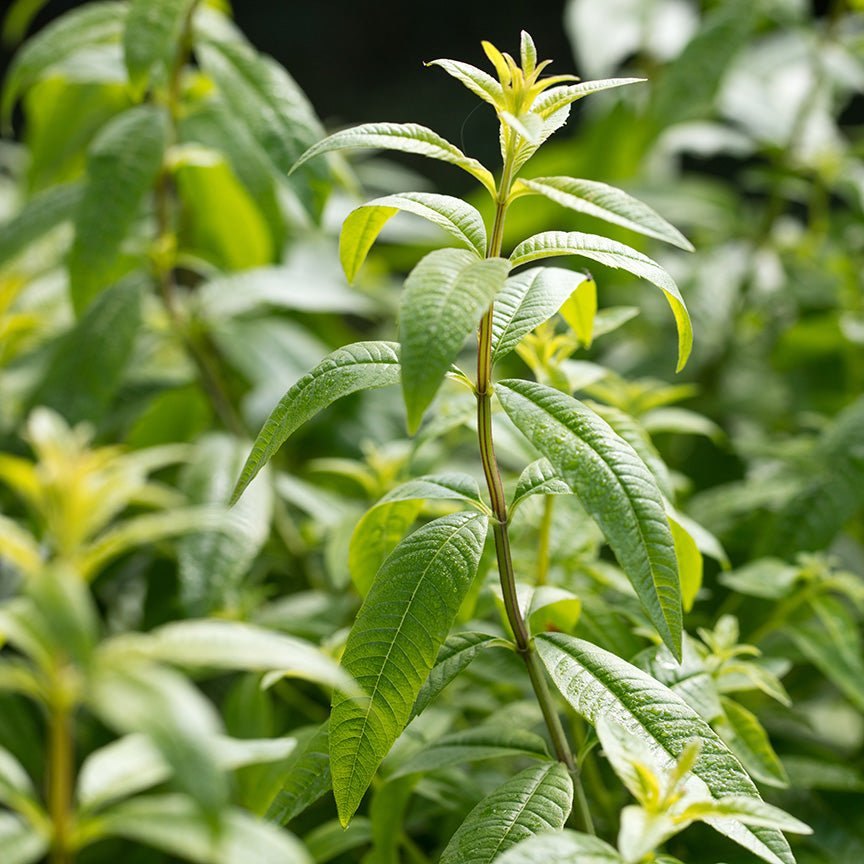
- Plant part
- Leaves
- Vietnamese name
- Cỏ roi ngựa chanh
- Scent family
- Citrus
- Plant family
- Verbenaceae
- Lots published
- —
 Leaves
Composition profile
The published composition from the article, read as structure: 5 compounds adding up to about 57 % of the sample. Figures are printed as the source gives them — one sample, not a species average.
| Compound | Level | Class | Note |
|---|---|---|---|
| Geranial EU | 18.7–21.1 % | Aldehydes | Middle |
| Neral EU | 15.3–16.2 % | Aldehydes | Middle |
| Spathulenol | 7.2–8.7 % | — | — |
| Limonene EU | 5.0–5.4 % | Monoterpenes | Top |
| Curcumene | 4.7–5.3 % | — | — |
By chemical class
- Aldehydes37.3 %
- Unclassified14.0 %
- Monoterpenes5.4 %
By note
- Top5.4 %
- Middle37.3 %
- Unclassified14.0 %
Group totals use the upper bound of each range and only the compounds the article lists; bars are relative to the identified total.
Compare with the 2 chemically closest oils Which other oils are rich in Geranial?
What lemon verbena is
Lemon verbena (Aloysia citrodora, formerly Lippia citriodora) is a South American shrub whose crushed leaves smell of sweet lemon. The dried leaves are used for tea in many countries. With the essential oil, the first thing to know is the regulation.
The oil is prohibited as a fragrance ingredient
- The IFRA Standard for verbena oil and absolute (49th Amendment, 2020) states that verbena oil should not be used as a fragrance ingredient, because of dermal sensitisation and phototoxicity. Only the absolute from Lippia citriodora may be used, with limits, for example a maximum of 0.69% in fine fragrance (category 4) and 0.17% in creams (categories 5A–5D).
- EU: Directive 2009/164/EU prohibits verbena essential oils and their derivatives (other than the absolute) when used as a fragrance ingredient, on the basis of their sensitising potential; the absolute may be used at a maximum of 0.2% in the finished product.
So this is an oil that should not be used in cosmetics, candles, room sprays or any fragranced product, including home-made ones.
Composition: two types of oil
| Compound | Portugal (2023) | Iran (2014) | Palestine, 3 sites (2024) | Jericho, Palestine (2024) |
|---|---|---|---|---|
| Geranial | 18.7–21.1% | 30.67–36.87% | 26.32–37.22% | 10.79% |
| Neral | 15.3–16.2% | 21.71–28.33% | 18.38–29.00% | 7.59% |
| Limonene | 5.0–5.4% | 6.07–7.27% | – | – |
| Curcumene | 4.7–5.3% (ar-) | – | 7.76–16.91% | 26.94% |
| Spathulenol | 7.2–8.7% | – | – | 13.69% |
The Portuguese sample was dried leaf; the Iranian samples covered several plant parts; the Palestinian samples were leaves of cultivated plants. A dash means it was not in the part we could read.
The table shows two types of oil. Most samples are the citral type (geranial plus neral 34–66%). But the Jericho sample, and a 2017 Moroccan study cited in the literature, belong to a low-citral type rich in curcumene, spathulenol and caryophyllene oxide, smelling more of spicy wood than of lemon. In Greece, citral falls from May to September while limonene rises, so the harvest season changes the oil too.
Its smell
Geranial gives the sharp lemon part, neral the softer, sweeter one; sesquiterpenes such as curcumene and spathulenol add a warm, slightly woody base. Compared with lemongrass and lemon myrtle, citral-type lemon verbena has less citral, so its lemon is softer and its base more complex.
Sources
- IFRA Standard: Verbena oil and absolute (Lippia citriodora Kunth.). Amendment 49, 2020.
- Commission Directive 2009/164/EU of 22 December 2009 amending Council Directive 76/768/EEC concerning cosmetic products.
- Sprea R.M., Fernandes L.H.M., Pires T.C.S.P. et al. (2023). Volatile Compounds and Biological Activity of the Essential Oil of Aloysia citrodora Palau: Comparison of Hydrodistillation and Microwave-Assisted Hydrodistillation. Molecules 28(11), 4528. doi:10.3390/molecules28114528
- Shahhoseini R., Hosseini N., Ghorbanpour M. (2014). Study of Essential Oil Content and Composition of Different Parts of Lemon verbena (Lippia citriodora) Grown in Iran. Journal of Essential Oil Bearing Plants 17(1), 120–125. doi:10.1080/0972060X.2013.854505
- Al-Maharik N., Salama Y., Al-Hajj N. et al. (2024). Chemical composition, anticancer, antimicrobial activity of Aloysia citriodora Palau essential oils from four different locations in Palestine. BMC Complementary Medicine and Therapies 24(1), 94. doi:10.1186/s12906-024-04390-9
Buy Lemon verbena
Lemon verbena oil: no lot has been brought in yet, so it is not on sale. Message us if you need it.
Where you may already have smelled it
According to the analyses cited above, this oil contains up to 21.1 % geranial. It is also the leading compound in the scenes below from the scent dictionary. Smelling one of those scenes again is a way to get to know it without opening a bottle. A shared compound does not mean the oil smells exactly like the scene.
Chemically close
The oils whose published composition is closest to this one, compared across every compound we could read. Close in composition does not mean the scent is identical or that one can replace the other.
- May chang Litsea cubeba shared: Geranial, Neral · closeness 0.93 · compare
- Lemon myrtle Backhousia citriodora shared: Geranial, Neral · closeness 0.92 · compare
- East Indian lemongrass Cymbopogon flexuosus shared: Geranial, Neral · closeness 0.91 · compare
Further reading
Close to Lemon verbena
Also from the leaves Cypress · Fragonia · Hemlock spruce · Honey myrtle · Kaffir lime leaf · Palmarosa · Patchouli · Red myrtle
Same method: direct steam distillation Baeckea · Davana · Kaffir lime leaf · Lemon myrtle · Opopanax · Perilla · Thyme ct linalool · Thyme ct thymol
Quick answers
What does lemon verbena essential oil smell like?
Lemon, but soft and sweet, with a floral, tea-like note that lemongrass lacks. It is more delicate than most lemon-scented oils.
What is the botanical name of lemon verbena oil?
The plant is Aloysia citrodora, in the Verbenaceae family. In Vietnamese it is called cỏ roi ngựa chanh.
How is lemon verbena oil produced?
From the leaves of the plant, by direct steam distillation. See the method for what that does to the oil.
Last updated