Perilla essential oil
Perilla frutescens
Tía tô · Lamiaceae
Green, warm, slightly spicy, with a note close to cumin and cinnamon that no other herb has. Anyone who has eaten rice porridge or noodles with tía tô will recognise it from the first breath.
That signature comes from perillaldehyde, a compound found almost only in this plant. Fresh leaves have an extra green, slightly fishy note from bruising, while the oil keeps the warm spice and loses the freshness.
Perilla has chemotypes too. The perillaldehyde-rich type is the one grown as a herb, and the smell you know. Other perilla lines are rich in perilla ketone, smell entirely different and are not eaten, so for this oil the lot analysis matters more than usual.
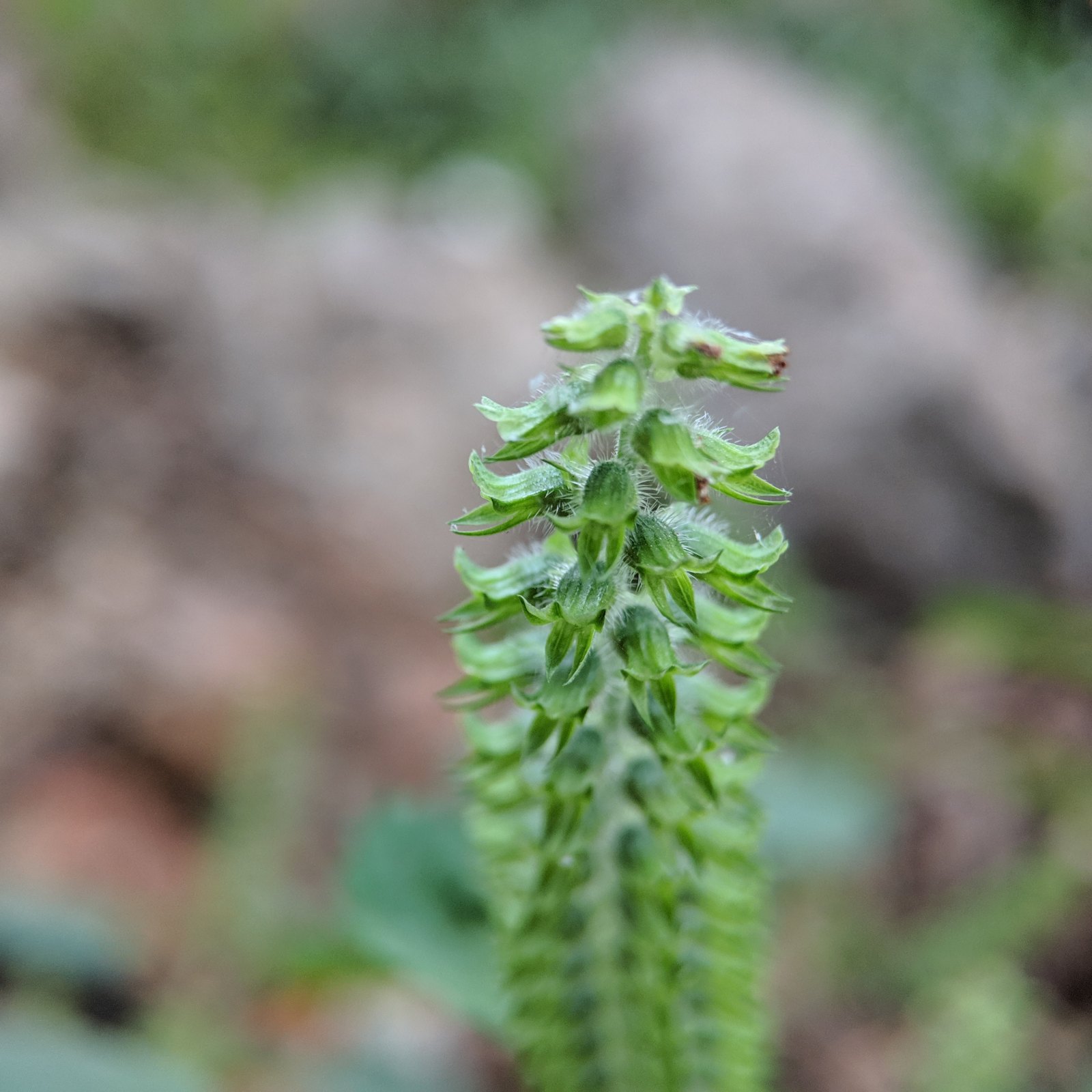
- Plant part
- Leaves
- Vietnamese name
- Tía tô
- Scent family
- Green
- Plant family
- Lamiaceae
- Lots published
- —
 Leaves
Composition profile
The published composition from the article, read as structure: 6 compounds adding up to about 59 % of the sample. Figures are printed as the source gives them — one sample, not a species average.
| Compound | Level | Class | Note |
|---|---|---|---|
| Limonene EU | 14.34 % | Monoterpenes | Top |
| Perillaldehyde | 14.07 % | Aldehydes | Base |
| Myristicin | 8.32 % | — | — |
| α-Bergamotene | 7.82 % | — | — |
| trans-Shisool | 7.75 % | — | — |
| β-Caryophyllene EU | 6.51 % | Sesquiterpenes | Base |
By chemical class
- Unclassified23.9 %
- Monoterpenes14.3 %
- Aldehydes14.1 %
- Sesquiterpenes6.5 %
By note
- Top14.3 %
- Base20.6 %
- Unclassified23.9 %
Group totals use the upper bound of each range and only the compounds the article lists; bars are relative to the identified total.
Put it beside another oil in the Compare tool Which other oils are rich in Limonene?
Perilla has at least eight chemotypes
Few plants give as many kinds of oil as perilla (Perilla frutescens). A 2009 study in Plant Systematics and Evolution distilled oil from the fresh leaves of 26 perilla accessions, mostly from Sichuan province, China, identified 49 compounds and sorted them into eight chemotypes:
| Code | Main compound |
|---|---|
| PA | Perillaldehyde |
| PK | Perilla ketone |
| DLP | Limonene and/or piperitone |
| PT | Piperitenone |
| MS | Myristicin |
| AL | Apiol |
| EM | Elemicin |
| DEK | Dehydroelsholtzia ketone |
The DLP, AL and DEK types were recorded for the first time in this study. The authors also followed two accessions through the seasons and found that the chemotype did not change with the season. One notable conclusion: classification by the form of leaf and stem does not always match the chemotype. Two plants that look alike can still give quite different oils.
A 2024 study groups them more simply: a monoterpene group with six types (PA, PK, perillene, piperitenone, citral, elsholtzia ketone), and a separate phenylpropanoid group.
The PA type is the kitchen perilla
The perilla note Vietnamese people know, in a bowl of rice porridge or on a plate of fresh herbs, comes from perillaldehyde, the main compound of the PA type. According to the 2024 study in Medicinal Plant Biology, the PA type is also the one recognised by the Chinese Pharmacopoeia as the medicinal perilla, and is the main aromatic ingredient in traditional preparations in China and Japan.
The PK type is different. The same 2024 study notes that perilla ketone has been considered a potent lung toxin. That is why perilla is not a plant where “any perilla leaf will do”. Outside the home garden, wild plants or cultivars of unknown origin may belong to a type other than the one grown as a herb.
Perilla grown in Vietnam: two samples, two types
Two studies that distilled oil from the leaves of perilla grown in Vietnam got quite different results:
| Compound | Leaves, steam-distilled (2021) | Leaves (2020) |
|---|---|---|
| Limonene | 14.34% | 1.04% |
| Perillaldehyde | 14.07% | 7.97% |
| Myristicin | 8.32% | 43.90% |
| α-Bergamotene | 7.82% | – |
| trans-Shisool | 7.75% | – |
| β-Caryophyllene | 6.51% | – |
| Elemicin | – | 28.79% |
| α-Humulene | – | 8.33% |
A dash means the compound is not in that paper's list of main compounds, not that it is absent. The 2020 paper writes “α-caryophyllene”, an older name for α-humulene.
The 2021 sample had 42 compounds; limonene and perillaldehyde lead, almost level, with a share of myristicin. The 2020 sample sits almost in the phenylpropanoid group: myristicin and elemicin together make up more than 70%, perillaldehyde under 8%, and the oil yield was only 0.1%.
In other words, in Vietnam too the name “perilla” does not guarantee the PA type.
What this means for buying the oil
For most essential oils, the species on the label already says a lot. For perilla it does not. A bottle labelled “Perilla frutescens” could be the familiar PA type, or a type rich in myristicin or elemicin, with an entirely different smell and different safety notes.
So for perilla, the lot analysis matters more than usual. The first things to check are whether the main compound is perillaldehyde, and whether perilla ketone is present at a significant level. The article on six questions to ask the seller has more pointers.
Sources
- Zhang X., Wu W., Zheng Y. et al. (2009). Essential oil variations in different Perilla L. accessions: chemotaxonomic implications. Plant Systematics and Evolution 281, 1–10. doi:10.1007/s00606-009-0152-1
- Research to complete the process of distillation of purple essential oil in Vietnam (Perilla frutescens var. crispa) and applications in food processing (2021). Journal of Science and Technology, Hanoi University of Industry, 57(6), 124. vjol.info.vn (abstract read)
- Evaluation of the physical and chemical properties of Vietnamese Perilla frutescens L. essential oil (2020). Asian Journal of Chemistry. doi:10.14233/ajchem.2020.22264 (abstract read)
- Yang S.M. et al. (2024). Analysis of monoterpene biosynthesis and functional TPSs of Perilla frutescens based on transcriptome and metabolome. Medicinal Plant Biology 3, e017. doi:10.48130/mpb-0024-0017
Buy Perilla
Perilla oil: no lot has been brought in yet, so it is not on sale. Message us if you need it.
In the scent dictionary: Perilla leaf — a description of the smell, the compounds behind it, and how to smell it for yourself.
Where you may already have smelled it
According to the analyses cited above, this oil contains up to 14.3 % limonene. It is also the leading compound in the scenes below from the scent dictionary. Smelling one of those scenes again is a way to get to know it without opening a bottle. A shared compound does not mean the oil smells exactly like the scene.
Further reading
Close to Perilla
Same plant family: Lamiaceae Bee balm · Bergamot mint · Catnip · Clary sage · Japanese mint · Melissa · Patchouli · Rosemary ct verbenone
Also from the leaves Engelmann spruce · Indian patchouli · Lemon verbena · Lolot pepper leaf · Melissa · Palmarosa · Sitka spruce · White spruce
Same method: direct steam distillation Engelmann spruce · Haitian vetiver · Lemon myrtle · Melissa · Peru balsam · Sitka spruce · White spruce · Wild ginger
Quick answers
What does perilla essential oil smell like?
Green, warm, slightly spicy, with a note close to cumin and cinnamon that no other herb has. Anyone who has eaten rice porridge or noodles with tía tô will recognise it from the first breath.
What is the botanical name of perilla oil?
The plant is Perilla frutescens, in the Lamiaceae family. In Vietnamese it is called tía tô.
How is perilla oil produced?
From the leaves of the plant, by direct steam distillation. See the method for what that does to the oil.
What are the main compounds of perilla oil?
From the composition data on this page, the oil is led by Limonene, Perillaldehyde and β-Caryophyllene. Proportions vary with origin, harvest and method; a lot analysis is the only answer for a given bottle.
Last updated