Essential oils · Woody & Resinous family
Scots pine essential oil
Pinus sylvestris
Thông Scotland · Pinaceae
Pine in the full sense: sharp, fresh, dry resin, like freshly sawn wood. This is the “pine forest” smell many people imagine.
Scots pine (Pinus sylvestris) is the most widely distributed pine of Europe and northern Asia. Its needle oil is usually dominated by α-pinene, with δ-3-carene, limonene and some bornyl acetate.
Being rich in monoterpenes, pine oil oxidises quickly in air, and old oil irritates skin more readily than fresh oil. Keep it tightly closed and use it within a short time of opening.
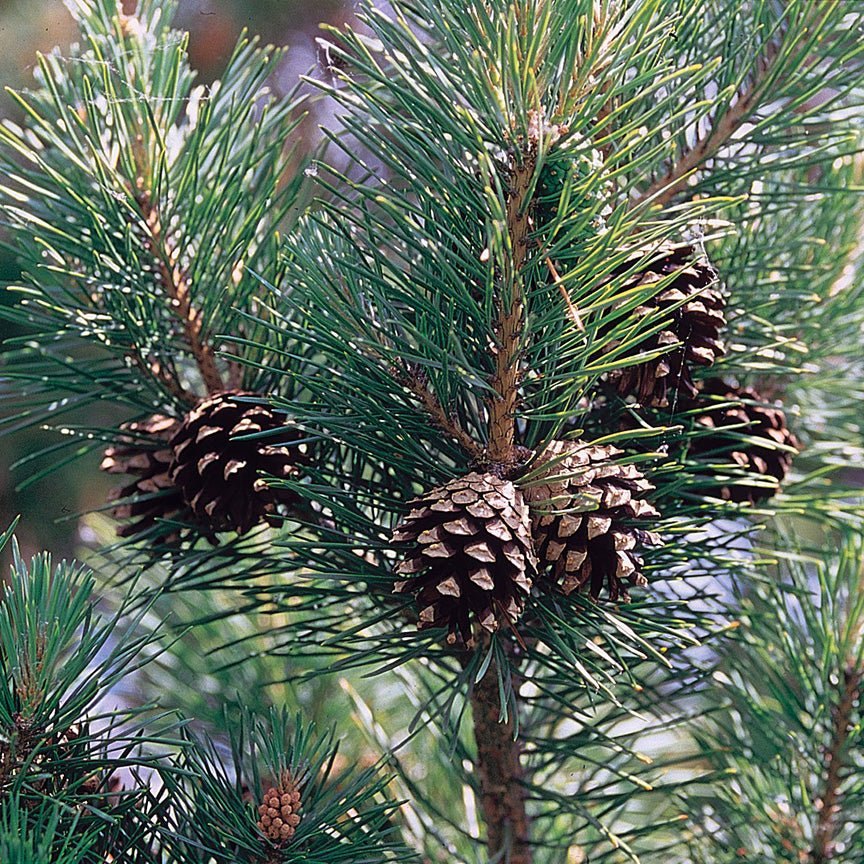
- Plant part
- Leaves
- Vietnamese name
- Thông Scotland
- Scent family
- Woody & Resinous
- Plant family
- Pinaceae
- Lots published
- —
 Leaves
Composition profile
The published composition from the article, read as structure: 6 compounds adding up to about 55 % of the sample. Figures are printed as the source gives them — one sample, not a species average.
| Compound | Level | Class | Note |
|---|---|---|---|
| α-Pinene EU | 7.0–16.1 % | Monoterpenes | Top |
| δ-3-Carene | 5.2–14.3 % | Monoterpenes | Top |
| α-Cadinol | 4.2–8.5 % | — | — |
| δ-Cadinene | 2.3–5.9 % | Sesquiterpenes | Base |
| β-Caryophyllene EU | 2.6–5.8 % | Sesquiterpenes | Base |
| Bornyl acetate | 1.1–3.9 % | — | — |
By chemical class
- Monoterpenes30.4 %
- Unclassified12.4 %
- Sesquiterpenes11.7 %
By note
- Top30.4 %
- Base11.7 %
- Unclassified12.4 %
Group totals use the upper bound of each range and only the compounds the article lists; bars are relative to the identified total.
Compare with the 2 chemically closest oils Which other oils are rich in α-Pinene?
Scots pine
Scots pine (Pinus sylvestris) is the most widely distributed pine in Europe and northern Asia, from Spain to Siberia. Its needle oil is the “pine forest” smell many people imagine: sharp, fresh, dry resin, with a note like freshly sawn wood. See the pine wood entry in the scent dictionary.
Three chemotypes
A 2020 study in Molecules analysed 36 Scots pine needle-and-twig oils and notes that the species can mainly be divided into three types: δ-3-carene, α-pinene and isoabienol. Among the 36 samples, α-pinene was the main compound in 19 and δ-3-carene in 14. The authors split the oils into a δ-3-carene-rich group (over 5%) and a low δ-3-carene group.
Which type dominates depends on region. A 1995 study found that Estonian Scots pines belong to a high δ-3-carene type, with that compound making up about 20–60% of the monoterpene fraction.
Composition in two regions
| Compound | Dried needles, northern Lithuania | Fresh needles, Bosnia |
|---|---|---|
| α-Pinene | 7.0–16.1% | 39.82% |
| δ-3-Carene | 5.2–14.3% | – |
| Bornyl acetate | 1.1–3.9% | – |
| β-Caryophyllene | 2.6–5.8% | – |
| δ-Cadinene | 2.3–5.9% | – |
| α-Cadinol | 4.2–8.5% | – |
The Lithuanian dried-needle oils (2008) had total monoterpene hydrocarbons of only 26.4–41.3%, while one fresh sample reached 71.0%. Dried needles lose much of their light compounds, so the oil leans towards heavy sesquiterpenes such as cadinene and cadinol, with a deeper woodiness. The fresh Bosnian sample (2024) had nearly 40% α-pinene, far brighter and more resinous.
How δ-3-carene and α-pinene differ
α-Pinene is clean, sharp pine resin. δ-3-Carene is sweeter and more pungent, somewhat woody. A carene-type Scots pine is therefore rounder and warmer than a pinene type. The analysis tells you which type a lot belongs to.
Storage and safety
Pine oils rich in monoterpenes oxidise quickly in air and light, and oxidised oil irritates skin more than fresh oil. Keep tightly closed and cool, use within a short time of opening, and dilute before use on skin.
Sources
- Allenspach M., Valder C., Flamm D. et al. (2020). Verification of Chromatographic Profile of Primary Essential Oil of Pinus sylvestris L. Combined with Chemometric Analysis. Molecules 25(13), 2973. doi:10.3390/molecules25132973
- Judzentiene A., Kupcinskiene E. (2008). Chemical composition on essential oils from needles of Pinus sylvestris L. grown in northern Lithuania. Journal of Essential Oil Research 20(1), 26–29. doi:10.1080/10412905.2008.9699413
- Mirkovic S., Tadic V., Milenkovic M.T. et al. (2024). Antimicrobial Activities of Essential Oils of Different Pinus Species from Bosnia and Herzegovina. Pharmaceutics 16(10), 1331. doi:10.3390/pharmaceutics16101331
- Orav A., Kailas T., Liiv M., Aav R. (1995). Capillary gas chromatographic analysis of the monoterpenoic fraction of Estonian conifer needle oil. Proceedings of the Estonian Academy of Sciences, Chemistry 44(2/3), 149–155. doi:10.3176/chem.1995.2/3.09
Buy Scots pine
Scots pine oil: no lot has been brought in yet, so it is not on sale. Message us if you need it.
Where you may already have smelled it
According to the analyses cited above, this oil contains up to 16.1 % α-pinene. It is also the leading compound in the scenes below from the scent dictionary. Smelling one of those scenes again is a way to get to know it without opening a bottle. A shared compound does not mean the oil smells exactly like the scene.
Chemically close
The oils whose published composition is closest to this one, compared across every compound we could read. Close in composition does not mean the scent is identical or that one can replace the other.
Further reading
Close to Scots pine
Same plant family: Pinaceae Atlas cedarwood · Balsam fir · Larch / Tamarack · Norway pine · Pinyon pine · Sitka spruce · White pine
Also from the leaves Indian patchouli · Larch / Tamarack · Lemon eucalyptus · Norway pine · Pinyon pine · Red myrtle · White pine · White spruce
Same method: direct steam distillation East Indian lemongrass · Eucalyptus dives · Honey myrtle · Larch / Tamarack · Myrrh · Norway pine · Pinyon pine · White pine
Quick answers
What does Scots pine essential oil smell like?
Pine in the full sense: sharp, fresh, dry resin, like freshly sawn wood. This is the “pine forest” smell many people imagine.
What is the botanical name of Scots pine oil?
The plant is Pinus sylvestris, in the Pinaceae family. In Vietnamese it is called thông scotland.
How is Scots pine oil produced?
From the leaves of the plant, by direct steam distillation. See the method for what that does to the oil.
What are the main compounds of Scots pine oil?
From the composition data on this page, the oil is led by α-Pinene, δ-3-Carene and δ-Cadinene. Proportions vary with origin, harvest and method; a lot analysis is the only answer for a given bottle.
Last updated