Essential oils · Woody & Resinous family
Mastic essential oil
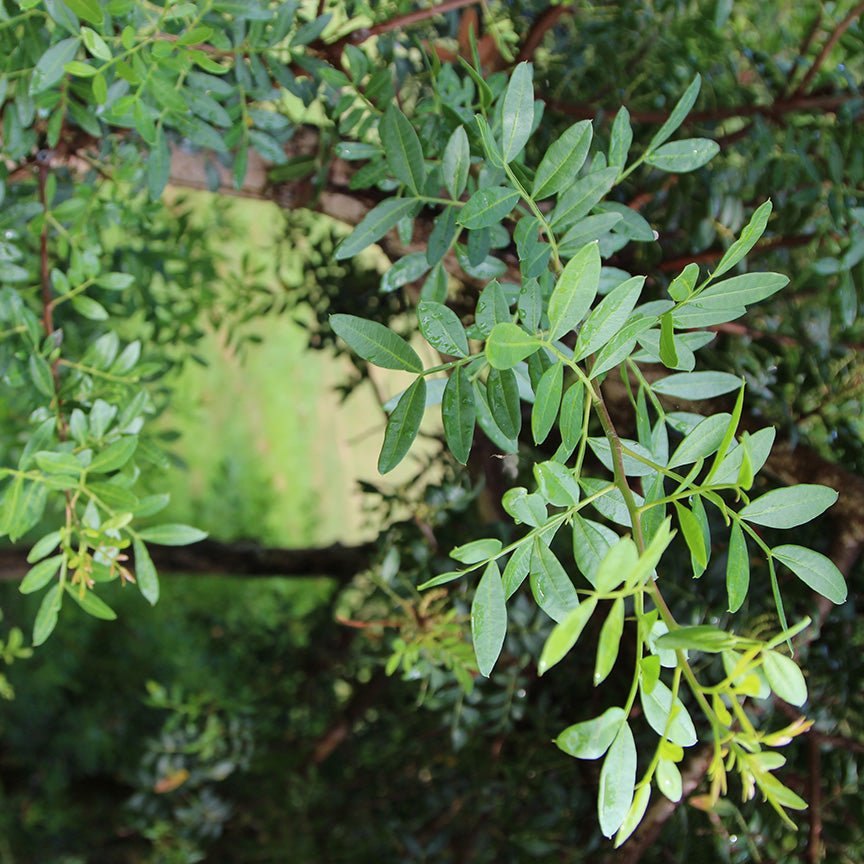
Pistacia lentiscus
Mastic · Anacardiaceae
Fresh resin, pine, slightly lemony, with a sweet balsamic note. It is clean and bright, close to pine resin but softer.
Mastic is the resin of Pistacia lentiscus, most famously from the Greek island of Chios, where it is collected by cutting the bark. The oil distilled from the resin is usually rich in α-pinene, with myrcene and other monoterpenes.
Chios mastic is a protected geographical indication in Europe. The resin has been known for thousands of years as a natural chewing gum.
- Plant part
- Resin
- Vietnamese name
- Mastic
- Scent family
- Woody & Resinous
- Plant family
- Anacardiaceae
- Lots published
- —
 Resin
Composition profile
The published composition from the article, read as structure: 5 compounds adding up to about 100 % of the sample. Figures are printed as the source gives them — one sample, not a species average.
| Compound | Level | Class | Note |
|---|---|---|---|
| α-Pinene EU | 56.4–73.0 % | Monoterpenes | Top |
| Myrcene | 12.6–19.9 % | Monoterpenes | Top |
| β-Caryophyllene EU | 2.21–6.38 % | Sesquiterpenes | Base |
| β-Pinene EU | 2.47–3.08 % | Monoterpenes | Top |
| Limonene EU | 1.24–1.98 % | Monoterpenes | Top |
By chemical class
- Monoterpenes98.0 %
- Sesquiterpenes6.4 %
By note
- Top98.0 %
- Base6.4 %
Group totals use the upper bound of each range and only the compounds the article lists; bars are relative to the identified total.
Compare with the 2 chemically closest oils Which other oils are rich in α-Pinene?
What mastic is
Mastic is the resin of Pistacia lentiscus var. chia, best known from the Greek island of Chios. Both Chios mastic gum and Chios mastic oil are Protected Designation of Origin (PDO) products in the EU. The European Pharmacopoeia has its own monograph for mastic, requiring at least 10 ml of oil per kg of anhydrous resin.
Composition: Chios gum oil
A 2021 study distilled 11 resin samples from the Chios Mastiha Growers Association following the European Pharmacopoeia method:
| Compound | Fresh oil (7 samples) | Oil about 2 years old | Resin over 10 years old |
|---|---|---|---|
| α-Pinene | 56.4–73.0% (mean 64.8) | 65.7% | 12.0% |
| Myrcene | 12.6–19.9% (mean 16.4) | lower | absent |
| β-Caryophyllene | 2.21–6.38% | lower | replaced by its oxide |
| β-Pinene | 2.47–3.08% | – | below 1% |
| Limonene | 1.24–1.98% | higher | absent |
| Verbenone, pinocarveol, α-campholenal | below 1% each | – | dominant |
The average yield was 14.7 ml of oil per kg of resin. Monoterpene hydrocarbons made up 86.01% of fresh oil but only 13.2% of oil from resin over 10 years old; very old resin gives almost no oil at all.
Verbenone: a marker of age
The table shows the most important thing about mastic: with time, α-pinene and myrcene oxidise into compounds such as verbenone, pinocarveol and α-campholenal. In fresh oil these are below 1%; in very old resin they become the main compounds. On an analysis, high verbenone is a sign of old oil or resin.
Not only Chios
A 2020 study from Izmir, Turkey, found similar results: two wild resin samples had 56.2% and 51.9% α-pinene, and 20.1% and 18.6% myrcene. The authors note that the enantiomer ratios of these two samples matched 45 authentic Chios oils. The cultivated sample was different: 70.8% α-pinene but only 2.5% myrcene.
Leaf and twig oil from the same variety is something else entirely: the leaves gave germacrene D 20.1%, myrcene 13.9% and β-caryophyllene 10.8%. A “mastic” rich in germacrene D is not resin oil.
Its smell
α-Pinene gives the bright, clean pine resin; myrcene adds a green, slightly balsamic, overripe-fruit note that makes mastic softer than ordinary pine resin. Old oil, high in verbenone, loses its freshness and leans towards a dry, camphoraceous smell.
Safety
Mastic belongs to the cashew family, not the pine family named in the IFRA standard on Pinaceae derivatives, but the principle is the same: pinene-rich oils oxidise quickly, and pinene must be labelled above a threshold under EU Regulation 2023/1545. Keep tightly closed and cool, and dilute before use on skin.
Sources
- Pachi V.K., Mikropoulou E.V., Dimou S. et al. (2021). Chemical Profiling of Pistacia lentiscus var. Chia Resin and Essential Oil: Ageing Markers and Antimicrobial Activity. Processes 9(3), 418. doi:10.3390/pr9030418
- Tabanca N., Nalbantsoy A., Kendra P.E. et al. (2020). Chemical Characterization and Biological Activity of the Mastic Gum Essential Oils of Pistacia lentiscus var. chia from Turkey. Molecules 25(9), 2136. doi:10.3390/molecules25092136
- Kivcak B., Akay S., Demirci B., Baser K.H.C. (2004). Chemical Composition of Essential Oils from Leaves and Twigs of Pistacia lentiscus, Pistacia lentiscus var. chia, and Pistacia terebinthus from Turkey. Pharmaceutical Biology 42(4–5), 360–366. doi:10.1080/13880200490519677
Buy Mastic
Mastic oil: no lot has been brought in yet, so it is not on sale. Message us if you need it.
Where you may already have smelled it
According to the analyses cited above, this oil contains up to 73 % α-pinene. It is also the leading compound in the scenes below from the scent dictionary. Smelling one of those scenes again is a way to get to know it without opening a bottle. A shared compound does not mean the oil smells exactly like the scene.
Chemically close
The oils whose published composition is closest to this one, compared across every compound we could read. Close in composition does not mean the scent is identical or that one can replace the other.
- Frankincense sacra Boswellia sacra shared: α-Pinene, Myrcene · closeness 0.97 · compare
- Pinyon pine Pinus edulis shared: α-Pinene, Myrcene · closeness 0.96 · compare
- Kunzea Kunzea ambigua shared: α-Pinene · closeness 0.92 · compare
Further reading
Close to Mastic
Same plant family: Anacardiaceae Pink pepper
Also from the resin Frankincense · Frankincense frereana · Frankincense sacra · Myrrh · Opopanax · Peru balsam
Same method: direct steam distillation Bergamot mint · Cajeput · Green myrtle · Hops · Manuka · May chang · Palmarosa · Red myrtle
Quick answers
What does mastic essential oil smell like?
Fresh resin, pine, slightly lemony, with a sweet balsamic note. It is clean and bright, close to pine resin but softer.
What is the botanical name of mastic oil?
The plant is Pistacia lentiscus, in the Anacardiaceae family. In Vietnamese it is called mastic.
How is mastic oil produced?
From the resin of the plant, by direct steam distillation. See the method for what that does to the oil.
What are the main compounds of mastic oil?
From the composition data on this page, the oil is led by α-Pinene, Myrcene and β-Caryophyllene. Proportions vary with origin, harvest and method; a lot analysis is the only answer for a given bottle.
Last updated