Essential oils · Floral family
Tuberose essential oil
Polianthes tuberosa
Hoa huệ · Asparagaceae
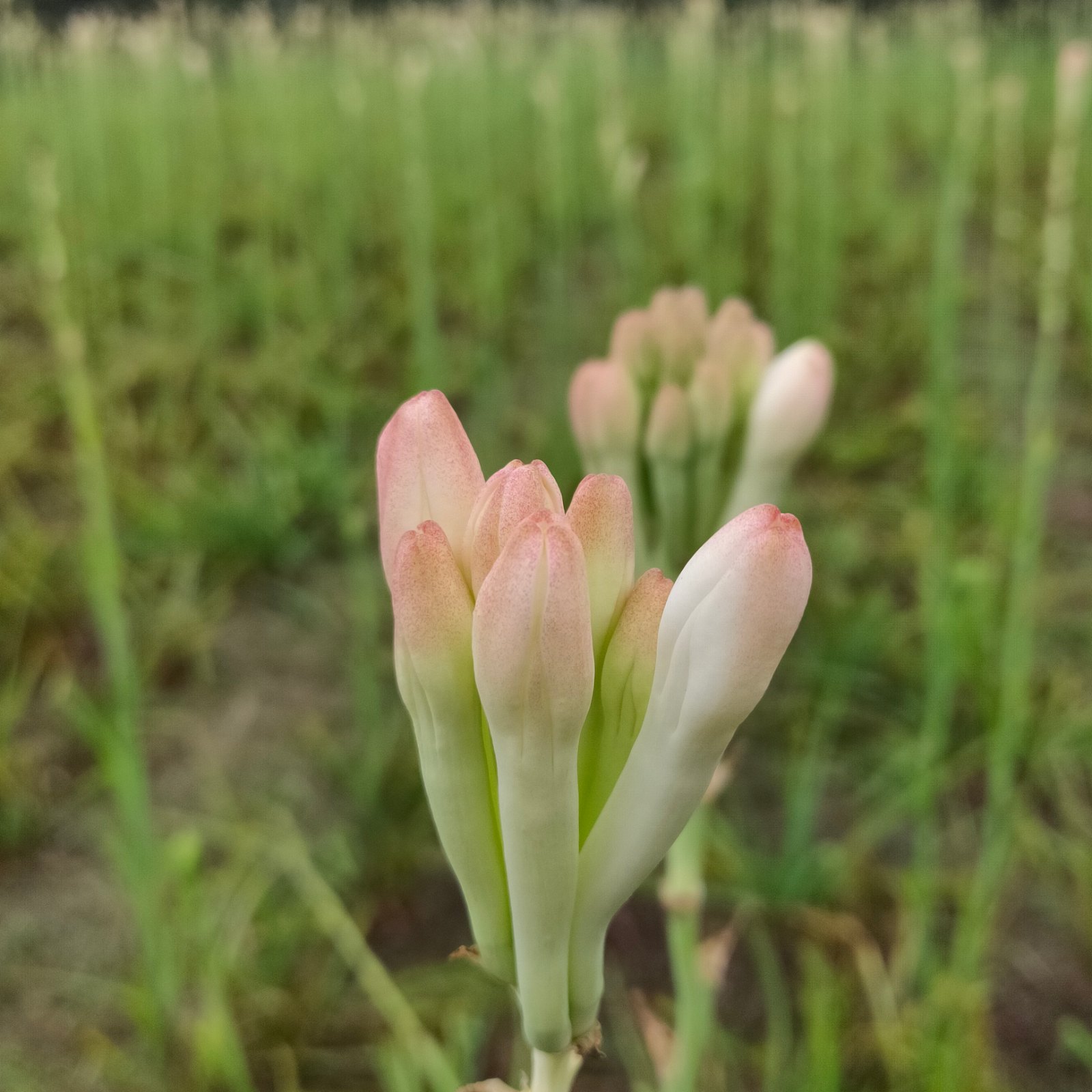
White flowers, dense, sweet and creamy, with a green, slightly rubbery opening that few other flowers have. It is one of the heaviest floral smells there is, and close up it is almost overwhelming.
Tuberose keeps releasing its scent after it has been picked, and most strongly at night. That is why, in the past, it was laid on cold fat for days to capture all of that scent rather than distilled. Today the product is an absolute extracted with solvent, and it remains among the most expensive raw materials.
Vietnamese people know this smell well, even if few call it tuberose: it is the bunch of white hoa huệ on the family altar on the full moon and the first day of the lunar month. Hoa huệ is not the same as hoa huệ tây — that is the Vietnamese name for the Easter lily, a completely different plant, and the two names are often mixed up.
- Plant part
- Flowers
- Method
- Enfleurage
- Vietnamese name
- Hoa huệ
- Scent family
- Floral
- Plant family
- Asparagaceae
- Lots published
- —
 Flowers
Composition profile
The published composition from the article, read as structure: 8 compounds adding up to about 96 % of the sample. Figures are printed as the source gives them — one sample, not a species average.
| Compound | Level | Class | Note |
|---|---|---|---|
| Methyl benzoate | 30.17 % | — | — |
| Benzyl benzoate | 23.64 % | — | — |
| 7-Decen-5-olide | 13.33 % | — | — |
| Methyl salicylate EU | 12.11 % | Esters | Middle |
| (E)-Methyl isoeugenol | 8.83 % | — | — |
| Methyl anthranilate | 4.45 % | Esters | Base |
| Methyl eugenol | 1.80 % | — | — |
| Indole | 1.78 % | Other compounds | Base |
By chemical class
- Unclassified77.8 %
- Esters16.6 %
- Other compounds1.8 %
By note
- Middle12.1 %
- Base6.2 %
- Unclassified77.8 %
Group totals use the upper bound of each range and only the compounds the article lists; bars are relative to the identified total.
What tuberose is
Tuberose is hoa huệ (Polianthes tuberosa), the white flower familiar on Vietnamese family altars. The plant is native to Mexico and now grown throughout the tropics. In perfumery tuberose is one of the heaviest and most expensive white-floral notes, in the same group as jasmine and ylang-ylang.
Tuberose does not survive distillation. The genuine product is an absolute, made by solvent extraction or, in the old way, by laying the flowers on fat (enfleurage).
The extraction method changes the composition
A 2009 study in Thailand compared four ways of extracting tuberose. The table shows two of them: cold enfleurage and hexane extraction.
| Compound | Cold enfleurage | Hexane |
|---|---|---|
| Methyl benzoate | 30.17% | – |
| Benzyl benzoate | 23.64% | 24.25% |
| 7-Decen-5-olide | 13.33% | 14.96% |
| Methyl salicylate | 12.11% | – |
| (E)-Methyl isoeugenol | 8.83% | 1.89% |
| Methyl anthranilate | 4.45% | – |
| Methyl eugenol | 1.80% | 1.07% |
| Indole | 1.78% | – |
Figures are relative peak-area percentages; a dash means the compound was not in the authors’ list for that sample.
The difference is large. The cold-enfleurage sample kept light, fast-evaporating compounds such as methyl benzoate and methyl salicylate, which very likely contribute to the green, sharp opening people mention when smelling fresh tuberose. The hexane sample lost almost all of that group and contained wax instead: pentacosane made up 19.23% of the hexane sample, an almost odourless compound.
Yields also differed: 0.3137% for cold enfleurage and 0.0279% for hexane, according to the authors’ table.
The compounds behind tuberose
- Methyl benzoate gives a sweet, slightly fruity and slightly harsh opening.
- Methyl salicylate is the main compound of wintergreen oil, the smell of muscle rub. In moderate amounts it gives tuberose a cool, slightly medicinal edge.
- 7-Decen-5-olide is a creamy lactone, contributing to tuberose’s rich, milky side.
- Methyl anthranilate and indole are shared by many white flowers: one gives a grape and orange-blossom note, the other an animalic note that gives a floral smell depth.
CO₂ extraction
A 2019 study in Processes extracted dried Mexican tuberose flowers with supercritical CO₂, with yields of 0.73–2.54%. In these samples benzyl benzoate made up 4.76–7.89%, methyl anthranilate 0.31–0.62%, and waxy compounds such as pentacosane remained abundant (6.15–11.06%).
Regulation and safety
Tuberose contains a little methyl eugenol, a substance restricted by IFRA. Methyl salicylate is on the EU list of cosmetic ingredients that must be labelled above a threshold. Tuberose absolute is concentrated and should always be diluted, and the analysis of a lot should give a specific figure for methyl eugenol.
Sources
- Rakthaworn P., Dilokkunanant U., Sukkatta U. et al. (2009). Extraction Methods for Tuberose Oil and Their Chemical Components. Kasetsart Journal (Natural Science) 43(5), 204–211.
- Fragoso-Jimenez J.C., Tapia-Campos E., Estarron-Espinosa M. et al. (2019). Effect of Supercritical Fluid Extraction Process on Chemical Composition of Polianthes tuberosa Flower Extracts. Processes 7(2), 60. doi:10.3390/pr7020060
Buy Tuberose
Tuberose oil: no lot has been brought in yet, so it is not on sale. Message us if you need it.
Where you may already have smelled it
According to the analyses cited above, this oil contains up to 12.1 % methyl salicylate. It is also part of, though not the lead in, the scenes below from the scent dictionary. Smelling one of those scenes again is a way to get to know it without opening a bottle. A shared compound does not mean the oil smells exactly like the scene.
Further reading
Close to Tuberose
Also from the flowers Champaca · Clary sage · Lavandin · Linden blossom · Night jasmine · Osmanthus · Rose absolute · Rose otto
Quick answers
What does tuberose essential oil smell like?
White flowers, dense, sweet and creamy, with a green, slightly rubbery opening that few other flowers have. It is one of the heaviest floral smells there is, and close up it is almost overwhelming.
What is the botanical name of tuberose oil?
The plant is Polianthes tuberosa, in the Asparagaceae family. In Vietnamese it is called hoa huệ.
How is tuberose oil produced?
From the flowers of the plant, by enfleurage. See the method for what that does to the oil.
What are the main compounds of tuberose oil?
From the composition data on this page, the oil is led by Methyl salicylate, Methyl anthranilate and Indole. Proportions vary with origin, harvest and method; a lot analysis is the only answer for a given bottle.
Last updated