Essential oils · Floral family
Ylang ylang essential oil
Cananga odorata
Ngọc lan tây · Annonaceae
Sweet, dense, creamy, with a note of ripe banana in the middle. It is one of the heaviest floral smells, and close up it is almost overwhelming.
The flowers are distilled continuously for many hours and the oil is drawn off in fractions over time. The first fraction is called extra, the brightest and most floral; the later fractions grow deeper and lean towards wood. “Complete” is all of them together.
So two bottles both labelled ylang ylang can be far apart, depending on which fraction they are. This is an oil to smell at arm’s length first, because up close it hides the very layers most worth smelling.
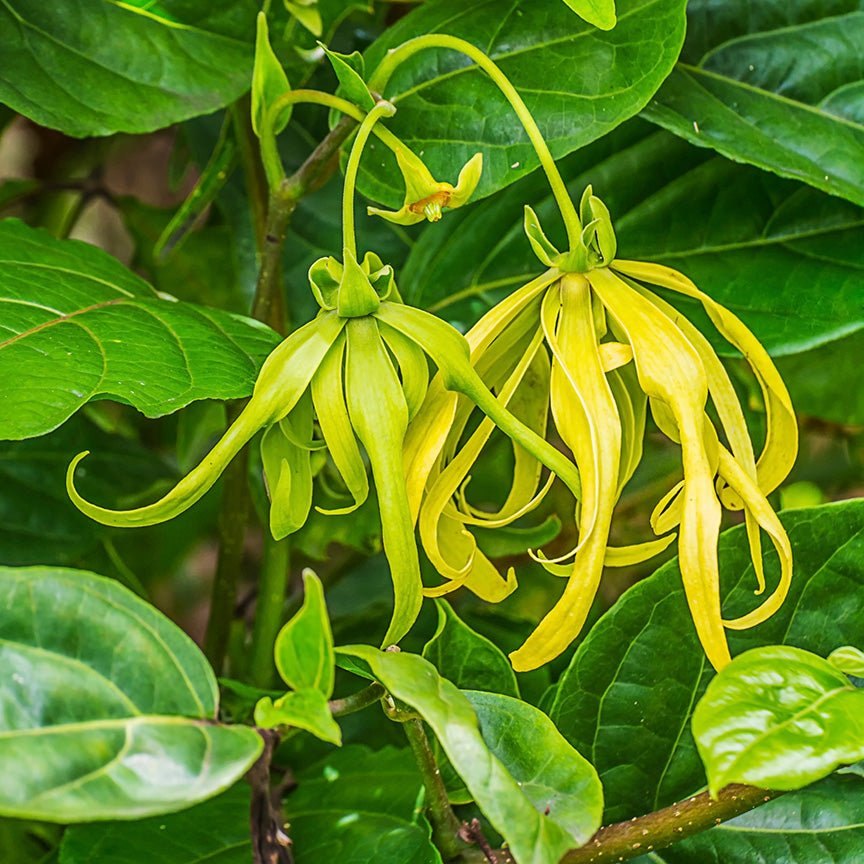
- Plant part
- Flowers
- Vietnamese name
- Ngọc lan tây
- Scent family
- Floral
- Plant family
- Annonaceae
- Lots published
- —
 Flowers
Composition profile
The composition in the article, read as structure: 9 compounds, each with its chemical class and note. The article gives only a standard’s permitted ranges, not measurements.
| Compound | Level | Class | Note |
|---|---|---|---|
| Germacrene D | 14–20 % | Sesquiterpenes | Base |
| Benzyl acetate | 11–17.5 % | Esters | Middle |
| α-Farnesene | 6.5–15 % | Sesquiterpenes | Base |
| p-Cresyl methyl ether | 5–13 % | — | — |
| Linalool EU | 7–12 % | Alcohols | Middle |
| β-Caryophyllene EU | 2.5–8 % | Sesquiterpenes | Base |
| Methyl benzoate | 4–6.5 % | — | — |
| Geranyl acetate | 2.5–6 % | — | — |
| Benzyl benzoate | 4–6 % | — | — |
No group totals: these are a standard’s permitted ranges, and adding ranges does not give the composition of any real sample.
Put it beside another oil in the Compare tool Which other oils are rich in Germacrene D?
Extra, I, II, III and complete
Ylang ylang is one of the few essential oils sold by fraction rather than as a single grade. The flowers of Cananga odorata are distilled continuously for many hours, and the oil is collected in fractions over time:
| Fraction | Collected | Smell |
|---|---|---|
| Extra | the first hours | bright, the most floral and fruity |
| I (first) | next | floral, fuller |
| II (second) | midway | deeper, less bright |
| III (third) | at the end | woody, spicy, the heaviest |
| Complete | all combined, or distilled in one run | the whole range |
ISO 3063 is a standard dedicated to ylang ylang oil, and the fractions are described with their own requirements. The early fractions hold the light, fast-evaporating compounds, including linalool and esters. The late fractions hold the heavier sesquiterpenes.
The consequence for buyers is simple. A bottle labelled only “ylang ylang” without the fraction does not say enough. Extra and III differ almost as two different oils, and their prices are far apart. If the label does not say, ask.
Composition fraction by fraction
The French edition of that standard, NF ISO 3063 (AFNOR, 2005), gives the allowed range of each compound in each fraction, separately for oil from the Comoros and oil from Madagascar. The table below takes the Comoros columns, from the comparison table in a 2025 study in Plants:
| Compound (NF ISO 3063, Comoros oil) | Extra | First | Second | Third |
|---|---|---|---|---|
| p-Cresyl methyl ether | 5–13% | 3–8.5% | 2–5% | 0.1–1% |
| Methyl benzoate | 4–6.5% | 1.5–5.5% | 1–3.5% | 0.1–0.8% |
| Linalool | 7–12% | 3–10% | 2–6% | 0.1–2% |
| Benzyl acetate | 11–17.5% | 6–14% | 4–8.8% | 0.5–3% |
| Geranyl acetate | 2.5–6% | 2–5% | 1.7–6% | 0.4–3% |
| β-Caryophyllene | 2.5–8% | 4–10% | 4.8–14% | 5–15% |
| Germacrene D | 14–20% | 10–24% | 16–28% | 20–35% |
| (E,E)-α-Farnesene | 6.5–15% | 7–18% | 14–21% | 12–29% |
| Benzyl benzoate | 4–6% | 4.2–9.2% | 4.5–7.8% | 4–8% |
Read across the rows and you see the story of the still. Benzyl acetate, which gives the sweet floral note, goes from 11–17.5% in the Extra fraction down to 0.5–3% in the Third. p-Cresyl methyl ether and methyl benzoate fall the same way. Germacrene D and α-farnesene, by contrast, are sesquiterpenes, heavy and slow to evaporate, so they rise and make up much of the Third fraction. That is why the Third leans towards wood and spice.
Origin also makes two bottles differ. In the same Extra fraction, oil from Madagascar under the standard has less benzyl acetate (5.5–14%) and more geranyl acetate (7–14%) than oil from the Comoros.
Not the same as cananga
Ylang ylang (Cananga odorata forma genuina) has a close relative, Cananga odorata forma macrophylla, whose oil is sold as cananga. Cananga oil is cheaper, coarser and more woody and leathery. Vietnam has its own standard for it, TCVN 13143:2020, adopting ISO 3523:2002. The two oils are often swapped on the market, so a botanical name on the label that includes the forma is a good sign.
Many compounds that must appear on cosmetic labels
Ylang ylang oil contains several compounds on the list of fragrance allergens that the European Union requires to be named on cosmetic labels above a threshold, such as linalool, benzyl benzoate, benzyl salicylate and geraniol. That is why ylang ylang should always be diluted for skin use, and people prone to fragrance allergy should test it first on a small patch of skin. The dilution page gives the figures.
Sources
- ISO 3063. Oil of ylang-ylang (Cananga odorata (Lam.) Hook. f. et Thomson forma genuina).
- Chakira A., Soria C., Lallemand L. et al. (2025). Improving the Quality of Ylang-Ylang Essential Oils Cananga odorata (Lam.) Hook.f. & Thomson] Through Microwave-Assisted Extraction Compared to Conventional Extraction Methods. Plants 14(20), 3217. [doi:10.3390/plants14203217 (Appendix A, Table A1: comparison with NF ISO 3063)
- TCVN 13143:2020 (ISO 3523:2002). Oil of cananga, macrophylla type.
- Regulation (EU) 2023/1545 on the labelling of fragrance allergens in cosmetic products.
Buy Ylang ylang
Ylang ylang oil: no lot has been brought in yet, so it is not on sale. Message us if you need it.
In the scent dictionary: Ylang-ylang — a description of the smell, the compounds behind it, and how to smell it for yourself.
Where you may already have smelled it
According to the analyses cited above, this oil contains up to 17.5 % benzyl acetate. It is also the leading compound in the scenes below from the scent dictionary. Smelling one of those scenes again is a way to get to know it without opening a bottle. A shared compound does not mean the oil smells exactly like the scene.
Further reading
Close to Ylang ylang
Also from the flowers Clary sage · Clove bud · Helichrysum · Lavender · Osmanthus · Pomelo blossom · Spike lavender · St John’s wort
Same method: direct steam distillation Black spruce · Cajeput · Carrot seed · Frankincense · Frankincense frereana · Frankincense sacra · Frankincense serrata · Vetiver
Quick answers
What does ylang ylang essential oil smell like?
Sweet, dense, creamy, with a note of ripe banana in the middle. It is one of the heaviest floral smells, and close up it is almost overwhelming.
What is the botanical name of ylang ylang oil?
The plant is Cananga odorata, in the Annonaceae family. In Vietnamese it is called ngọc lan tây.
How is ylang ylang oil produced?
From the flowers of the plant, by direct steam distillation. See the method for what that does to the oil.
What are the main compounds of ylang ylang oil?
From the composition data on this page, the oil is led by Germacrene D, Benzyl acetate and α-Farnesene. Proportions vary with origin, harvest and method; a lot analysis is the only answer for a given bottle.
Last updated