Essential oils · Floral family
Lavandin essential oil
Lavandula × intermedia
Hoa oải hương lai · Lamiaceae
Lavender, but louder, sharper, with clear camphor at the top. The sweet floral part is still there, but a cool edge rises over it.
That cool edge is camphor and 1,8-cineole, inherited from spike lavender. Linalool and linalyl acetate, inherited from true lavender, give the floral part.
Beside true lavender, lavandin sounds “louder” but less refined. That is why it is cheaper, and why it is so often blended into bottles labelled lavender.
- Plant part
- Flowers
- Vietnamese name
- Hoa oải hương lai
- Scent family
- Floral
- Plant family
- Lamiaceae
- Lots published
- —
 Flowers
Also made another way
The “Method” field above gives the usual commercial method. The lines below are other documented methods, each giving a different product.
- Water-distilled lavandin oil · Water distillation Water distillation keeps 13.7 % linalyl acetate against 21.8 % with steam, from the same flowers. Source: A. Filly et al. (2016), Comptes Rendus Chimie 19(6): 707–717
Composition profile
The published composition from the article, read as structure: 4 compounds adding up to about 74 % of the sample. Figures are printed as the source gives them — one sample, not a species average.
| Compound | Level | Class | Note |
|---|---|---|---|
| Linalool EU | 34.2 % | Alcohols | Middle |
| Linalyl acetate EU | 27.2 % | Esters | Middle |
| Camphor EU | 7.2 % | Ketones | Middle |
| 1,8-Cineole | 5.7 % | Oxides | Top |
By chemical class
- Alcohols34.2 %
- Esters27.2 %
- Ketones7.2 %
- Oxides5.7 %
By note
- Top5.7 %
- Middle68.6 %
Group totals use the upper bound of each range and only the compounds the article lists; bars are relative to the identified total.
Compare with the 2 chemically closest oils Which other oils are rich in Linalool?
What lavandin is
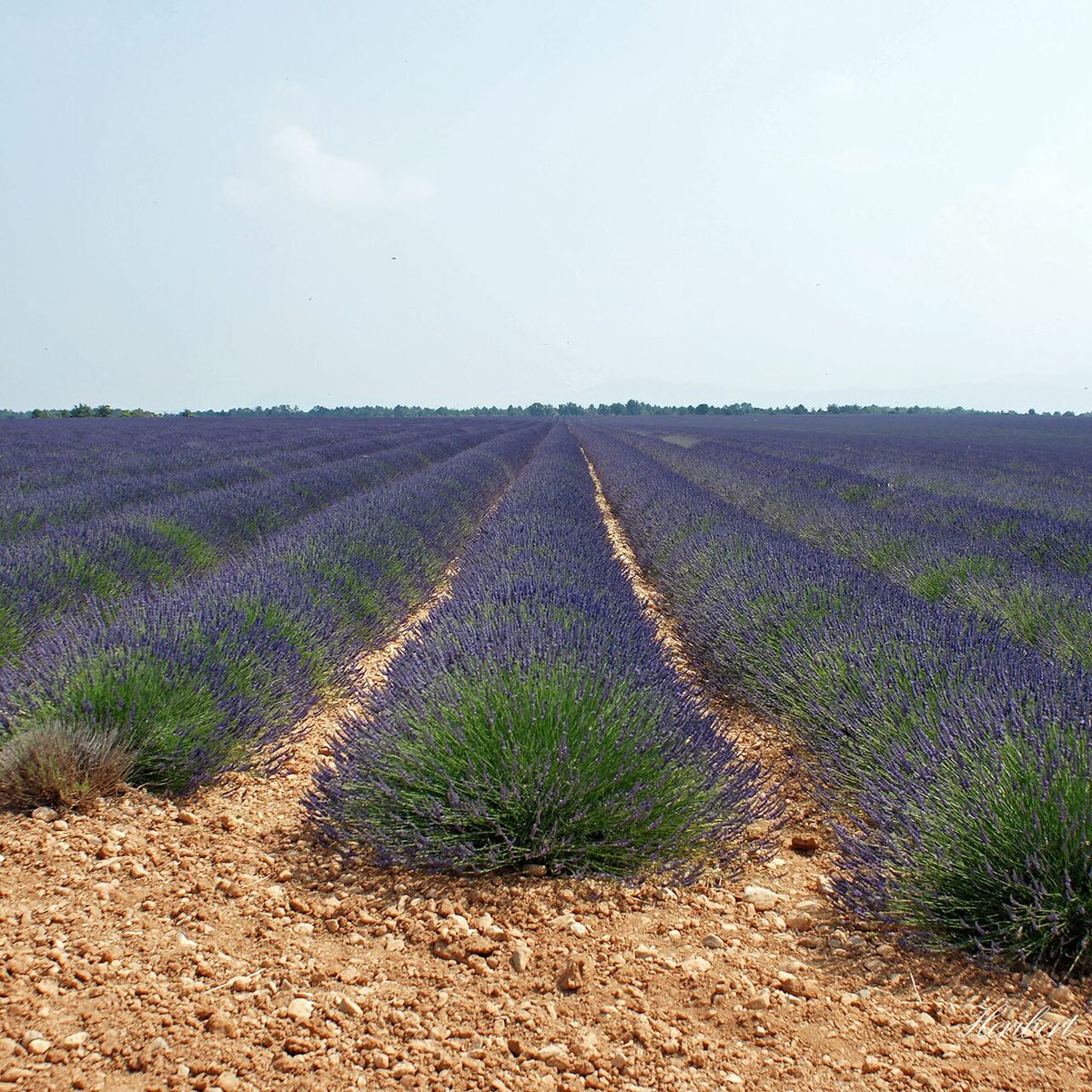
Lavandin (Lavandula × intermedia) is a natural hybrid of true lavender (L. angustifolia) and spike lavender (L. latifolia). The hybrid is larger, hardier and yields far more oil than its parents, so much of the “lavender” grown for oil in Provence and Spain is in fact lavandin.
As a hybrid, its oil sits between the two parents: the linalool and linalyl acetate of true lavender, plus camphor and 1,8-cineole from spike lavender.
Composition: the camphor signature
A 2022 study in Molecules grew seven true lavender cultivars and eight lavandin cultivars on the same plots in Ukraine and compared their oils.
In both species, linalool (26.14–57.07%) and linalyl acetate (9.08–24.45%) were the two main compounds. The difference lies in the compounds that follow:
| Next group in true lavender | Next group in lavandin |
|---|---|
| Terpinen-4-ol 2.16–22.44% | Camphor 10.11–12.55% |
| Lavandulyl acetate 2.12–10.23% | Borneol 5.49–8.71% |
| Lavandulol 1.30–3.14% | 1,8-Cineole 0.47–7.41% |
The authors also note that their true lavender samples did not meet industry standards, mainly because of high terpinen-4-ol, a feature of these new cultivars.
A 2024 study analysing 215 oils from the two most common lavandin clones in Spain points the same way:
| Compound (mean) | ‘Grosso’ | ‘Super’ |
|---|---|---|
| Linalool | 34.2% | 35.8% |
| Linalyl acetate | 27.2% | 33.7% |
| Camphor | 7.2% | 5.0% |
| 1,8-Cineole | 5.7% | 3.8% |
‘Super’ is richer in linalyl acetate and lower in camphor and cineole, which makes it closer to true lavender in composition. The authors also found considerable variation within each clone.
Spotting lavandin in a bottle of “lavender”
Lavandin is much cheaper than true lavender, so it is often blended in or sold in its place. Two signs in an analysis:
- High camphor. Camphor is not among the main compounds of true lavender; camphor at 5–12% as in the tables above points to lavandin, or to spike lavender.
- Low lavandulyl acetate. In the 2022 study it was one of the characteristic compounds of true lavender, and not among the main compounds of lavandin.
On labels, lavandin is usually called “lavandin”, often with the clone name, such as Grosso, Super or Abrial. A bottle labelled “lavender” without L. angustifolia does not tell you which you have.
Sources
- Pokajewicz K., Bialon M., Svydenko L. et al. (2022). Comparative Evaluation of the Essential Oil of the New Ukrainian Lavandula angustifolia and Lavandula x intermedia Cultivars Grown on the Same Plots. Molecules 27, 2152. doi:10.3390/molecules27072152
- Ortiz de Elguea-Culebras G. et al. (2024). Essential oils of lavandin (Lavandula x intermedia Emeric ex Loisel.) of Spain: A case study on clones ‘Grosso’ and ‘Super’. Journal of Applied Research on Medicinal and Aromatic Plants 41, 100550. doi:10.1016/j.jarmap.2024.100550
Buy Lavandin
Lavandin oil: no lot has been brought in yet, so it is not on sale. Message us if you need it.
Where you may already have smelled it
According to the analyses cited above, this oil contains up to 34.2 % linalool. It is also the leading compound in the scenes below from the scent dictionary. Smelling one of those scenes again is a way to get to know it without opening a bottle. A shared compound does not mean the oil smells exactly like the scene.
Chemically close
The oils whose published composition is closest to this one, compared across every compound we could read. Close in composition does not mean the scent is identical or that one can replace the other.
- Lavender Lavandula angustifolia shared: Linalool, Linalyl acetate · closeness 0.94 · compare
- Petitgrain Citrus aurantium var. amara shared: Linalyl acetate, Linalool · closeness 0.87 · compare
- Clary sage Salvia sclarea shared: Linalyl acetate, Linalool · closeness 0.80 · compare
Further reading
Close to Lavandin
Same plant family: Lamiaceae Basil ct linalool · Basil ct methyl chavicol · Holy basil (tulsi) · Indian patchouli · Lavender · Patchouli · Peppermint · Vietnamese balm
Also from the flowers Blue tansy · Clary sage · Linden blossom · Lotus · Night jasmine · Saffron · Tagetes · Ylang ylang
Same method: direct steam distillation Cornmint · Cupressus · Frankincense serrata · Honey myrtle · Indian patchouli · Manuka · Patchouli · Ponderosa pine
Quick answers
What does lavandin essential oil smell like?
Lavender, but louder, sharper, with clear camphor at the top. The sweet floral part is still there, but a cool edge rises over it.
What is the botanical name of lavandin oil?
The plant is Lavandula × intermedia, in the Lamiaceae family. In Vietnamese it is called hoa oải hương lai.
How is lavandin oil produced?
From the flowers of the plant, by direct steam distillation. See the method for what that does to the oil.
What are the main compounds of lavandin oil?
From the composition data on this page, the oil is led by Linalool, Linalyl acetate and Camphor. Proportions vary with origin, harvest and method; a lot analysis is the only answer for a given bottle.
Last updated