Essential oils · Floral family
Clary sage essential oil
Salvia sclarea
Xô thơm hương · Lamiaceae
Hay, tea, slightly sweet, with a warm musky note underneath. Hard to file as flower or leaf, because it stands in between.
The main compound is linalyl acetate, as in lavender, so the two share a soft sweetness. What sets clary sage apart is that musky layer, and it lasts much longer than lavender.
This plant also yields sclareol, the raw material the fragrance industry uses to make ambergris substitutes. In other words, part of the “marine musk” in a great many modern perfumes traces back to a plant growing in a field — and if you smell the oil carefully you can hear that family resemblance.
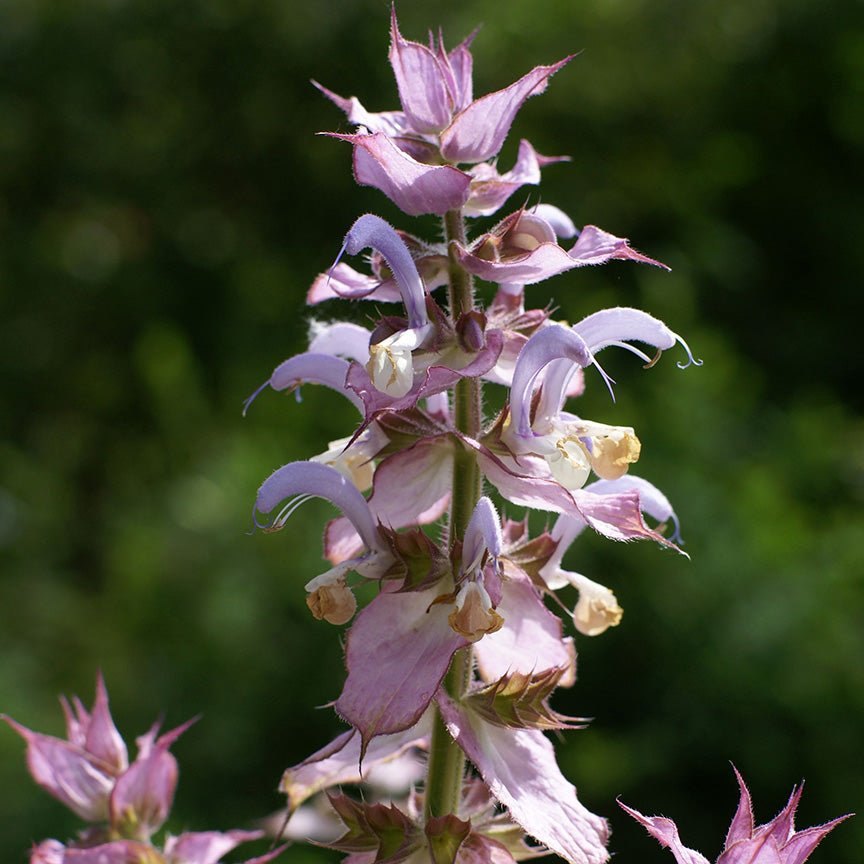
- Plant part
- Flowers
- Vietnamese name
- Xô thơm hương
- Scent family
- Floral
- Plant family
- Lamiaceae
- Lots published
- —
 Flowers
Composition profile
The published composition from the article, read as structure: 4 compounds adding up to about 100 % of the sample. Figures are printed as the source gives them — one sample, not a species average.
| Compound | Level | Class | Note |
|---|---|---|---|
| Linalyl acetate EU | 55–78 % | Esters | Middle |
| Linalool EU | 6.5–25 % | Alcohols | Middle |
| Germacrene D | 1–12 % | Sesquiterpenes | Base |
| α-Terpineol EU | 0–5 % | Alcohols | Middle |
By chemical class
- Esters78.0 %
- Alcohols30.0 %
- Sesquiterpenes12.0 %
By note
- Middle100.0 %
- Base12.0 %
Group totals use the upper bound of each range and only the compounds the article lists; bars are relative to the identified total.
Compare with the 2 chemically closest oils Which other oils are rich in Linalyl acetate?
One plant, two products
Clary sage (Salvia sclarea) is a biennial native to the Mediterranean basin and Western Asia, now grown widely in France, Hungary and Bulgaria, as well as North America and China. According to a 2021 study in Horticulture Research, the plant is grown for two linked products:
- The essential oil, steam distilled from fresh inflorescences. Its main compounds are linalyl acetate and linalool, the same pair as in lavender.
- Sclareol, a diterpene that barely evaporates. After the oil has been distilled off, the remaining plant material is extracted with an organic solvent to recover the sclareol.
In other words, the spent material from clary sage distillation is not waste. It is the raw material for a second product.
Composition
A 2024 assessment by the European Food Safety Authority (EFSA) of clary sage oil as a feed additive sets a specification based on the European Pharmacopoeia monograph, for oil steam-distilled from flowering stems in France or Russia. The last column is three wild populations in Sicily (Italy) from a 2021 study, distilled from dried inflorescences:
| Compound | EFSA specification | Wild Sicily (2021) |
|---|---|---|
| Linalyl acetate | 55–78% | 38.73–41.63% |
| Linalool | 6.5–25% | 22.42–25.55% |
| Germacrene D | 1–12% | 3.61–4.50% |
| α-Terpineol | 0–5% | 5.76–7.14% |
| Sclareol | – | 2.93–5.50% |
The three batches EFSA analysed all fell within the specification: linalyl acetate 61.87–74.84% (mean 68.28%), linalool 10.88–17.91%, germacrene D 3.57–4.50% and α-terpineol 0.55–2.64%. The Sicilian samples also had geranyl acetate 2.64–3.04%, β-caryophyllene 2.00–2.66% and neryl acetate 1.54–1.71%. Thujone was not detected in the batches EFSA analysed (limit of detection 0.001%). A dash means it was not reported.
ISO has published a standard specific to French-type clary sage oil, ISO 24255:2025. We have not been able to read its limits.
Reading the table
Commercial oil is an ester oil: linalyl acetate makes up about two-thirds and linalool about a seventh. The wild Sicilian populations show that the same species can lean strongly towards linalool and α-terpineol, with linalyl acetate only about 40%. Sclareol barely evaporates, so it makes up only a few per cent of the distilled oil; most of the sclareol stays behind in the spent material, as described above.
Sclareol and the smell of ambergris
Ambergris is a waxy substance formed in the gut of sperm whales, long prized in perfumery for its particular smell and its fixative power. According to the 2021 study, most of those qualities come from one constituent, ambroxide.
Strong demand for ambergris-type odorants drove the search for synthetic routes to ambroxide. The most common route today is semi-synthesis from clary sage sclareol. So part of the “marine”, “amber” smell in modern perfume comes from a field crop rather than a whale.
Where sclareol is made in the plant
The 2021 study answered a specific question: where sclareol is made. The authors showed that it accumulates mainly in the flower calyces, inside the cells of glandular trichomes. They also found an almost hairless mutant, named beardless, and showed that more than 90% of sclareol is produced by the large capitate glandular trichomes. The mutant also had less linalyl acetate.
Put simply, the density of glandular trichomes on the calyx determines the plant’s sclareol content and part of its linalyl acetate content.
Reading the label
On the market, “clary sage” can mean the distilled essential oil, a solvent extract, or purified sclareol. The three differ in composition and smell, so the label should state how the product was obtained. Also, do not confuse clary sage with common sage (Salvia officinalis), a species in the same genus whose oil is rich in thujone, with an entirely different smell and different safety notes.
Safety
EFSA classes clary sage oil as irritant to skin and eyes and as a dermal and respiratory sensitiser for people who handle it. Linalool is on the EU list of fragrance allergens that must be named on cosmetic labels. Store the oil tightly closed in a cool, dark place, and always dilute before use on skin.
Sources
- Chalvin C., Drevensek S., Gilard F. et al. (2021). Sclareol and linalyl acetate are produced by glandular trichomes through the MEP pathway. Horticulture Research 8, 206. doi:10.1038/s41438-021-00640-w
- EFSA FEEDAP Panel (2024). Safety and efficacy of a feed additive consisting of an essential oil derived from the flowering stems of Salvia sclarea L. (clary sage oil) for use in all animal species (FEFANA asbl). EFSA Journal 22(11), e9016. doi:10.2903/j.efsa.2024.9016
- Tuttolomondo T., Virga G., Licata M., Iacuzzi N., Farruggia D., La Bella S. (2021). Assessment of production and qualitative characteristics of different populations of Salvia sclarea L. found in Sicily (Italy). Agronomy 11(8), 1508. doi:10.3390/agronomy11081508
- ISO 24255:2025. Essential oil of clary sage (Salvia sclarea L.), French type.
- Regulation (EU) 2023/1545 on the labelling of fragrance allergens.
Buy Clary sage
Clary sage oil: no lot has been brought in yet, so it is not on sale. Message us if you need it.
Where you may already have smelled it
According to the analyses cited above, this oil contains up to 25 % linalool. It is also the leading compound in the scenes below from the scent dictionary. Smelling one of those scenes again is a way to get to know it without opening a bottle. A shared compound does not mean the oil smells exactly like the scene.
Chemically close
The oils whose published composition is closest to this one, compared across every compound we could read. Close in composition does not mean the scent is identical or that one can replace the other.
Further reading
Close to Clary sage
Same plant family: Lamiaceae Basil ct linalool · Bee balm · Bergamot mint · Cornmint · Japanese mint · Oregano · Peppermint · Thyme ct thymol
Also from the flowers Blue tansy · Clove bud · Everlasting Madagascar · Helichrysum · Jasmine grandiflorum · Night jasmine · Roman chamomile · Tagetes
Same method: direct steam distillation Angelica root · Bee balm · Blue tansy · Chinese cassia · Clove bud · Rose otto · Rosewood · Siberian fir
Quick answers
What is clary sage? Is it the same as common sage?
Clary sage (Salvia sclarea) is a Mediterranean biennial. It is not common sage (Salvia officinalis): they share a genus, but common sage oil is rich in thujone, with a different smell and different safety notes.
What does clary sage oil smell like?
Hay, tea, a little sweetness and a warm musky layer underneath. Its main compound is linalyl acetate, as in lavender, so the two share a soft sweetness, but clary sage lasts much longer.
What is clary sage oil used for?
In the fragrance trade it is a perfume and flavour material, and the plant also gives sclareol, the starting point for making ambroxide, the ambergris note in many modern perfumes. This page does not discuss medicinal uses; if you put it on skin, always dilute it, since EFSA classes the oil as a skin irritant and sensitiser.
Can I make clary sage oil at home?
Commercial clary sage oil is steam-distilled from the flowering tops with industrial equipment; at kitchen scale the yield is tiny and hard to separate. What you can make at home is dried flowers steeped in a vegetable oil, but that is an infused oil, not an essential oil, and it does not have the composition shown on this page.
What is sclareol?
Sclareol is an almost non-volatile diterpene that builds up mainly in the glandular hairs on clary sage calyces. After the oil is distilled, the spent plant is solvent-extracted for sclareol, which is then converted into ambroxide, the replacement for ambergris from sperm whales.
What does clary sage essential oil smell like?
Hay, tea, slightly sweet, with a warm musky note underneath. Hard to file as flower or leaf, because it stands in between.
What is the botanical name of clary sage oil?
The plant is Salvia sclarea, in the Lamiaceae family. In Vietnamese it is called xô thơm hương.
How is clary sage oil produced?
From the flowers of the plant, by direct steam distillation. See the method for what that does to the oil.
Last updated