Essential oils · Floral family
Rose otto essential oil
Rosa × damascena
Hoa hồng Damask · Rosaceae
Fresh rose: sweet, honeyed, a little lemon at the edges and a very thin trace of spice. Rounder and deeper than any “rose scent” you have met in cosmetics.
Most of the bottle is citronellol and geraniol, but those two are also found in geranium and palmarosa. What makes real rose are a few compounds present only in parts per thousand, among them damascenone, which the nose picks up at extremely low concentrations.
It takes several tonnes of petals for a kilo of oil. And real rose oil sets like wax when it is cold, because it carries the natural wax of the petals; warm it in your palm and it turns liquid again. A bottle that never sets is a bottle worth asking more about.
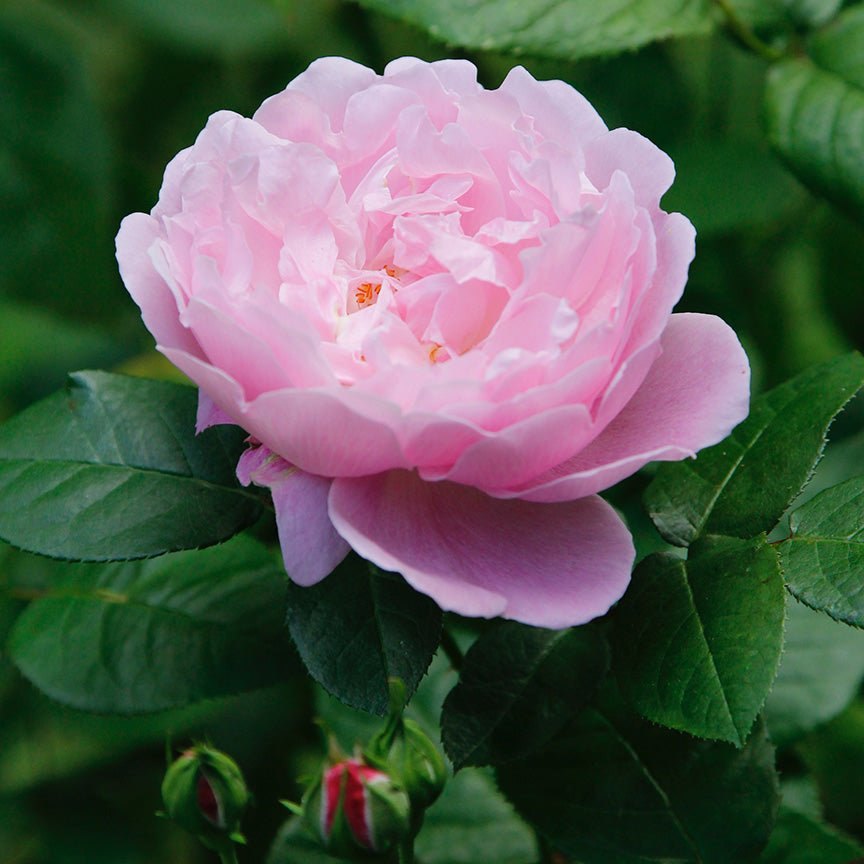
- Plant part
- Flowers
- Vietnamese name
- Hoa hồng Damask
- Scent family
- Floral
- Plant family
- Rosaceae
- Lots published
- —
 Flowers
Also made another way
The “Method” field above gives the usual commercial method. The lines below are other documented methods, each giving a different product.
- Rose oil with cohobation · Cohobation 2-Phenylethyl alcohol stays in the water: 1.3 % in the oil, 35.6 % in the aromatic water, 98.2 % in the residue water; so the water is distilled again. Source: S. Erbaş, H. Baydar (2016), Records of Natural Products 10(5): 555–565
- Rose concrete and absolute · Solvent extraction The absolute has 36.5 % 2-phenylethyl alcohol against 1.3 % in the oil distilled from the same flowers. Source: S. Erbaş, H. Baydar (2016), Records of Natural Products 10(5): 555–565
Composition profile
The published composition from the article, read as structure: 7 compounds adding up to about 73 % of the sample. Figures are printed as the source gives them — one sample, not a species average.
| Compound | Level | Class | Note |
|---|---|---|---|
| Citronellol EU | 28.72 % | Alcohols | Middle |
| Geraniol EU | 21.40 % | Alcohols | Base |
| Nonadecane | 11.10 % | — | — |
| Heneicosane | 5.00 % | — | — |
| Nerol | 4.80 % | — | — |
| Methyl eugenol | 1.30 % | — | — |
| 2-Phenylethanol | 0.40 % | Alcohols | Middle |
By chemical class
- Alcohols50.5 %
- Unclassified22.2 %
By note
- Middle29.1 %
- Base21.4 %
- Unclassified22.2 %
Group totals use the upper bound of each range and only the compounds the article lists; bars are relative to the identified total.
Put it beside another oil in the Compare tool Which other oils are rich in Citronellol?
Rose oil and rose absolute
From the same Damask rose petals, the fragrance trade makes two different products:
- Rose oil (rose otto), distilled with steam. This is the oil on this page.
- Rose absolute, extracted with solvent.
The biggest difference between them is phenylethyl alcohol, the compound behind the characteristic “fresh rose” smell. It dissolves fairly well in water, so in steam distillation most of it stays in the distillation water rather than going into the oil. That water is rose water. Rose otto therefore has little phenylethyl alcohol, while the absolute keeps a great deal: a Bulgarian study recorded 46.56% phenylethyl alcohol in R. damascena absolute against 0.66% in the oil, and another measured 65.52% in rose water. The two smell clearly different: otto is bright and honeyed, the absolute deeper and closer to the flower on the stem.
Composition
| Compound | ISO 9842:2003 | Bulgaria (2021) | China, 4 oils (2023) |
|---|---|---|---|
| Citronellol | 20.0–34.0% | 28.72% | 36.69–39.09% |
| Geraniol | 15.0–22.0% | 21.40% | 7.55–7.88% |
| Nerol | 0–12.0% | 4.80% | 5.94–6.77% |
| Phenylethyl alcohol | ≤ 3.5% | 0.40% | 2.07–2.13% |
| Methyl eugenol | – | 1.30% | 0.03% |
| Nonadecane | 8.0–15.0% | 11.10% | 10.87–11.82% |
| Heneicosane | 3.0–5.5% | 5.00% | 5.63–7.05% |
The ISO ranges come from a table quoted in a 2021 review, from ISO 9842:2003; that edition has been replaced by ISO 9842:2024, covering oil from Turkey, Morocco and Bulgaria, whose ranges we have not read. A dash means it was not reported. Chinese industrial oils have much higher citronellol and lower geraniol than the old standard; a 2016 sample from Isparta (Turkey) was the opposite, with 35.4% geraniol and 31.6% citronellol.
Oil yield is very low. A 2023 study in Bulgaria recorded 0.015–0.048%, equivalent to roughly 2 to nearly 7 tonnes of flowers per kilogram of oil; the 2020 safety assessment by the Cosmetic Ingredient Review (CIR) uses the figure of 4,000 kg of flowers for 1 kg of oil.
The wax that makes the oil solidify
The description at the top of the page notes that genuine oil solidifies in the cold. What solidifies it are long-chain hydrocarbons, mainly nonadecane and heneicosane, which the trade calls stearoptenes; the table above shows these two make up about 15–19% of the oil. They come from the waxy layer of the petals and travel with the steam into the oil. They have almost no smell of their own.
This has two consequences. An oil that never solidifies when cool is a reason to ask questions, since its wax may have been removed or the oil cut. Conversely, a bottle that sets solid does not prove the oil is genuine, because wax can be added. The ISO 9842 standard for rose oil has a chromatographic profile for comparison, and only an analysis of the lot can answer the question.
Methyl eugenol
Natural rose oil contains a small amount of methyl eugenol: 1.30% in the Bulgarian sample and 0.03% in the Chinese oils in the table above. IFRA restricts this compound in finished products because of dermal sensitisation and systemic toxicity, for example to 0.011% in fine fragrance (category 4). For people using essential oils at ordinary dilutions, this is no reason to avoid rose oil. But it is a reason cosmetic manufacturers must calculate how much rose oil goes into a formula rather than adding as much as they like.
To see why rose oil is so expensive, the article on how many kilograms of flowers make a kilogram of oil has the figures.
Sources
- ISO 9842:2024, standard for Rosa × damascena rose oil; replaces ISO 9842:2003.
- Mileva M., Ilieva Y., Jovtchev G. et al. (2021). Rose Flowers—A Delicate Perfume or a Natural Healer? Biomolecules 11(1), 127. doi:10.3390/biom11010127
- Dobreva A., Nedeltcheva-Antonova D. (2023). Comparative Chemical Profiling and Citronellol Enantiomers Distribution of Industrial-Type Rose Oils Produced in China. Molecules 28(3), 1281. doi:10.3390/molecules28031281
- Dobreva A., Nedeva D., Mileva M. (2023). Resources 12(7), 83. doi:10.3390/resources12070083
- Dobreva A. et al. (2021). Molecules 26(16), 4991. doi:10.3390/molecules26164991
- Erbas S., Baydar H. (2016). Records of Natural Products 10(5).
- Cosmetic Ingredient Review (2020). Safety assessment of Rosa damascena-derived ingredients.
- IFRA Standard: Methyl eugenol, Amendment 51 (2023).
- Tisserand and Young (2014). Essential Oil Safety, 2nd edition. Churchill Livingstone.
Buy Rose otto
Rose otto oil: no lot has been brought in yet, so it is not on sale. Message us if you need it.
Where you may already have smelled it
According to the analyses cited above, this oil contains up to 21.4 % geraniol. It is also the leading compound in the scenes below from the scent dictionary. Smelling one of those scenes again is a way to get to know it without opening a bottle. A shared compound does not mean the oil smells exactly like the scene.
Further reading
- Real or fake essential oil: four ways of diluting, and the traces they leave
- What perfume note names mean: jasmine, tuberose, amber and thirty more
- How many kilos of flowers for a kilo of essential oil
- Part V. International essential oils: composition, chemotypes and ISO · research
- Appendix A2. Facts on international essential oils and ISO standards · research
Close to Rose otto
Same plant family: Rosaceae Rose absolute
Also from the flowers Champaca · Clove bud · Immortelle Madagascar · Jasmine sambac · Lotus · Osmanthus · Rose absolute · Saffron
Same method: direct steam distillation Cupressus · Douglas fir · Frankincense sacra · Honey myrtle · Lavandin · May chang · Patchouli · Spearmint
Quick answers
What is the Damask rose?
The Damask rose (Rosa × damascena) is a hybrid rose grown for its oil, mainly in Bulgaria, Turkey and Morocco. The oil distilled from the petals is called rose otto; the solvent-extracted product is rose absolute.
What is the difference between rose otto and rose absolute?
Phenylethyl alcohol, the compound behind the fresh-rose smell. It dissolves in water, so on distillation most of it stays in the rose water; a Bulgarian study measured 0.66% in the oil but 46.56% in the absolute. Rose otto is therefore brighter and more lemony, the absolute deeper and rounder. See rose absolute.
How many roses does it take to make one kilo of rose oil?
The yield is tiny: a 2023 Bulgarian study recorded 0.015–0.048%, roughly 2 to almost 7 tonnes of flowers per kilo of oil. The 2020 CIR safety report uses a figure of 4,000 kg of flowers per kg of oil.
Why does rose oil turn solid in the cold?
Because it carries the petal wax, mainly nonadecane and heneicosane (together called stearoptene), about 15–19% of the oil. It melts again in the warmth of your hand. A bottle that never sets is worth asking about, but a solid one does not prove the oil is genuine either.
What are the main compounds of Damask rose oil?
Citronellol and geraniol make up most of it, with nerol, phenylethyl alcohol and the waxy fraction. But what makes real rose is a few compounds present at parts per thousand, such as damascenone, which the nose picks up at extremely low levels. That is why geranium and palmarosa share the two main compounds and still cannot replace rose.
What does rose otto essential oil smell like?
Fresh rose: sweet, honeyed, a little lemon at the edges and a very thin trace of spice. Rounder and deeper than any “rose scent” you have met in cosmetics.
What is the botanical name of rose otto oil?
The plant is Rosa × damascena, in the Rosaceae family. In Vietnamese it is called hoa hồng damask.
How is rose otto oil produced?
From the flowers of the plant, by direct steam distillation. See the method for what that does to the oil.
Last updated