Essential oils · Floral family
Champaca essential oil
Magnolia × alba
Hoa ngọc lan trắng · Magnoliaceae
Sweet flowers, with ripe fruit and a note of tea. It is brighter and airier than jasmine, without the heavy indolic layer.
White champaca oil is very rich in linalool, and that is why it is so light. The fruit and tea come from compounds making up only a few percent, and they are what separate champaca from a plain bottle of linalool.
Anyone who grew up in Vietnam has met this smell: white ngọc lan flowers wrapped in a leaf and placed on the altar, or fallen all over a pagoda courtyard in the early morning. The fresh flower smells richer and a little headier than the oil, because part of it does not survive extraction.
- Plant part
- Flowers
- Method
- Solvent extraction
- Vietnamese name
- Hoa ngọc lan trắng
- Scent family
- Floral
- Plant family
- Magnoliaceae
- Lots published
- —
 Flowers
Composition profile
The published composition from the article, read as structure: 6 compounds adding up to about 100 % of the sample. Figures are printed as the source gives them — one sample, not a species average.
| Compound | Level | Class | Note |
|---|---|---|---|
| Linalool EU | 85.78 % | Alcohols | Middle |
| β-Elemene | 3.82 % | Sesquiterpenes | Base |
| Methyl eugenol | 3.59 % | — | — |
| Ethyl 2-methylbutyrate | 3.14 % | — | — |
| Methyl 2-methylbutyrate | 2.43 % | — | — |
| β-Caryophyllene EU | 0.92 % | Sesquiterpenes | Base |
By chemical class
- Alcohols85.8 %
- Unclassified9.2 %
- Sesquiterpenes4.7 %
By note
- Middle85.8 %
- Base4.7 %
- Unclassified9.2 %
Group totals use the upper bound of each range and only the compounds the article lists; bars are relative to the identified total.
Compare with the 2 chemically closest oils Which other oils are rich in Linalool?
What white champaca is
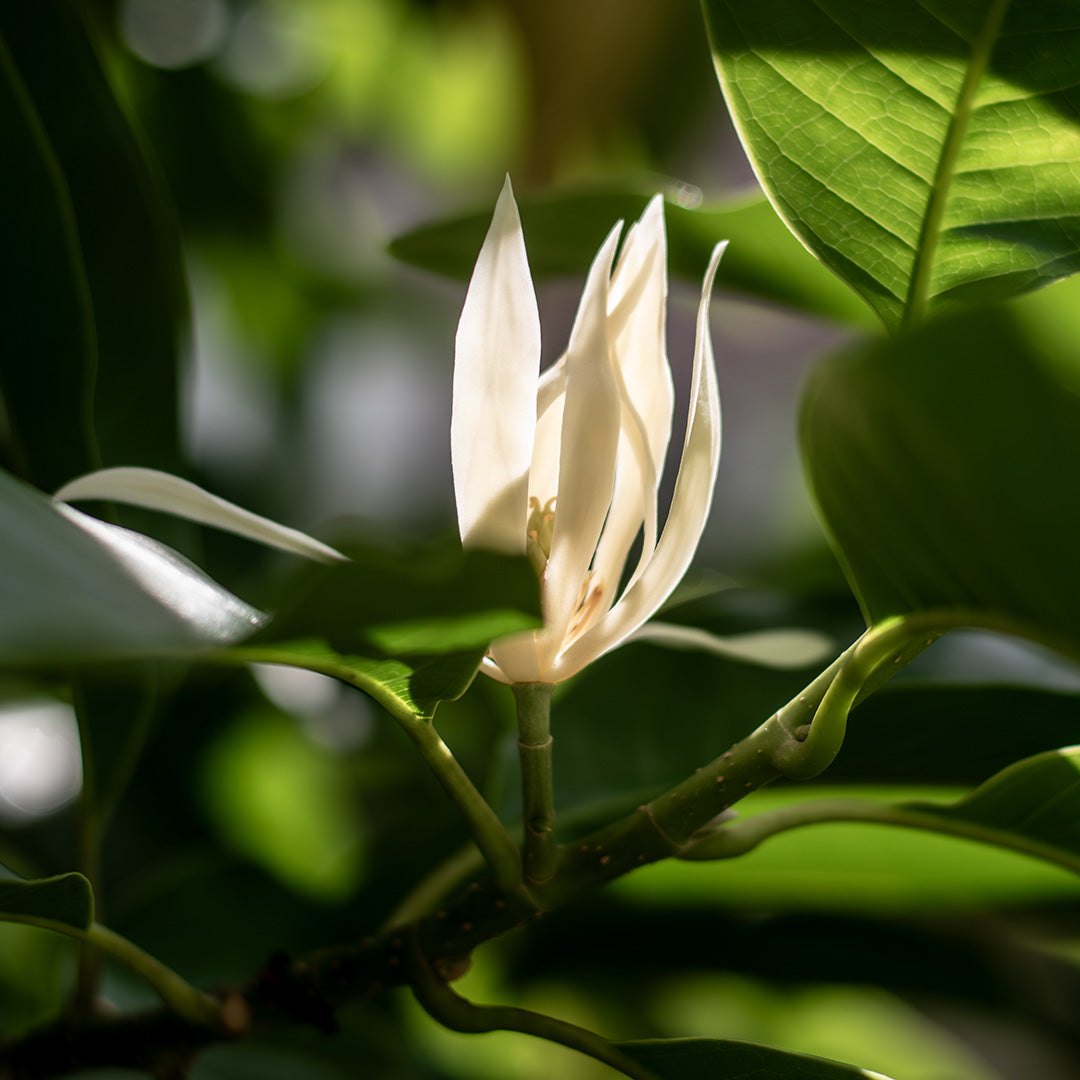
White champaca (Magnolia × alba, formerly Michelia alba), ngọc lan trắng in Vietnamese, is a magnolia-family tree with ivory flowers and long, narrow petals. It differs from ylang-ylang in both plant family and smell. In Vietnam the flowers are familiar on altars, in temples, and wrapped in banana leaves at early markets. See the white champaca entry in the scent dictionary.
Distilled oil: almost all linalool
A 2009 study in Thailand compared several ways of extracting white champaca flowers:
| Compound | Water distillation | Steam distillation |
|---|---|---|
| Linalool | 85.78% | 91.74% |
| β-Elemene | 3.82% | 1.42% |
| Methyl eugenol | 3.59% | 1.36% |
| Ethyl 2-methylbutyrate | 3.14% | 1.47% |
| Methyl 2-methylbutyrate | 2.43% | 1.31% |
| β-Caryophyllene | 0.92% | 1.00% |
The oil yield was low: 0.225% by water distillation and 0.120% by steam distillation.
Linalool makes up 86–92% of the oil, which is why white champaca oil is lighter and brighter than jasmine. The ripe-fruit note comes from two small esters, ethyl and methyl 2-methylbutyrate, smelling of apple and pineapple. They are only a few per cent, but they are what separates champaca from a plain bottle of linalool.
Absolute: a quite different smell
The same study extracted the flowers with hexane, the way an absolute is made, and obtained an entirely different profile: phenylethyl alcohol 39.10%, indole 25.98% and linalool only 13.30%. A cold-enfleurage sample had indole as high as 67.89%.
Indole gives white flowers their animalic, rich, slightly heady note. That explains a familiar observation: a fresh champaca flower smells richer and headier than the distilled oil. The headiness is largely indole, which passes poorly through distillation but stays in the absolute.
Champaca leaf
The leaves and stems also give linalool-rich oil. A study on trees grown in Vietnam found leaf oil with linalool 72.89%, (E)-nerolidol 4.42% and β-caryophyllene 4.04%; the stem oil had linalool 80.65%. Leaf oil is far cheaper than flower oil, and a low-priced “champaca” bottle may well be leaf oil. The label should state the part distilled.
Methyl eugenol
The flower oil in the Thai study contained up to 3.59% methyl eugenol, a substance IFRA restricts in skin products. The analysis of a lot should give a specific figure, and the oil should be diluted before use.
Sources
- Punjee P., Dilokkunanant U., Sukkatta U. et al. (2009). Scented Extracts and Essential Oil Extraction from Michelia alba D.C. Kasetsart Journal (Natural Science) 43(5), 197–203. tci-thaijo.org
- Chemical composition and antimicrobial activity of the essential oils from stems and leaves of Michelia alba D.C. growing in Vietnam (2018). Academia Journal of Biology 40(3). vjs.ac.vn
Buy Champaca
Champaca oil: no lot has been brought in yet, so it is not on sale. Message us if you need it.
Where you may already have smelled it
According to the analyses cited above, this oil contains up to 85.8 % linalool. It is also the leading compound in the scenes below from the scent dictionary. Smelling one of those scenes again is a way to get to know it without opening a bottle. A shared compound does not mean the oil smells exactly like the scene.
Chemically close
The oils whose published composition is closest to this one, compared across every compound we could read. Close in composition does not mean the scent is identical or that one can replace the other.
- Rosewood Aniba rosaeodora shared: Linalool · closeness 1.00 · compare
- Pomelo blossom Citrus maxima shared: Linalool · closeness 0.99 · compare
- Coriander seed Coriandrum sativum shared: Linalool · closeness 0.98 · compare
Further reading
Close to Champaca
Also from the flowers Helichrysum · Jasmine grandiflorum · Jasmine sambac · Lavandin · Lotus · Pomelo blossom · Spike lavender · Ylang ylang
Same method: solvent extraction Benzoin · Jasmine grandiflorum · Jasmine sambac · Labdanum · Lotus · Pomelo blossom
Quick answers
What does champaca essential oil smell like?
Sweet flowers, with ripe fruit and a note of tea. It is brighter and airier than jasmine, without the heavy indolic layer.
What is the botanical name of champaca oil?
The plant is Magnolia × alba, in the Magnoliaceae family. In Vietnamese it is called hoa ngọc lan trắng.
How is champaca oil produced?
From the flowers of the plant, by solvent extraction. See the method for what that does to the oil.
What are the main compounds of champaca oil?
From the composition data on this page, the oil is led by Linalool, β-Elemene and β-Caryophyllene. Proportions vary with origin, harvest and method; a lot analysis is the only answer for a given bottle.
Last updated