Essential oils · Woody & Resinous family
Frankincense serrata essential oil
Boswellia serrata
Nhũ hương Serrata · Burseraceae
Resin, slightly lemony, with a spicy, slightly cloudy note, less bright than the African frankincenses.
Boswellia serrata is the frankincense of India. Its oil usually features α-thujene prominently, unlike B. sacra and B. carterii, which are rich in α-pinene. The difference is enough for the nose to tell them apart side by side.
Serrata resin is also the raw material for many extracts sold for their boswellic acids. As the frankincense page explains, those acids do not pass into the distilled essential oil.
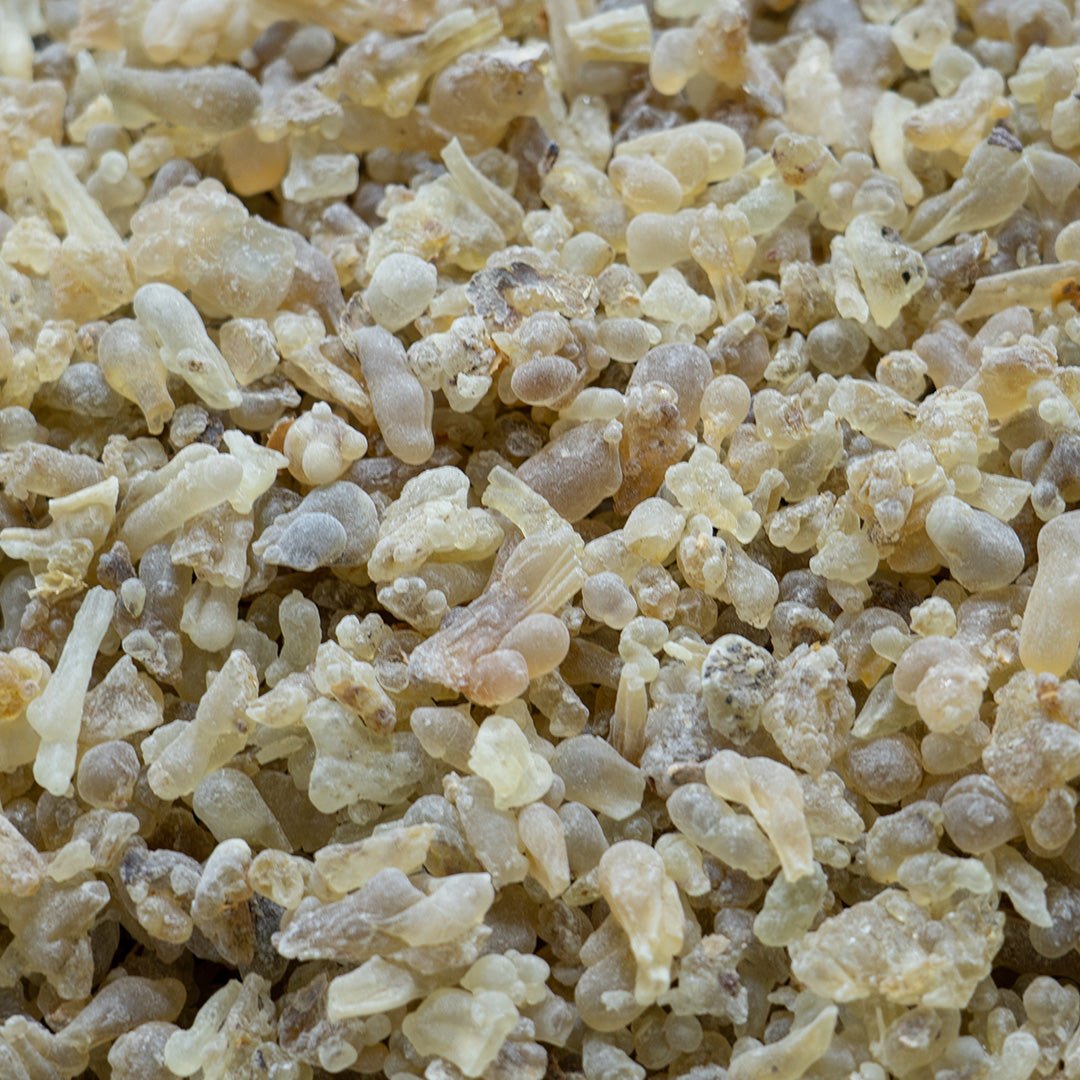
- Plant part
- Resin
- Vietnamese name
- Nhũ hương Serrata
- Scent family
- Woody & Resinous
- Plant family
- Burseraceae
- Lots published
- —
 Resin
Composition profile
The published composition from the article, read as structure: 7 compounds adding up to about 84 % of the sample. Figures are printed as the source gives them — one sample, not a species average.
| Compound | Level | Class | Note |
|---|---|---|---|
| α-Thujene | 61.36 % | Monoterpenes | Top |
| α-Pinene EU | 7.73 % | Monoterpenes | Top |
| Sabinene | 5.07 % | Monoterpenes | Top |
| p-Cymene | 4.28 % | Monoterpenes | Top |
| Estragole | 2.74 % | Other compounds | Middle |
| Limonene EU | 1.55 % | Monoterpenes | Top |
| δ-3-Carene | 1.15 % | Monoterpenes | Top |
By chemical class
- Monoterpenes81.1 %
- Other compounds2.7 %
By note
- Top81.1 %
- Middle2.7 %
Group totals use the upper bound of each range and only the compounds the article lists; bars are relative to the identified total.
Put it beside another oil in the Compare tool Which other oils are rich in α-Thujene?
What frankincense serrata is
Boswellia serrata is the frankincense species of India. The essential oil is distilled from the tree’s oleo-gum-resin. Of the four Boswellia species on the frankincense page, serrata is the one where every analysis we have read shows α-thujene, rather than α-pinene, as the leading compound.
Composition: Indian samples
A 2007 study analysed natural resin and commercial samples from several regions of India, hydrodistilled and analysed by GC and GC-MS. Its abstract states that α-thujene was one of the major constituents in all samples, whereas α-pinene was recorded in only one. The table compares it with a 1987 analysis of Indian olibanum oil:
| Compound | India (1987) | Punjab (2007) | M. Pradesh (2007) |
|---|---|---|---|
| α-Thujene | 61.36% | 47.4% | 22.7% |
| α-Pinene | 7.73% | trace | – |
| δ-3-Carene | 1.15% | 9.6% | – |
| Sabinene | 5.07% | 1.0% | 0.4% |
| p-Cymene | 4.28% | 1.6% | 2.8% |
| Limonene | 1.55% | 0.7% | 2.6% |
| Estragole | 2.74% | – | 0.1% |
The Punjab sample also had 9.1% epi-cubenol; the Madhya Pradesh sample had 5.5% benzyl tiglate. Two commercial samples bought in New Delhi had 26.2% and 29.5% α-thujene; the second was the only one with α-pinene recorded, at 11.2%. Estragole is also called methyl chavicol. A dash means it was not reported. We read the detailed figures of these two studies through the SCENTinDB database, not from the full papers.
Reading the table
Even within India, α-thujene ranges from about 23% to 61%. What is consistent is that α-pinene is low or absent, the opposite of B. sacra and B. carterii. The smell is therefore less like pine resin and leans towards a spicy, woody, slightly muted note.
Boswellic acids
Serrata resin is the raw material for many extracts sold on the strength of boswellic acids. As the frankincense page explains, these acids are large, non-volatile molecules and do not pass into oil distilled in the ordinary way. Serrata essential oil and serrata resin extract are two different products.
Safety
The serrata samples above contain 0.1% to 2.74% estragole. IFRA restricts estragole in finished products because of dermal sensitisation and systemic toxicity; for example, the limit for fine fragrance (category 4) is 0.014%. Ask the supplier for an analysis that reports estragole. Always dilute and store tightly closed.
Sources
- Singh B., Kumar R., Bhandari S. et al. (2007). Volatile constituents of natural Boswellia serrata oleo-gum-resin and commercial samples. Flavour and Fragrance Journal 22(2), 145–147. doi:10.1002/ffj.1772
- Verghese J., Joy M.T., Retamar J.A. et al. (1987). A fresh look at the constituents of indian olibanum oil. Flavour and Fragrance Journal 2(3), 99–102. doi:10.1002/ffj.2730020304
- SCENTinDB, essential oil composition database (cb.imsc.res.in), entry for Boswellia serrata.
- IFRA Standard: Estragole, Amendment 51 (2023).
Buy Frankincense serrata
Frankincense serrata oil: no lot has been brought in yet, so it is not on sale. Message us if you need it.
Further reading
Close to Frankincense serrata
Same plant family: Burseraceae Elemi · Frankincense frereana · Myrrh · Opopanax · Palo santo
Also from the resin Benzoin · Elemi · Frankincense · Labdanum · Opopanax · Peru balsam
Same method: direct steam distillation Atlas cedarwood · Clove bud · German chamomile · Lavender · Nutmeg · Opopanax · Peru balsam · Rosemary ct verbenone
Quick answers
What does frankincense serrata essential oil smell like?
Resin, slightly lemony, with a spicy, slightly cloudy note, less bright than the African frankincenses.
What is the botanical name of frankincense serrata oil?
The plant is Boswellia serrata, in the Burseraceae family. In Vietnamese it is called nhũ hương serrata.
How is frankincense serrata oil produced?
From the resin of the plant, by direct steam distillation. See the method for what that does to the oil.
Last updated