Essential oils · Floral family
Jasmine grandiflorum essential oil
Jasminum grandiflorum
Hoa nhài lớn · Oleaceae
Jasmine, but rounder and warmer than Arabian jasmine, less green, with a fruity note and a deep indolic layer. It is rich and long-lasting.
This is Jasminum grandiflorum, the five-petalled jasmine grown in Egypt, India and Grasse, and what Western perfumery usually means by “jasmine”. Its absolute is rich in benzyl acetate, benzyl benzoate and linalool, with indole and cis-jasmone, a compound that contributes much of its character.
Compared with Arabian jasmine, it has less of the green, bright fruit and more warmth. As with every jasmine, the real product is an absolute, not a distilled oil.
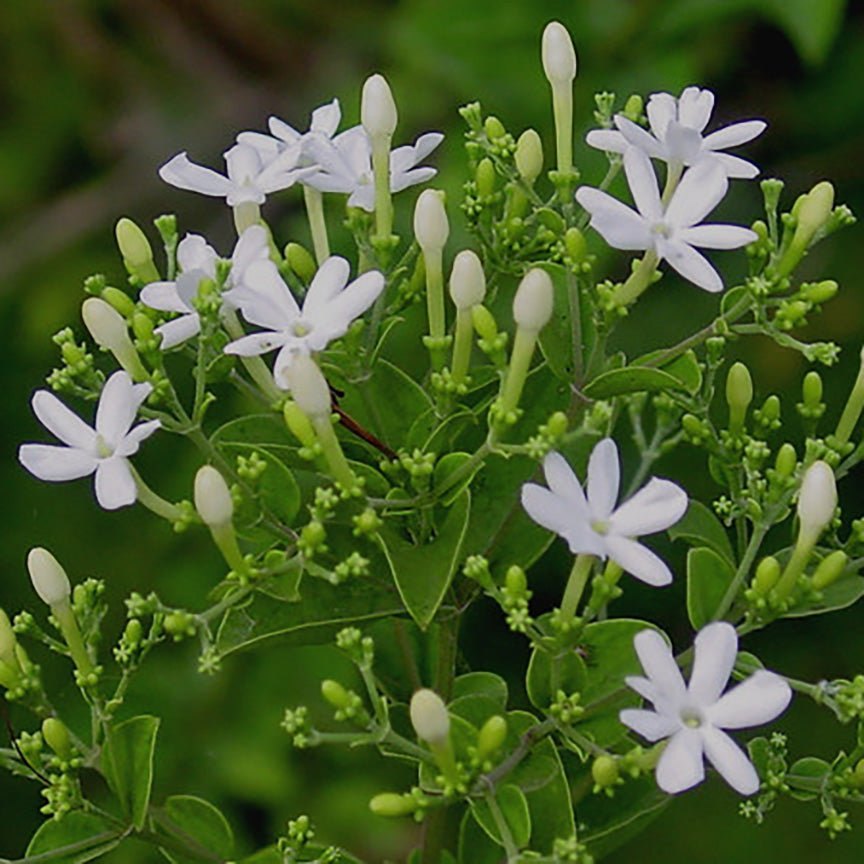
- Plant part
- Flowers
- Method
- Solvent extraction
- Vietnamese name
- Hoa nhài lớn
- Scent family
- Floral
- Plant family
- Oleaceae
- Lots published
- —
 Flowers
Composition profile
The published composition from the article, read as structure: 8 compounds adding up to about 75 % of the sample. Figures are printed as the source gives them — one sample, not a species average.
| Compound | Level | Class | Note |
|---|---|---|---|
| Benzyl acetate | 23.7 % | Esters | Middle |
| Benzyl benzoate | 20.7 % | — | — |
| Phytol | 10.9 % | — | — |
| Linalool EU | 8.2 % | Alcohols | Middle |
| Isophytol | 5.5 % | — | — |
| Eugenol EU | 2.5 % | Phenols | Base |
| cis-Jasmone | 1.9 % | Ketones | Base |
| Indole | 1.8 % | Other compounds | Base |
By chemical class
- Unclassified37.1 %
- Esters23.7 %
- Alcohols8.2 %
- Phenols2.5 %
- Ketones1.9 %
- Other compounds1.8 %
By note
- Middle31.9 %
- Base6.2 %
- Unclassified37.1 %
Group totals use the upper bound of each range and only the compounds the article lists; bars are relative to the identified total.
Put it beside another oil in the Compare tool Which other oils are rich in Benzyl acetate?
Grandiflorum and sambac
Jasmine grandiflorum (Jasminum grandiflorum), also called Spanish or royal jasmine, is the five-petalled jasmine grown widely in Egypt, India and around Grasse. When Western perfumery says “jasmine”, it usually means this species. The jasmine of Vietnam is Jasminum sambac, a double flower used to scent tea; the two species are close but smell clearly different. See also why jasmine cannot be distilled.
Composition of a commercial absolute
A 2007 study in Natural Product Communications analysed a commercial jasmine grandiflorum absolute from India:
| Compound | Share |
|---|---|
| Benzyl acetate | 23.7% |
| Benzyl benzoate | 20.7% |
| Phytol | 10.9% |
| Linalool | 8.2% |
| Isophytol | 5.5% |
| Eugenol | 2.5% |
| cis-Jasmone | 1.9% |
| Indole | 1.8% |
Benzyl acetate gives a sweet floral note, slightly fruity and pear-like; benzyl benzoate is almost odourless but forms a base and fixes the scent. What really makes “jasmine” are the small compounds: cis-jasmone with a green floral, slightly celery-like note; indole with an animalic richness; and a very small amount of methyl jasmonate (0.6% in this sample). Phytol and isophytol are long-chain alcohols, almost odourless, left over from the flower waxes.
Same species, different absolutes
A 2012 study, also in Natural Product Communications, made an absolute in the laboratory from grandiflorum flowers grown in Delhi: an n-pentane concrete, then cold methanol washing to remove waxes. The result was very different from the commercial sample: (Z)-3-hexenyl benzoate 22.0%, (E,E)-α-farnesene 17.0%, benzyl acetate 11.3%, linalool 8.1%, methyl anthranilate 3.0%, with benzyl benzoate only 0.6% and indole 0.1%.
Two absolutes of the same species from the same country, with benzyl benzoate differing more than thirtyfold. Composition depends heavily on cultivar, region, harvest season and process. Faced with two bottles of grandiflorum absolute, only the analysis of each lot shows how alike they are.
How grandiflorum differs from sambac
Compared with sambac, grandiflorum has less green and bright-fruit character and more warmth and roundness. On two smelling strips side by side, sambac smells fresher and closer to tea, grandiflorum richer and more “perfume”.
Regulation
Linalool, eugenol and benzyl benzoate are all on the EU list of cosmetic ingredients that must be labelled above a threshold. Jasmine absolute is concentrated and should be diluted thoroughly.
Sources
- Jirovetz L., Buchbauer G., Schweiger T. et al. (2007). Chemical composition, olfactory evaluation and antimicrobial activities of Jasminum grandiflorum L. absolute from India. Natural Product Communications 2(4), 407–412. doi:10.1177/1934578X0700200411
- Prakash O., Sahoo D., Rout P.K. (2012). Liquid CO₂ extraction of Jasminum grandiflorum and comparison with conventional processes. Natural Product Communications 7(1), 89–92. doi:10.1177/1934578X1200700131
Buy Jasmine grandiflorum
Jasmine grandiflorum oil: no lot has been brought in yet, so it is not on sale. Message us if you need it.
Where you may already have smelled it
According to the analyses cited above, this oil contains up to 23.7 % benzyl acetate. It is also the leading compound in the scenes below from the scent dictionary. Smelling one of those scenes again is a way to get to know it without opening a bottle. A shared compound does not mean the oil smells exactly like the scene.
Further reading
Close to Jasmine grandiflorum
Same plant family: Oleaceae Jasmine sambac · Osmanthus
Also from the flowers Clove bud · Lavandin · Linden blossom · Lotus · Moroccan blue chamomile · Saffron · Spike lavender · St John’s wort
Same method: solvent extraction Benzoin · Labdanum · Lotus · Night jasmine · Osmanthus · Vanilla
Quick answers
What does jasmine grandiflorum essential oil smell like?
Jasmine, but rounder and warmer than Arabian jasmine, less green, with a fruity note and a deep indolic layer. It is rich and long-lasting.
What is the botanical name of jasmine grandiflorum oil?
The plant is Jasminum grandiflorum, in the Oleaceae family. In Vietnamese it is called hoa nhài lớn.
How is jasmine grandiflorum oil produced?
From the flowers of the plant, by solvent extraction. See the method for what that does to the oil.
What are the main compounds of jasmine grandiflorum oil?
From the composition data on this page, the oil is led by Benzyl acetate, Linalool and Eugenol. Proportions vary with origin, harvest and method; a lot analysis is the only answer for a given bottle.
Last updated