Essential oils · Woody & Resinous family
Frankincense essential oil
Boswellia carterii
Nhũ hương · Burseraceae
Resin, lemon, pine. The opening is bright and close to lemon peel, then it settles into a warm, slightly spicy layer of resin.
Many people expect the solemn smoke of a church and are surprised not to find it. That smoke is burnt resin; the oil is resin distilled with steam, and the two processes give two quite different smells. The main compound is usually α-pinene, also the main compound of pine resin, though some batches are rich in limonene or α-thujene.
This catalogue has four Boswellia species, and they are not interchangeable. Carterii is the brightest and most lemony; sacra is rounder, serrata cloudier, frereana sweeter and less piney.
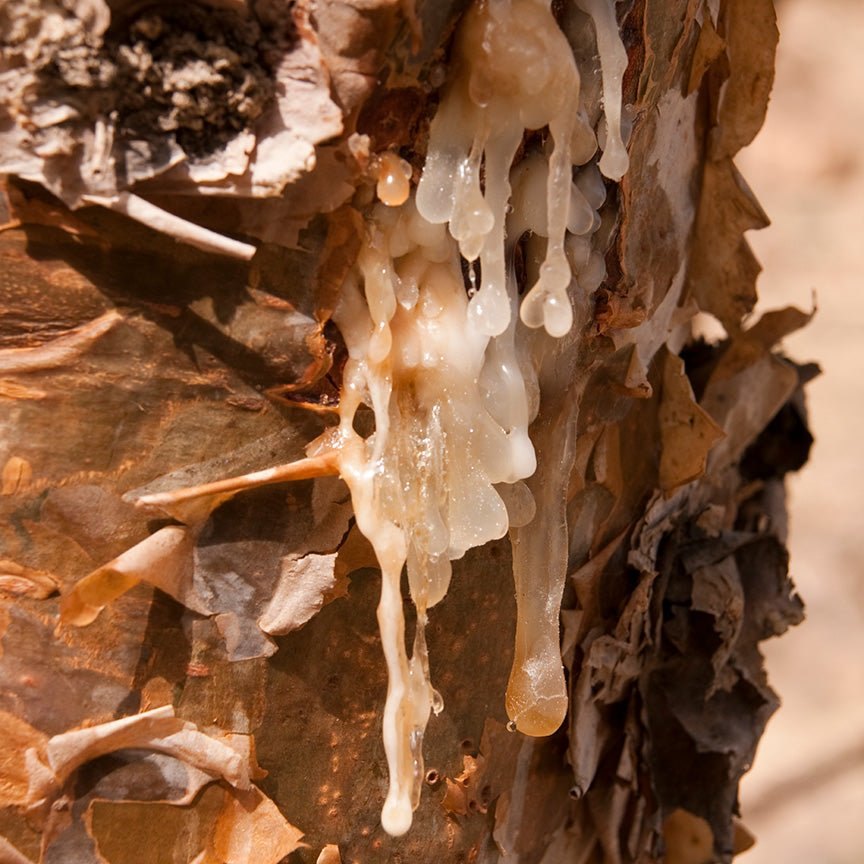
- Plant part
- Resin
- Vietnamese name
- Nhũ hương
- Scent family
- Woody & Resinous
- Plant family
- Burseraceae
- Lots published
- —
 Resin
Composition profile
The published composition from the article, read as structure: 9 compounds adding up to about 68 % of the sample. Figures are printed as the source gives them — one sample, not a species average.
| Compound | Level | Class | Note |
|---|---|---|---|
| α-Pinene EU | 31.8–33.3 % | Monoterpenes | Top |
| Limonene EU | 10.1 % | Monoterpenes | Top |
| α-Thujene | 9.1–9.2 % | Monoterpenes | Top |
| p-Cymene | 5.5–5.6 % | Monoterpenes | Top |
| Sabinene | 3.2–3.5 % | Monoterpenes | Top |
| Myrcene | 3.2–3.4 % | Monoterpenes | Top |
| β-Caryophyllene EU | 1.8–1.9 % | Sesquiterpenes | Base |
| Octyl acetate | 0.9–1.0 % | — | — |
| Incensole | 0.1–0.2 % | — | — |
By chemical class
- Monoterpenes65.1 %
- Sesquiterpenes1.9 %
- Unclassified1.2 %
By note
- Top65.1 %
- Base1.9 %
- Unclassified1.2 %
Group totals use the upper bound of each range and only the compounds the article lists; bars are relative to the identified total.
Compare with the 2 chemically closest oils Which other oils are rich in α-Pinene?
Frankincense, agarwood and “incense”
In Vietnamese the word trầm invites confusion. Frankincense is the resin of Boswellia trees, which grow in the dry lands of Somalia, Oman, Ethiopia and India. The bark is cut, the resin seeps out and dries into tears. Agarwood is something else entirely: the wood of Aquilaria trees infected by a fungus. Both are burned as incense in rituals, but they have nothing in common botanically or chemically.
Four species, four oils
This catalogue has four Boswellia species, and they are not interchangeable:
- Boswellia carterii, the oil on this page, is the brightest and most lemony. The Kew plant list (POWO) treats B. carteri as a synonym of B. sacra, but some chemists still separate the African populations as B. carteri and the Arabian ones as B. sacra.
- B. sacra from Oman is rounder.
- B. serrata from India is duller.
- B. frereana is sweeter, with less pine.
In carterii and sacra the main compound is usually α-pinene, also the main compound of pine resin. A label that says only “frankincense” without the species is not enough, as the article on species names explains.
Composition: a reference sample and twenty commercial bottles
| Compound | Somaliland, 2 samples (2022) | 20 commercial oils (2009) |
|---|---|---|
| α-Pinene | 31.8–33.3% | 2–64% |
| Limonene | 10.1% | 1–20% |
| α-Thujene | 9.1–9.2% | 1–33% |
| p-Cymene | 5.5–5.6% | 3–17% |
| Sabinene | 3.2–3.5% | 2–7% |
| Myrcene | 3.2–3.4% | 1–9% |
| β-Caryophyllene | 1.8–1.9% | 0.1–8% |
| Octyl acetate | 0.9–1.0% | – |
| Incensole | 0.1–0.2% | – |
The first column is B. carteri resin from Somaliland, hydrodistilled in the laboratory in 2022. The second is 20 commercial oils of unstated origin, from a 2009 conference report. A dash means it was not reported.
The commercial range is so wide that α-pinene is 2% in one bottle and 64% in another. A 2019 study grouped “carteri” oils into chemotypes: an α-pinene type (mean 36.3%), a limonene type (34.3%) and an α-thujene type (43.0%). Another study the same year traced methoxydecane in some oils sold as carteri to the species B. occulta, meaning the oil may have been blended or the species mixed. Incensole, often mentioned in connection with frankincense, is present only in traces in the distilled oil.
Boswellic acids are not in the essential oil
This is the most commonly misadvertised point. Boswellic acids are a group of compounds much studied in Boswellia resin, and many sellers of frankincense oil trade on their reputation. But according to a review by the Tisserand Institute:
- Boswellic acids are large, non-volatile molecules with boiling points of around 500–600 °C. They do not travel with the steam during distillation.
- They do not appear in standard GC/MS analysis of the oil.
- A 2011 study reported about 3% boswellic acids in B. sacra oil, but it later emerged that prolonged vacuum distillation had been used and that this amount sat in the heaviest fraction. Oil distilled the ordinary way contains only traces, below 0.01%.
In short: if you want to talk about boswellic acids, you are talking about the resin or a resin extract, not a bottle of essential oil.
Storage
Frankincense oil is rich in monoterpenes and oxidises as easily as pine oil. Old oil loses its fresh lemony top, the resin note turns harsh, and it can be more irritating to skin. Keep it tightly closed, in the dark, and stored properly.
Sources
- Ojha P.K., Poudel D.K., Rokaya A., Satyal R., Setzer W.N., Satyal P. (2022). Plants 11(16), 2134. doi:10.3390/plants11162134
- Kamatou G.P., Viljoen A., van Vuuren S., Balwanth P., Gosai R. (2009). African Journal of Traditional, Complementary and Alternative Medicines 6, 443–444. Conference abstract.
- Johnson et al. (2019). Natural Product Communications. doi:10.1177/1934578X19866307
- Johnson et al. (2019). Plants 8(4), 88. doi:10.3390/plants8040088
- Plants of the World Online (Kew). Boswellia carteri Birdw.
- Tisserand Institute. Does Frankincense oil contain boswellic acid? tisserandinstitute.org
Buy Frankincense
Frankincense oil: no lot has been brought in yet, so it is not on sale. Message us if you need it.
Where you may already have smelled it
According to the analyses cited above, this oil contains up to 33.3 % α-pinene and up to 10.1 % limonene. Both are also the leading compound in the scenes below from the scent dictionary. Smelling one of those scenes again is a way to get to know them without opening a bottle. A shared compound does not mean the oil smells exactly like the scene.
- Canarium resinScrape a fresh drop of resin oozing from a Canarium trunk and smell it on the knife tip
- Pine woodFresh pine sawdust, just sawn
- Buddha’s handTake a ripe yellow Buddha’s hand and lightly scratch the peel with a fingernail
- Ripe kumquat peelLightly squeeze the peel of a ripe yellow kumquat
Chemically close
The oils whose published composition is closest to this one, compared across every compound we could read. Close in composition does not mean the scent is identical or that one can replace the other.
- Frankincense frereana Boswellia frereana shared: α-Pinene, α-Thujene · closeness 0.95 · compare
- Frankincense sacra Boswellia sacra shared: α-Pinene, Limonene · closeness 0.92 · compare
- Mastic Pistacia lentiscus shared: α-Pinene, Limonene · closeness 0.90 · compare
Further reading
Close to Frankincense
Same plant family: Burseraceae Frankincense frereana · Frankincense sacra · Frankincense serrata · Opopanax · Palo santo
Also from the resin Elemi · Frankincense frereana · Frankincense sacra · Frankincense serrata · Labdanum · Peru balsam
Same method: direct steam distillation Cassia bark · Catnip · Clove basil · Frankincense frereana · Frankincense sacra · Frankincense serrata · Niaouli ct 1,8-cineole · Nutmeg
Quick answers
What does frankincense essential oil smell like?
Resin, lemon, pine. The opening is bright and close to lemon peel, then it settles into a warm, slightly spicy layer of resin.
What is the botanical name of frankincense oil?
The plant is Boswellia carterii, in the Burseraceae family. In Vietnamese it is called nhũ hương.
How is frankincense oil produced?
From the resin of the plant, by direct steam distillation. See the method for what that does to the oil.
Last updated