Essential oils · Gourmand family
Peru balsam essential oil
Myroxylon balsamum
Nhựa Peru · Fabaceae
Vanilla, cinnamon and sweet resin, a little like caramel. It is warm, round and long-lasting.
Peru balsam (Myroxylon balsamum var. pereirae) actually comes from El Salvador, not Peru; the name dates from when the balsam was shipped to Europe through Peruvian ports. Its main compounds are benzyl benzoate and benzyl cinnamate, with a little vanillin.
Crude Peru balsam is one of the best-known contact allergens. IFRA prohibits the crude balsam as a fragrance ingredient and allows only certain processed distillates or extracts, within concentration limits. Ask the seller exactly which form it is.
- Plant part
- Resin
- Vietnamese name
- Nhựa Peru
- Scent family
- Gourmand
- Plant family
- Fabaceae
- Lots published
- —
 Resin
Composition profile
The published composition from the article, read as structure: 1 compounds adding up to about 4 % of the sample. Figures are printed as the source gives them — one sample, not a species average.
| Compound | Level | Class | Note |
|---|---|---|---|
| Nerolidol | 4.2 % | Alcohols | Base |
By chemical class
- Alcohols4.2 %
By note
- Base4.2 %
Group totals use the upper bound of each range and only the compounds the article lists; bars are relative to the identified total.
Put it beside another oil in the Compare tool Which other oils are rich in Nerolidol?
What Peru balsam is
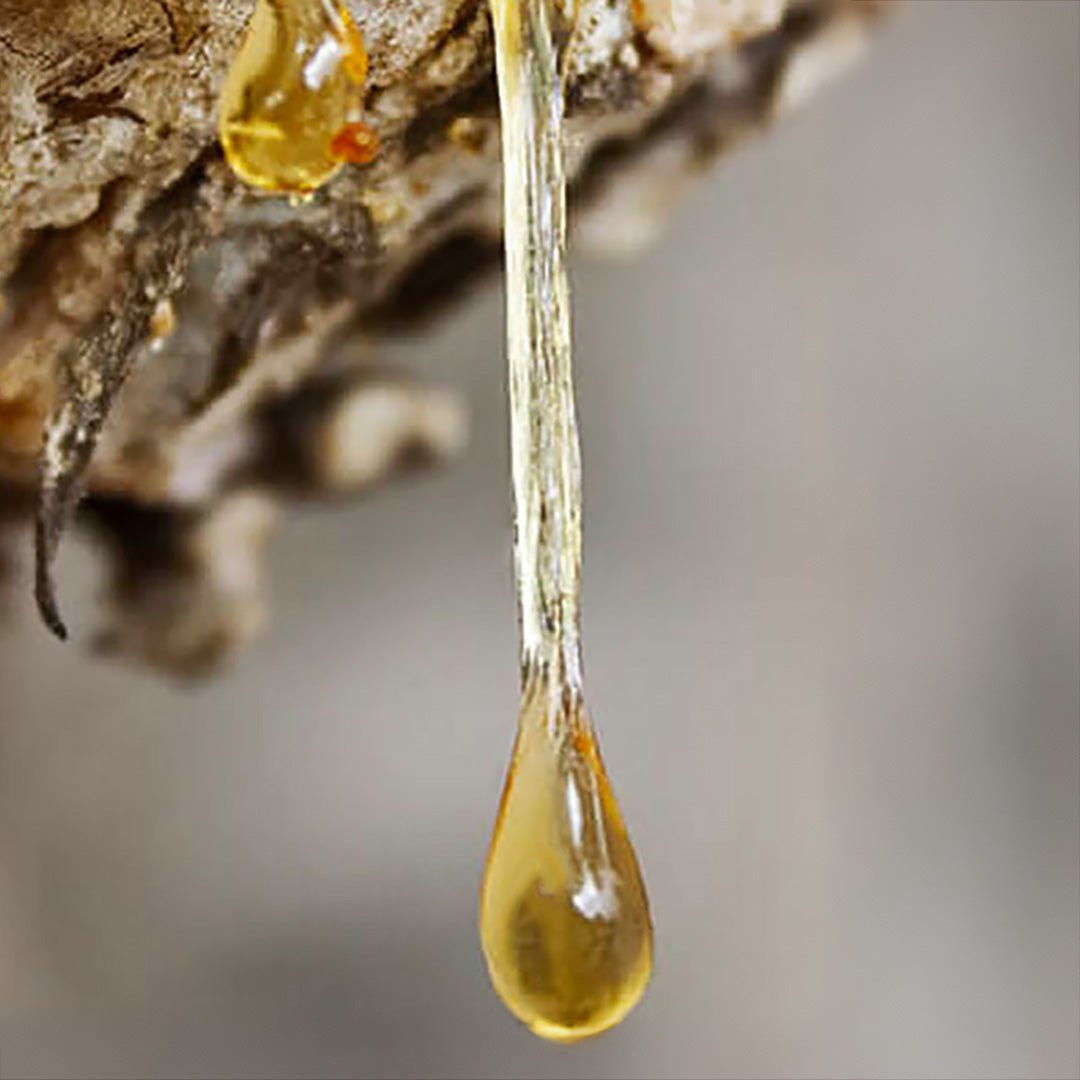
Peru balsam is the trunk exudate of Myroxylon balsamum var. pereirae. It is a thick, dark brown liquid, not an essential oil in the strict sense: the fragrant oily part (called cinnamein) makes up only about half to two-thirds, and the rest is resin and non-volatile material. From the crude balsam, an oil, an absolute or an “anhydrol” is distilled or extracted.
Composition
The European Medicines Agency (EMA) assessment report of 2016 brings together these figures:
| Component | Value |
|---|---|
| Esters (mainly benzyl benzoate and benzyl cinnamate), European Pharmacopoeia requirement | 45–70% |
| Cinnamein (volatile oily part) | 50–64% |
| Resin fraction | 20–28% |
| Benzyl benzoate | 58.2% (oil), 49.5% (absolute) |
| Benzyl cinnamate | 12.4% (oil), 10.5% (absolute) |
| Cinnamic acid | 13.5% (oil), 11.5% (absolute) |
| Benzoic acid | 8.1% (oil), 6.9% (absolute) |
| trans-Nerolidol | 4.2% (oil), 3.6% (absolute) |
| Vanillin | small amounts, no figure given |
Its smell
Benzyl benzoate is almost odourless; it is the soft, long-lasting support. The characteristic smell comes from benzyl cinnamate and cinnamic acid (balsamic, sweet, slightly cinnamon), plus a little vanillin and nerolidol. The result is a warm vanilla, cinnamon and caramel smell, closer to vanilla and labdanum than to light resins such as frankincense.
One of the most common contact allergens
- A 2019 review reports that 4–8% of patients routinely patch-tested for suspected contact dermatitis are sensitised to Peru balsam.
- A study in 13 Italian clinics (2018–2019, 12,030 patients) found 3.6% positive. Of 342 clinically relevant Peru balsam allergies, 68.1% were negative to fragrance mix I, so the authors concluded that Peru balsam is still worth keeping in the baseline series.
- The EMA calls it “one of the most common contact allergens”, and adopted no EU herbal monograph because of the sensitisation risk.
IFRA and EU rules
- The IFRA Standard for Peru balsam (49th Amendment): crude Peru balsam is prohibited and “should not be used as a fragrance ingredient for any finished product application”. Extracts and distillates (oil, absolute, anhydrol) are restricted, for example to a maximum of 0.41% in fine fragrance (category 4) and 0.10% in creams (categories 5A–5C). According to the EMA, IFRA banned the crude balsam in 1982.
- EU: Commission Directive 2008/42/EC placed crude Peru balsam on the list of prohibited substances (Annex II) when used as a fragrance ingredient, and limited extracts and distillates to a maximum of 0.4% in the finished product.
So when you see “Peru balsam” on a label, the first question is: is this the crude balsam or a distilled oil? Only the latter is permitted in fragrance. People already known to be allergic to Peru balsam should avoid both. Always dilute and test on a small patch of skin first.
Sources
- EMA/HMPC (2016). Assessment report on Myroxylon balsamum (L.) Harms var. pereirae (Royle) Harms, balsamum. EMA/HMPC/712648/2014.
- EMA/HMPC (2016). Public statement on Peru balsam. EMA/HMPC/712649/2014.
- de Groot A.C. (2019). Myroxylon pereirae resin (balsam of Peru) – A critical review of the literature and assessment of the significance of positive patch test reactions and the usefulness of restrictive diets. Contact Dermatitis 80(6), 335–353. doi:10.1111/cod.13263
- Guarneri F., Corazza M., Stingeni L. et al. (2021). Myroxylon pereirae (balsam of Peru): Still worth testing? Contact Dermatitis 85(3), 269–273. doi:10.1111/cod.13839
- IFRA Standard: Peru balsam. Amendment 49.
- Commission Directive 2008/42/EC of 3 April 2008 amending Council Directive 76/768/EEC concerning cosmetic products.
Buy Peru balsam
Peru balsam oil: no lot has been brought in yet, so it is not on sale. Message us if you need it.
Further reading
Close to Peru balsam
Same plant family: Fabaceae Copaiba
Also from the resin Benzoin · Copaiba · Frankincense frereana · Labdanum · Mastic · Opopanax
Same method: direct steam distillation Bee balm · Geranium · Haitian vetiver · Lavender · Opopanax · Spike lavender · Star anise · Virginian cedarwood
Quick answers
What does Peru balsam essential oil smell like?
Vanilla, cinnamon and sweet resin, a little like caramel. It is warm, round and long-lasting.
What is the botanical name of Peru balsam oil?
The plant is Myroxylon balsamum, in the Fabaceae family. In Vietnamese it is called nhựa peru.
How is Peru balsam oil produced?
From the resin of the plant, by direct steam distillation. See the method for what that does to the oil.
What are the main compounds of Peru balsam oil?
From the composition data on this page, the oil is led by Nerolidol. Proportions vary with origin, harvest and method; a lot analysis is the only answer for a given bottle.
Is there anything to watch out for with Peru balsam oil?
A skin sensitiser — on the EU list of allergens that must be declared on labels.
Last updated