Essential oils · Earthy family
Haitian vetiver essential oil
Chrysopogon zizanioides
Cỏ hương bài Haiti · Poaceae
Roots and earth like every vetiver, but cleaner, brighter and less smoky. There is a nutty, slightly floral note at the top.
It is the same species, Chrysopogon zizanioides, as vetiver. One review places Reunion and Haitian oil among the best quality, but a study comparing commercial oils from nine origins, including Haiti, found no meaningful differences in the main compounds.
So the origin on the label is no substitute for the analysis of each batch.
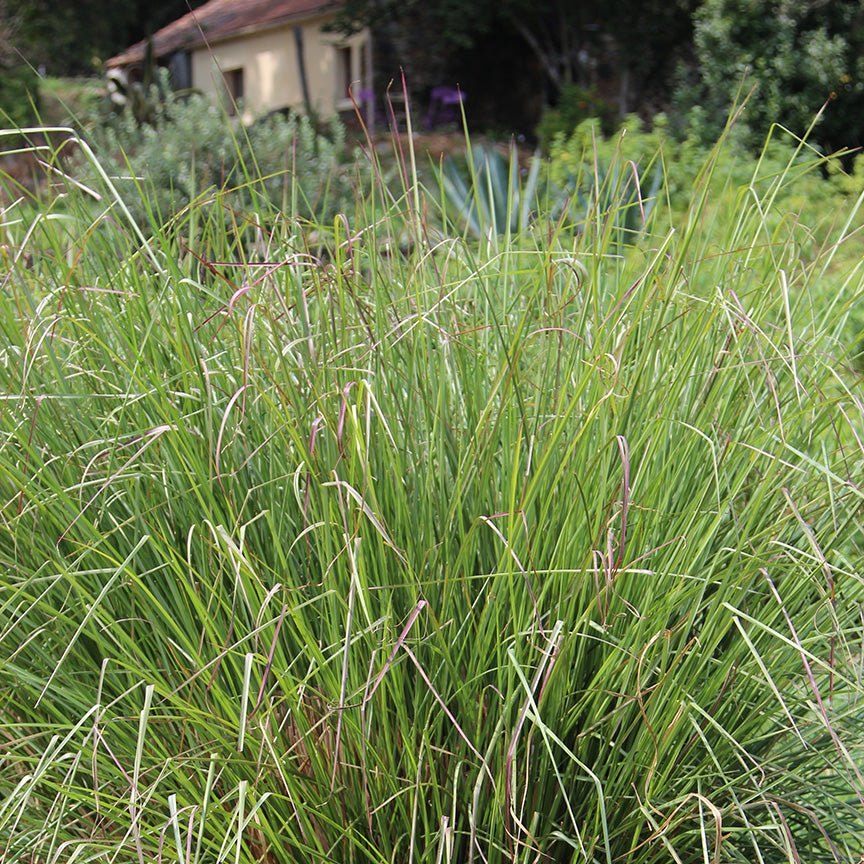
- Plant part
- Roots
- Vietnamese name
- Cỏ hương bài Haiti
- Scent family
- Earthy
- Plant family
- Poaceae
- Lots published
- —
 Roots
Composition profile
The published composition from the article, read as structure: 4 compounds adding up to about 32 % of the sample. Figures are printed as the source gives them — one sample, not a species average.
| Compound | Level | Class | Note |
|---|---|---|---|
| Khusimol | 3.4–13.7 % | — | — |
| Vetiselinenol | 1.3–7.8 % | — | — |
| α-Vetivone | 2.5–6.3 % | Ketones | Base |
| β-Vetispirene | 1.6–4.5 % | — | — |
By chemical class
- Unclassified26.0 %
- Ketones6.3 %
By note
- Base6.3 %
- Unclassified26.0 %
Group totals use the upper bound of each range and only the compounds the article lists; bars are relative to the identified total.
What Haitian vetiver is
Haitian vetiver is the essential oil distilled from the roots of Chrysopogon zizanioides grown in Haiti, the same species as vetiver. The PROSEA handbook of essential-oil plants (1999) notes that Haitian oil “differs somewhat” from Javanese and South Indian oil but is also dextro-rotatory like them, whereas North Indian khus oil is laevo-rotatory and rich in khusilal. According to PROSEA, Bourbon (Reunion) oil is regarded as the best quality; a 2019 review places Reunion and Haiti together among the best.
Composition
We have not read a peer-reviewed table specific to Haitian oil. A study comparing commercial oils from nine origins, including Haiti, Java, Reunion and India, gives the ranges below. The right-hand column is a supplier’s certificate of analysis for one lot of organic Haitian oil, not peer-reviewed data.
| Compound | Nine origins (2006) | One Haitian lot, supplier certificate (2020) |
|---|---|---|
| Khusimol | 3.4–13.7% | 13.79% |
| Vetiselinenol | 1.3–7.8% | 4.34% |
| α-Vetivone | 2.5–6.3% | 4.58% |
| β-Vetispirene | 1.6–4.5% | – |
According to PROSEA, sesquiterpene alcohols make up about half of vetiver oil. A dash means the certificate does not report it.
Origin and composition
The 2006 nine-origin study reports that “no meaningful differences were observed” between origins in the main compounds. So the word Haiti on a label says little about the composition of a particular lot; the batch analysis is what to look at. Price is another matter: PROSEA gives 1990s prices of US$135–155/kg for Reunion oil, US$90–100/kg for Haitian oil and US$54–62/kg for Javanese oil.
The ISO standard
ISO 4716:2013 (confirmed in 2024) is the standard for vetiver oil, covering oil from Reunion, China, Haiti, Indonesia, Madagascar, Brazil and the Comoros. We have read only the public abstract, which gives no numerical specifications.
Its smell
Khusimol and the other sesquiterpene alcohols give the woody, rooty, earthy part; α-vetivone and β-vetivone give a dry woodiness, slightly like roasted nuts. Vetiver in general evaporates very slowly and lasts a long time.
Safety
We found no IFRA or EU limit for plain vetiver oil. It should be distinguished from acetylated vetiver oil (vetiveryl acetate), a derivative:
- IFRA restricts acetylated vetiver oil because of dermal sensitisation and systemic toxicity; for example, the limit for fine fragrance (category 4) is 0.90%.
- In 2014 the EU Scientific Committee on Consumer Safety (SCCS) could not evaluate the safety of vetiveryl acetate and, because of a major concern about genotoxicity, considered it unsafe as a cosmetic ingredient.
- A final SCCS opinion of October 2024 concluded that acetylated vetiver oil with 1% α-tocopherol is safe at the intended maximum concentrations in spray products.
Always dilute before use on skin.
Sources
- Champagnat P., Figueredo G., Chalchat J.-C. et al. (2006). A Study on the Composition of Commercial Vetiveria zizanioides Oils from Different Geographical Origins. Journal of Essential Oil Research 18(4), 416–422. doi:10.1080/10412905.2006.9699129
- Burger P., Landreau A., Watson M. et al. (2017). Vetiver Essential Oil in Cosmetics: What Is New? Medicines 4(2), 41. doi:10.3390/medicines4020041
- Suyono H., Susanti D. (2019). The Medical Benefits of Vetiver Essential Oil. ICEO 2019, 9–12. doi:10.5220/0009954400090012
- Oyen L.P.A., ed. (1999). Plant Resources of South-East Asia 19: Essential-oil plants. PROSEA.
- ISO 4716:2013. Oil of vetiver (Vetiveria zizanioides (L.) Nash). Public abstract.
- IFRA Standard: Acetylated Vetiver oil, Amendment 49 (2020).
- SCCS (2014). Opinion on vetiveryl acetate, SCCS/1541/14.
- Amrita Aromatherapy. Certificate of analysis, organic Haitian vetiver oil, lot EAAHH (2020).
In the car
The main compounds of this oil boil above 250 °C, so it is among the oils that hold up when a car is parked in the sun. Which essential oils can take a hot car explains why. We are measuring a hanging scented wood for the car, vacuum-infused with essential oil.
Buy Haitian vetiver
Haitian vetiver oil: no lot has been brought in yet, so it is not on sale. Message us if you need it.
In the scent dictionary: Vetiver root — a description of the smell, the compounds behind it, and how to smell it for yourself.
Further reading
Close to Haitian vetiver
Same plant family: Poaceae Java citronella · Lemongrass · Palmarosa · Vetiver
Also from the roots Angelica root · Vetiver
Same method: direct steam distillation Davana · Lemon verbena · Peru balsam · Petitgrain · Star anise · Thyme ct linalool · Thyme ct thymol · Virginian cedarwood
Quick answers
What does Haitian vetiver essential oil smell like?
Roots and earth like every vetiver, but cleaner, brighter and less smoky. There is a nutty, slightly floral note at the top.
What is the botanical name of Haitian vetiver oil?
The plant is Chrysopogon zizanioides, in the Poaceae family. In Vietnamese it is called cỏ hương bài haiti.
How is Haitian vetiver oil produced?
From the roots of the plant, by direct steam distillation. See the method for what that does to the oil.
What are the main compounds of Haitian vetiver oil?
From the composition data on this page, the oil is led by α-Vetivone. Proportions vary with origin, harvest and method; a lot analysis is the only answer for a given bottle.
Last updated