Essential oils · Floral family
Lavender essential oil
Lavandula angustifolia
Oải hương · Lamiaceae
Herbs first, sweetness after. The opening has a green note close to hay, then the soft sweetness appears and stays for quite a while.
The two compounds behind it are linalool and linalyl acetate, and the ratio between them decides whether the bottle leans towards flower or leaf. Lavandin is quite different because it also contains camphor, which makes it sharper and colder.
Most Vietnamese people know lavender through fabric softener, which is far sweeter than the real plant. So the first time they smell the essential oil, many find it “doesn’t smell like lavender”. In fact, the familiar smell is the one that has been sweetened.
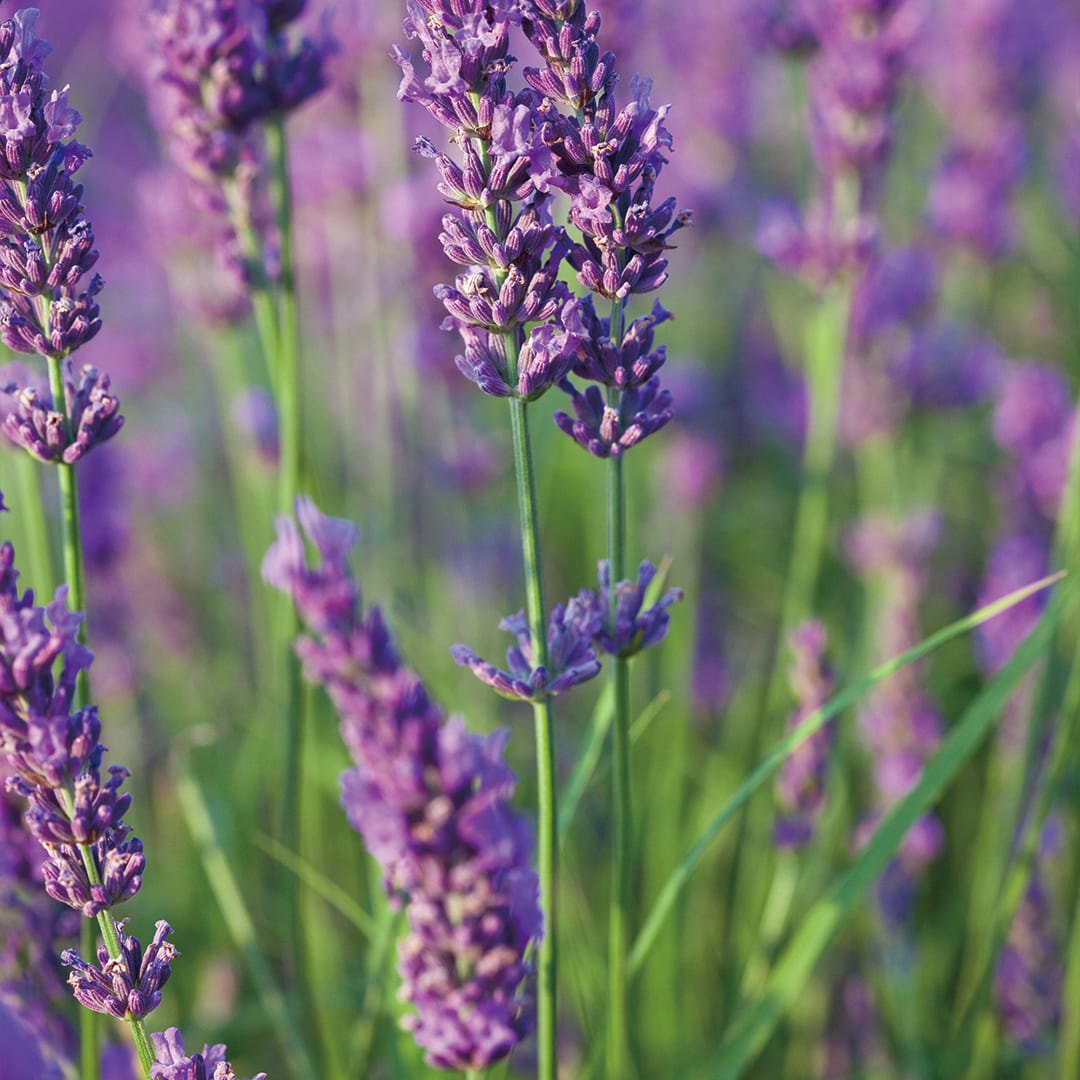
- Plant part
- Flowers
- Vietnamese name
- Oải hương
- Scent family
- Floral
- Plant family
- Lamiaceae
- Lots published
- —
 Flowers
Composition profile
The composition in the article, read as structure: 8 compounds, each with its chemical class and note. The article gives only a standard’s permitted ranges, not measurements.
| Compound | Level | Class | Note |
|---|---|---|---|
| Linalyl acetate EU | 25–45 % | Esters | Middle |
| Linalool EU | 25–38 % | Alcohols | Middle |
| cis-β-Ocimene | 4–10 % | Monoterpenes | Top |
| Terpinen-4-ol | 2–6 % | Alcohols | Middle |
| Lavandulyl acetate | ≥ 2.0 % | Esters | Base |
| 1,8-Cineole | ≤ 1.0 % | Oxides | Top |
| Camphor EU | ≤ 0.5 % | Ketones | Middle |
| Limonene EU | ≤ 0.5 % | Monoterpenes | Top |
No group totals: these are a standard’s permitted ranges, and adding ranges does not give the composition of any real sample.
Compare with the 2 chemically closest oils Which other oils are rich in Linalyl acetate?
Three plants all called lavender
The oil on this page is true lavender, Lavandula angustifolia, also called English lavender. Two others are often sold under the same word:
- Lavandin, Lavandula × intermedia. The plant yields far more oil, so the oil is much cheaper. It has more camphor, so it smells sharper and cooler.
- Spike lavender, Lavandula latifolia. Rich in 1,8-cineole and camphor, it smells closer to rosemary than to a flower.
Vietnam has a national standard for true lavender oil, TCVN 11883:2017; the international standard is ISO 3515:2002, confirmed in 2023. A label saying only “lavender oil” without the botanical name does not tell you which one you are holding, and lavandin is one of the oils most often blended into true lavender.
Composition: standards and reality
| Compound | ISO 3515 (France) | European Pharmacopoeia | Lavandin ‘Grosso’ |
|---|---|---|---|
| Linalool | 25–38% | 20–45% | 34.25% |
| Linalyl acetate | 25–45% | 25–47% | 27.24% |
| Camphor | ≤ 0.5% | – | 7.24% |
| 1,8-Cineole | ≤ 1.0% | ≤ 2.5% | 5.67% |
| Terpinen-4-ol | 2–6% | – | – |
| Lavandulyl acetate | ≥ 2.0% | ≥ 0.2% | – |
| (Z)-β-Ocimene | 4–10% | – | – |
| Limonene | ≤ 0.5% | < 1% | – |
The ISO column gives the ranges for population lavender, mainly from the south of France, which we read through a table quoted in a 2020 study; ISO 3515 also has other columns for clonal lavender and other origins. The European Pharmacopoeia column (10th edition) was read through a 2021 study. The lavandin column is the mean for the ‘Grosso’ clone grown in Spain, from a 2024 study; a dash means it was not reported.
Two points stand out. First, camphor is the clearest marker: true lavender under ISO has no more than 0.5%, while ‘Grosso’ lavandin averages over 7%. Second, real oils do not always sit neatly inside the standard. A study of 13 cultivars grown in Ukraine found linalool from 11.4% to 46.7% and linalyl acetate from 7.4% to 44.2%; a study of commercial oils in Bulgaria found one sample with linalyl acetate below the Pharmacopoeia limit. The right species is not enough; only the batch analysis shows whether the oil meets the standard.
The two compounds behind it, and how fakes give themselves away
The smell of lavender rests mainly on linalool and linalyl acetate. Both have cheap synthetic versions, so a common adulteration is to add them to lavandin oil to “make up the numbers”.
An ordinary GC/MS analysis struggles to catch this, because the percentages still look right. What gives it away is molecular structure. Linalool exists in two mirror-image forms. The lavender plant makes almost only one of them, while synthetic linalool contains both in equal amounts. Chiral chromatography measures that ratio. The article on chiral chromatography explains how.
Lavender cannot protect itself from oxidation
Many people think of lavender as the “gentlest” oil. In smell, perhaps; in storage, no. A 2008 study showed that lavender oil lacks natural protection against oxidation. In contact with air, the linalool and linalyl acetate in the oil form hydroperoxides, which are strong contact allergens.
So a bottle of lavender opened long ago and kept somewhere bright and warm can irritate someone who used it without trouble before. Keep it tightly capped, somewhere cool, and use it within a reasonable time. The storage page has more detail.
Sources
- TCVN 11883:2017. Oil of lavender (Lavandula angustifolia Mill.).
- ISO 3515:2002. Oil of lavender (Lavandula angustifolia Mill.), confirmed 2023.
- Despinasse et al. (2020). Plants 9(12), 1640. doi:10.3390/plants9121640
- Pokajewicz et al. (2021). Molecules 26(18), 5681. doi:10.3390/molecules26185681
- Todorova et al. (2023). International Journal of Analytical Chemistry 2023, 1997157. doi:10.1155/2023/1997157
- Ortiz de Elguea-Culebras et al. (2024). Journal of Applied Research on Medicinal and Aromatic Plants 41, 100550. doi:10.1016/j.jarmap.2024.100550
- Capetti et al. (2021). Molecules 26(18), 5610. doi:10.3390/molecules26185610
- Hagvall et al. (2008). Lavender oil lacks natural protection against autoxidation, forming strong contact allergens on air exposure. Contact Dermatitis 59(3), 143–150. doi:10.1111/j.1600-0536.2008.01402.x
Buy Lavender
Lavender oil: no lot has been brought in yet, so it is not on sale. Message us if you need it.
Where you may already have smelled it
According to the analyses cited above, this oil contains up to 38 % linalool. It is also the leading compound in the scenes below from the scent dictionary. Smelling one of those scenes again is a way to get to know it without opening a bottle. A shared compound does not mean the oil smells exactly like the scene.
Chemically close
The oils whose published composition is closest to this one, compared across every compound we could read. Close in composition does not mean the scent is identical or that one can replace the other.
- Lavandin Lavandula × intermedia shared: Linalool, Linalyl acetate · closeness 0.94 · compare
- Petitgrain Citrus aurantium var. amara shared: Linalyl acetate, Linalool · closeness 0.94 · compare
- Clary sage Salvia sclarea shared: Linalyl acetate, Linalool · closeness 0.90 · compare
Further reading
Close to Lavender
Same plant family: Lamiaceae Bergamot mint · Clary sage · Holy basil (tulsi) · Melissa · Perilla · Spearmint · Spike lavender · Thyme ct thymol
Also from the flowers Blue tansy · Champaca · Clary sage · Clove bud · German chamomile · Neroli · Night jasmine · Spike lavender
Same method: direct steam distillation Blue cypress · Ceylon cinnamon · Fokienia · Geranium · Melissa · Spike lavender · Thyme ct linalool · Vietnamese balm
Quick answers
What does lavender essential oil smell like?
Herbs first, sweetness after. The opening has a green note close to hay, then the soft sweetness appears and stays for quite a while.
What is the botanical name of lavender oil?
The plant is Lavandula angustifolia, in the Lamiaceae family. In Vietnamese it is called oải hương.
How is lavender oil produced?
From the flowers of the plant, by direct steam distillation. See the method for what that does to the oil.
What are the main compounds of lavender oil?
From the composition data on this page, the oil is led by Linalyl acetate, Linalool and cis-β-Ocimene. Proportions vary with origin, harvest and method; a lot analysis is the only answer for a given bottle.
Last updated