Essential oils · Woody & Resinous family
Frankincense frereana essential oil
Boswellia frereana
Nhũ hương Frereana · Burseraceae
Resin, light lemon and a sweet, slightly anise-like note. A batch low in α-pinene has less pine than other frankincense oils and is rounder.
Boswellia frereana grows in northern Somalia, and its resin is commonly chewed like gum in the Arab world. Its oil varies widely from tree to tree: α-pinene from 3% to 63%, while α-thujene is always substantial, at 14.5% or more.
The frankincense page compares the four Boswellia species in this catalogue. The species on the label is what to check, because the four give four smells.
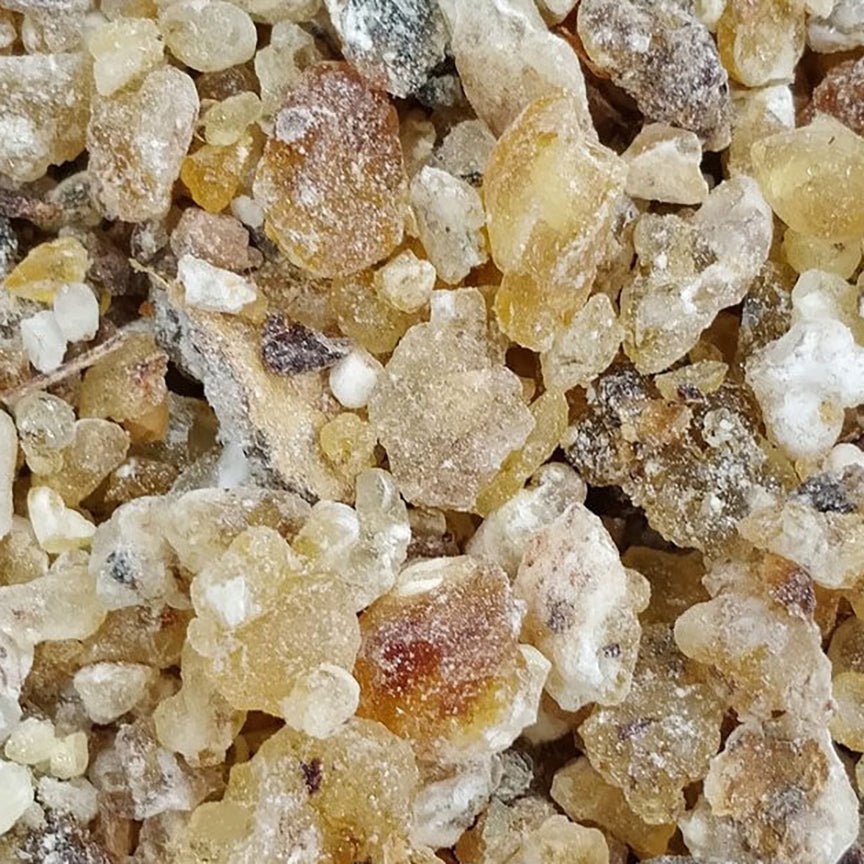
- Plant part
- Resin
- Vietnamese name
- Nhũ hương Frereana
- Scent family
- Woody & Resinous
- Plant family
- Burseraceae
- Lots published
- —
 Resin
Composition profile
The published composition from the article, read as structure: 4 compounds adding up to about 77 % of the sample. Figures are printed as the source gives them — one sample, not a species average.
| Compound | Level | Class | Note |
|---|---|---|---|
| α-Pinene EU | 48.6 % | Monoterpenes | Top |
| α-Thujene | 17.5 % | Monoterpenes | Top |
| p-Cymene | 7.1 % | Monoterpenes | Top |
| Sabinene | 3.6 % | Monoterpenes | Top |
By chemical class
- Monoterpenes76.8 %
By note
- Top76.8 %
Group totals use the upper bound of each range and only the compounds the article lists; bars are relative to the identified total.
Compare with the 2 chemically closest oils Which other oils are rich in α-Pinene?
What frereana frankincense is
Boswellia frereana is a frankincense species endemic to Somaliland and Somalia, in the Horn of Africa. The oil is distilled from the resin. According to a 2021 study, the resin is commonly used as chewing gum in the Arab world. It is one of four Boswellia species in the directory; the frankincense page compares all four.
Composition: 12 trees in Somaliland
The 2021 study in Natural Product Communications took resin from 12 individual trees in the Sanaag region, near Ceel Dibir (Somaliland), collected in October 2019, hydrodistilled it (yield around 13% by weight) and analysed it by GC-MS. These are the ranges across the 12 trees:
| Compound | Range (%) |
|---|---|
| α-Pinene | 3.0–63.0 |
| α-Thujene | 14.5–43.9 |
| p-Cymene | 1.7–13.0 |
| Sabinene | 3.3–8.0 |
| α-Phellandrene | 0.0–6.0 |
| β-Pinene | 0.3–4.1 |
| Limonene | 0.5–2.7 |
| β-Phellandrene | 0.1–2.5 |
| Bornyl acetate | 0.2–1.9 |
| Terpinen-4-ol | 0.4–1.8 |
One sample had 6.0% α-phellandrene and 10.0% of its dimers in total. The authors conclude that the samples still represent “a single, variable chemotype”.
One chemotype or two
Two years earlier, the same group published a comparison table for B. frereana oil from Somalia (unpublished results from their own laboratory, sample count not given) and wrote that there seemed to be two chemotypes:
| Compound | Type 1 | Type 2 |
|---|---|---|
| α-Pinene | 48.6% (24.7–67.9) | 2.3% (2.0–2.6) |
| α-Thujene | 17.5% (0.0–34.7) | 44.4% (33.1–51.3) |
| p-Cymene | 7.1% (2.1–12.3) | 14.0% (9.9–16.9) |
| Sabinene | 3.6% (2.2–7.0) | 6.9% (5.1–8.3) |
Means, with ranges in brackets. One type is rich in α-pinene and α-thujene; the other is led by α-thujene and p-cymene. With the 12 trees of 2021, values spread continuously between those two poles, so the authors merged them into one variable chemotype.
Whether one type or two, the conclusion for a buyer is the same: α-pinene can be a few per cent in one bottle and more than half in another. Two bottles of frereana can differ clearly, one leaning towards the pine-resin note of α-pinene, the other towards α-thujene, sabinene and p-cymene. The analysis of each lot matters more than the species name.
No boswellic acids found
The 2021 study also analysed the dichloromethane extract of resin from 7 trees. It was rich in triterpenoids: lupeol 14.7–32.5%, α-amyrin 13.0–25.2%, 3-epi-lupeol 6.4–14.2%, β-amyrin 5.3–8.0%. The authors write that, as in earlier studies, they found no boswellic or lupeolic acids, which are common in other Boswellia species, but they also note that these acids may not be volatile enough to be detected by GC-MS. As the frankincense page explains, boswellic acids, even when present in a resin, do not pass into the distilled oil.
Safety
We have not read an IFRA standard specific to B. frereana oil, and Regulation (EU) 2023/1545 has no entry for frankincense oil. However, the pinene and limonene in the oil are on the EU list of fragrance allergens that must be declared on cosmetic labels. Oils rich in monoterpenes oxidise easily, so store it airtight, and always dilute before use on skin.
Sources
- Johnson S., DeCarlo A., Satyal P., Dosoky N.S., Sorensen A., Setzer W.N. (2021). The Chemical Composition of Single-Tree Boswellia frereana Resin Samples. Natural Product Communications 16(9). doi:10.1177/1934578X211043727
- Johnson S., DeCarlo A., Satyal P., Dosoky N.S., Sorensen A., Setzer W.N. (2019). The Chemical Composition of Boswellia occulta Oleogum Resin Essential Oils. Natural Product Communications 14(7). doi:10.1177/1934578X19866307
- Regulation (EU) 2023/1545 on the labelling of fragrance allergens.
Buy Frankincense frereana
Frankincense frereana oil: no lot has been brought in yet, so it is not on sale. Message us if you need it.
Where you may already have smelled it
According to the analyses cited above, this oil contains up to 48.6 % α-pinene. It is also the leading compound in the scenes below from the scent dictionary. Smelling one of those scenes again is a way to get to know it without opening a bottle. A shared compound does not mean the oil smells exactly like the scene.
Chemically close
The oils whose published composition is closest to this one, compared across every compound we could read. Close in composition does not mean the scent is identical or that one can replace the other.
- Frankincense Boswellia carterii shared: α-Pinene, α-Thujene · closeness 0.95 · compare
- Frankincense sacra Boswellia sacra shared: α-Pinene · closeness 0.93 · compare
- Pinyon pine Pinus edulis shared: α-Pinene · closeness 0.91 · compare
Further reading
Close to Frankincense frereana
Same plant family: Burseraceae Elemi · Frankincense sacra · Frankincense serrata · Myrrh · Opopanax
Also from the resin Benzoin · Frankincense sacra · Frankincense serrata · Mastic · Opopanax · Peru balsam
Same method: direct steam distillation Frankincense sacra · Frankincense serrata · Holy basil (tulsi) · Nutmeg · Peru balsam · Roman chamomile · Tea tree · Wintergreen
Quick answers
What does frankincense frereana essential oil smell like?
Resin, light lemon and a sweet, slightly anise-like note. A batch low in α-pinene has less pine than other frankincense oils and is rounder.
What is the botanical name of frankincense frereana oil?
The plant is Boswellia frereana, in the Burseraceae family. In Vietnamese it is called nhũ hương frereana.
How is frankincense frereana oil produced?
From the resin of the plant, by direct steam distillation. See the method for what that does to the oil.
Last updated