Essential oils · Gourmand family
Saffron essential oil
Crocus sativus
Nghệ tây · Iridaceae
Honey, hay, leather and a slightly bitter metallic note. It is sweet and rich, and it lingers.
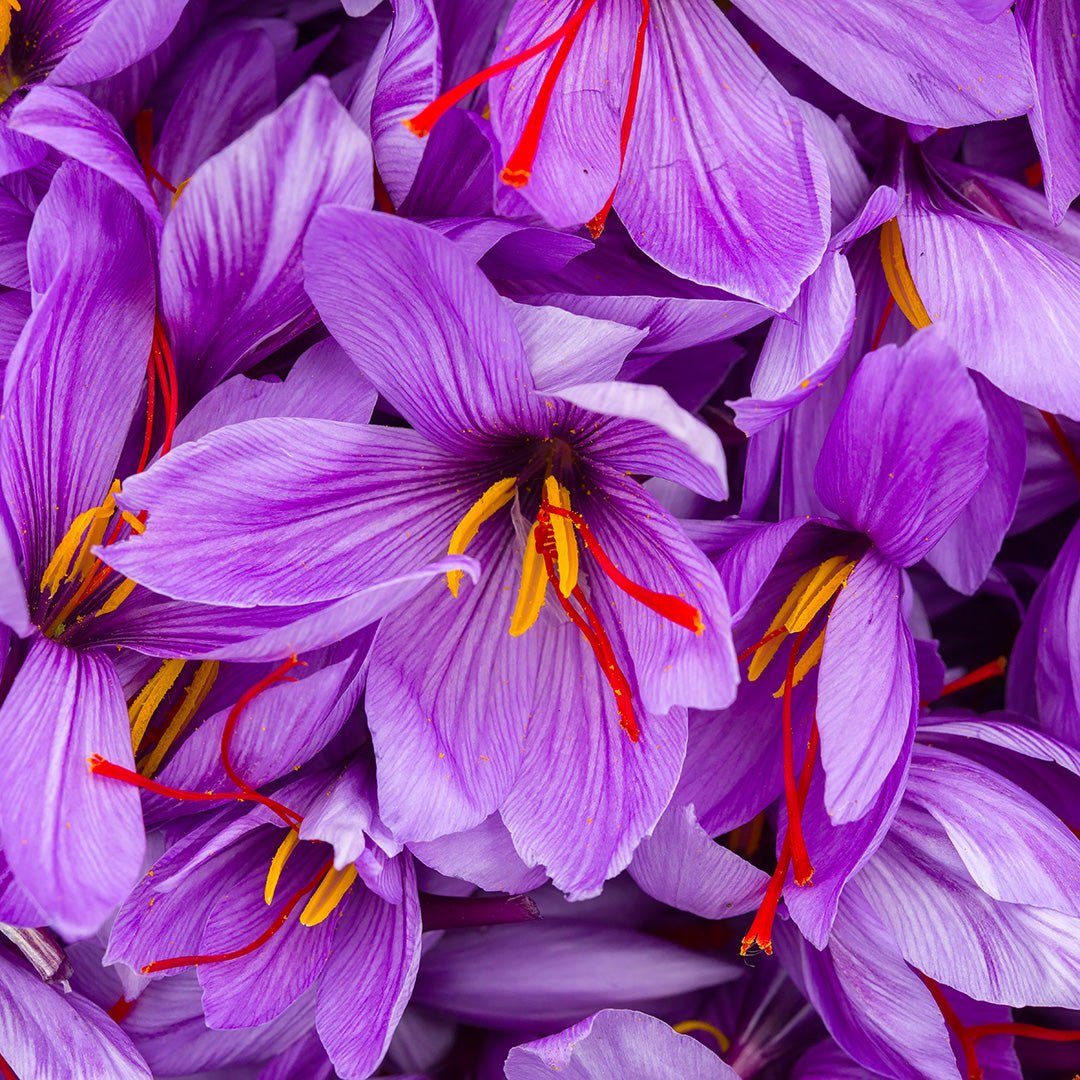
Saffron is the dried stigma of Crocus sativus. Its main odorant is safranal. The red-gold colour comes from crocin, which does not evaporate.
In perfumery, saffron is usually found as an extract such as an oleoresin or a tincture; we have not read a source confirming whether a distilled saffron essential oil exists on the market. A cheap bottle of “saffron essential oil” deserves a clear answer about what it really is.
- Plant part
- Flowers
- Method
- Hot maceration
- Vietnamese name
- Nghệ tây
- Scent family
- Gourmand
- Plant family
- Iridaceae
- Lots published
- —
 Flowers
What saffron is
Saffron is the dried stigma of Crocus sativus. Three groups of compounds give it its value: crocin for colour, picrocrocin for bitterness and safranal for aroma.
| Compound group | Role | Content (literature) |
|---|---|---|
| Crocin | red-yellow colour, non-volatile | 6–16% of dry mass |
| Picrocrocin | bitterness | about 1–13%, some sources up to 26% of dry mass |
| Safranal | main aroma | about 30–70% of the essential oil; over 65% of aroma components in La Mancha saffron |
Safranal: the aroma
A 2022 study of 8 saffron samples from Campania, Italy, analysed the headspace by HS-SPME GC-MS: safranal made up 92% of total volatiles in three samples, but only 43% in one wild sample. Isophorones (α-, β-, 4-ketoisophorone and relatives) were present in almost every sample.
Safranal gives saffron its characteristic smell: warm, slightly metallic, like hay and honey. It is present in very small amounts by weight: a 2008 study measured 2.23–2.57 mg of safranal per gram of stigma extract, against 230–342 mg/g of crocins.
Saffron in perfumery
The forms of saffron used in fragrance that we have read about are oleoresin (for example a “5% saffron oleoresin” from Kashmir stigmas made by Biolandes) and tincture. We have not read any source confirming whether or not a steam-distilled saffron essential oil exists on the market. So a bottle of “saffron essential oil” should prompt the question: is it an extract, a tincture, or a fragrance blend with synthetic safranal?
The ISO 3632 standard
Saffron stigma quality is graded under ISO 3632 using three spectrophotometric measures (as quoted in a 2022 study):
| Category | Colouring strength (crocin) | Bittering strength (picrocrocin) | Aroma strength (safranal) |
|---|---|---|---|
| I | ≥ 200 | ≥ 70 | 20–50 |
| II | 170–199 | 55–69 | 20–50 |
| III | 120–169 | 40–54 | 20–50 |
Moisture and volatile matter must be below 12% for filaments and below 10% for powder.
Adulteration
A 2023 review calls saffron “one of the most targeted products for fraudulent practices”. Recorded adulterants include safflower petals, marigold, turmeric (in powder), stigmas of other Crocus species and synthetic dyes. An EU-wide survey in 2021 found 11% of saffron samples suspicious; the overall figure for herbs and spices was 17%, and for oregano 48%. A 2023 study found that 65% of saffron food supplements tested did not match their declared content.
Safety
We have not read any IFRA standard or cosmetics regulation specific to saffron. For extracts used in fragrance, ask the supplier for its IFRA documentation, and always dilute.
Sources
- Cozzolino R., Stocchero M., Perestrelo R. et al. (2022). Comprehensive Evaluation of the Volatomic Fingerprint of Saffron from Campania towards Its Authenticity and Quality. Foods 11(3), 366. doi:10.3390/foods11030366
- Bagur M.J., Alonso Salinas G., Jimenez-Monreal A.M. et al. (2018). Saffron: An Old Medicinal Plant and a Potential Novel Functional Food. Molecules 23(1), 30. doi:10.3390/molecules23010030
- Aissa R., Ibourki M., Ait Bouzid H. et al. (2023). Phytochemistry, quality control and medicinal uses of Saffron (Crocus sativus L.): an updated review. Journal of Medicine and Life 16(6), 822–836. doi:10.25122/jml-2022-0353
- Bergomi A., Comite V., Santagostini L. et al. (2022). Determination of Saffron Quality through a Multi-Analytical Approach. Foods 11(20), 3227. doi:10.3390/foods11203227
- Maquet A., Lievens A., Paracchini V. et al. (2021). Results of an EU wide coordinated control plan to establish the prevalence of fraudulent practices in the marketing of herbs and spices. JRC, EUR 30877 EN. doi:10.2760/309557
- Mena-Garcia A., Sanz M.L., Diez-Municio M. et al. (2023). A Combined Gas and Liquid Chromatographic Approach for Quality Evaluation of Saffron-Based Food Supplements. Foods 12(22), 4071. doi:10.3390/foods12224071
Buy Saffron
Saffron oil: no lot has been brought in yet, so it is not on sale. Message us if you need it.
Further reading
Close to Saffron
Also from the flowers Clary sage · German chamomile · Hops · Lavender · Roman chamomile · Rose absolute · Spike lavender · Ylang ylang
Same method: hot maceration St John’s wort
Quick answers
What does saffron essential oil smell like?
Honey, hay, leather and a slightly bitter metallic note. It is sweet and rich, and it lingers.
What is the botanical name of saffron oil?
The plant is Crocus sativus, in the Iridaceae family. In Vietnamese it is called nghệ tây.
How is saffron oil produced?
From the flowers of the plant, by hot maceration. See the method for what that does to the oil.
Last updated