Essential oils · Fermented family
Hops essential oil
Humulus lupulus
Hoa bia · Cannabaceae
Green, lightly bitter, fruity, with a touch of ripe cheese. Anyone who has smelled a heavily hopped craft beer will recognise it at once.
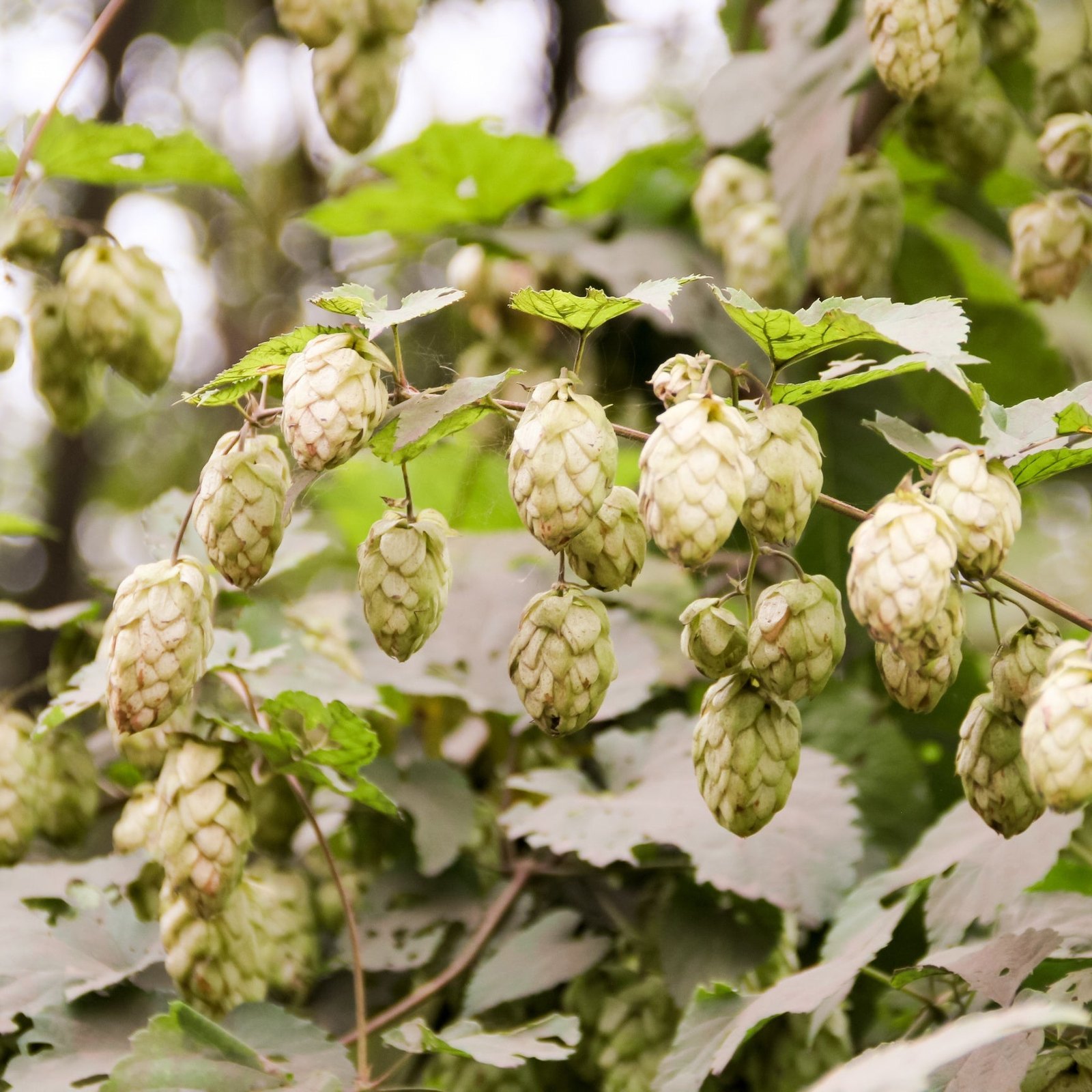
Hop oil (Humulus lupulus) is distilled from the female cones. The main compounds are usually myrcene, α-humulene and β-caryophyllene. Myrcene gives the fresh green part; humulene and caryophyllene give the spicy wood.
Composition varies a great deal with hop variety, which is exactly why brewers choose different varieties for different beers. A bottle of “hop oil” should name the variety.
- Plant part
- Flowers
- Vietnamese name
- Hoa bia
- Scent family
- Fermented
- Plant family
- Cannabaceae
- Lots published
- —
 Flowers
Composition profile
The published composition from the article, read as structure: 6 compounds adding up to about 81 % of the sample. Figures are printed as the source gives them — one sample, not a species average.
| Compound | Level | Class | Note |
|---|---|---|---|
| Myrcene | 40.57 % | Monoterpenes | Top |
| α-Humulene | 22.05 % | Sesquiterpenes | Base |
| β-Caryophyllene EU | 8.93 % | Sesquiterpenes | Base |
| β-Farnesene | 7.57 % | — | — |
| 2-Methylbutyl isobutyrate | 0.98 % | — | — |
| 2-Undecanone | 0.75 % | — | — |
By chemical class
- Monoterpenes40.6 %
- Sesquiterpenes31.0 %
- Unclassified9.3 %
By note
- Top40.6 %
- Base31.0 %
- Unclassified9.3 %
Group totals use the upper bound of each range and only the compounds the article lists; bars are relative to the identified total.
Put it beside another oil in the Compare tool Which other oils are rich in Myrcene?
What hop oil is
Hops (Humulus lupulus) are a climbing plant of the hemp family, grown mainly for the female cones used in brewing. The volatile oil in those cones is the source of the “hoppy” aroma in beer: green, resinous, sometimes fruity or floral. Steam-distilled hop oil is a concentrated form of that aroma.
Composition: three South African varieties
A 2025 study in Life distilled oil at industrial scale from fresh plant material (leaves, cones and bracts) of South African hop varieties:
| Compound | African Queen | Southern Aroma | XJA2/436 |
|---|---|---|---|
| Myrcene | 40.57% | 27.80% | 48.15% |
| α-Humulene | 22.05% | 24.07% | 19.52% |
| β-Caryophyllene | 8.93% | 13.36% | 8.47% |
| β-Farnesene | 7.57% | 4.23% | 5.11% |
| 2-Methylbutyl isobutyrate | 0.98% | 0.30% | 0.77% |
| 2-Undecanone | 0.75% | 0.99% | 0.43% |
The average yield was 0.8 g of oil per 100 g of biomass. Note that this material included leaves, not just cones.
Reading the table: myrcene versus humulene
The top three compounds make up roughly two-thirds to three-quarters of the oil, and the balance between them sets each variety’s character:
- Myrcene gives the green, resinous, slightly overripe-fruit part. XJA2/436, nearly half myrcene, will be the freshest and most “resinous”.
- α-Humulene (named after Humulus itself) and β-caryophyllene give the woody, spicy, dry part. Southern Aroma has the least myrcene and the most of these two, so it is deeper and spicier.
- Minor compounds such as the ester 2-methylbutyl isobutyrate and the ketone 2-undecanone are each below 1%. They do not set the framework of the smell, but they are part of why two varieties with similar ratios of the main three still do not smell identical.
Oil and extract are different things
Besides distilled oil, hops are also made into supercritical CO₂ extracts. According to a 2018 EFSA opinion, one CO₂ extract used as a feed flavouring contained 40% β-acids and only 1.5% hop oil. EFSA judged that extract corrosive to skin and eyes in the presence of water and a potential skin and respiratory sensitiser, and stated that its conclusions do not extend to other hop extracts. When buying a “hop extract”, it matters whether it is a distilled oil or an extract.
With hop oil, always dilute before use on skin.
Sources
- de Smidt O., du Plessis W., Zacharia P.R. et al. (2025). Comparison of Major Compounds in Essential Oils Steam Distilled from Fresh Plant Material of South African Hop Varieties. Life 15, 282. doi:10.3390/life15020282
- EFSA FEEDAP Panel (2018). Safety and efficacy of a super critical carbon dioxide extract of Humulus lupulus L. flos when used as a feed flavouring for all animal species. EFSA Journal 16(10), 5462. doi:10.2903/j.efsa.2018.5462
Buy Hops
Hops oil: no lot has been brought in yet, so it is not on sale. Message us if you need it.
Where you may already have smelled it
According to the analyses cited above, this oil contains up to 40.6 % myrcene and up to 22.1 % α-humulene. Both are also part of, though not the lead in, the scenes below from the scent dictionary. Smelling one of those scenes again is a way to get to know them without opening a bottle. A shared compound does not mean the oil smells exactly like the scene.
Further reading
Close to Hops
Also from the flowers Blue tansy · Champaca · Linden blossom · Moroccan blue chamomile · Neroli · Pomelo blossom · Rose absolute · Tagetes
Same method: direct steam distillation Guava leaf · Moroccan blue chamomile · Neroli · Palmarosa · Rose otto · Tagetes · Tarragon · Utah juniper
Quick answers
What does hops essential oil smell like?
Green, lightly bitter, fruity, with a touch of ripe cheese. Anyone who has smelled a heavily hopped craft beer will recognise it at once.
What is the botanical name of hops oil?
The plant is Humulus lupulus, in the Cannabaceae family. In Vietnamese it is called hoa bia.
How is hops oil produced?
From the flowers of the plant, by direct steam distillation. See the method for what that does to the oil.
What are the main compounds of hops oil?
From the composition data on this page, the oil is led by Myrcene, α-Humulene and β-Caryophyllene. Proportions vary with origin, harvest and method; a lot analysis is the only answer for a given bottle.
Last updated