Essential oils · Floral family
St John’s wort essential oil
Hypericum perforatum
Cỏ ban · Hypericaceae
Dry, green grass, slightly resinous and a little sweet like straw. It is light, with no single note standing out.
St John’s wort essential oil (Hypericum perforatum) is distilled from the flowering tops and is quite different from the familiar red “St John’s wort oil”. The red oil is the flowers macerated in vegetable oil; according to the European Medicines Agency, its colour comes from breakdown products formed while the flowers steep in sunlight, and the macerate does not in fact contain hypericin.
So a bottle labelled “essential oil” that is deep red is almost certainly a macerate. The two products differ in both composition and use.
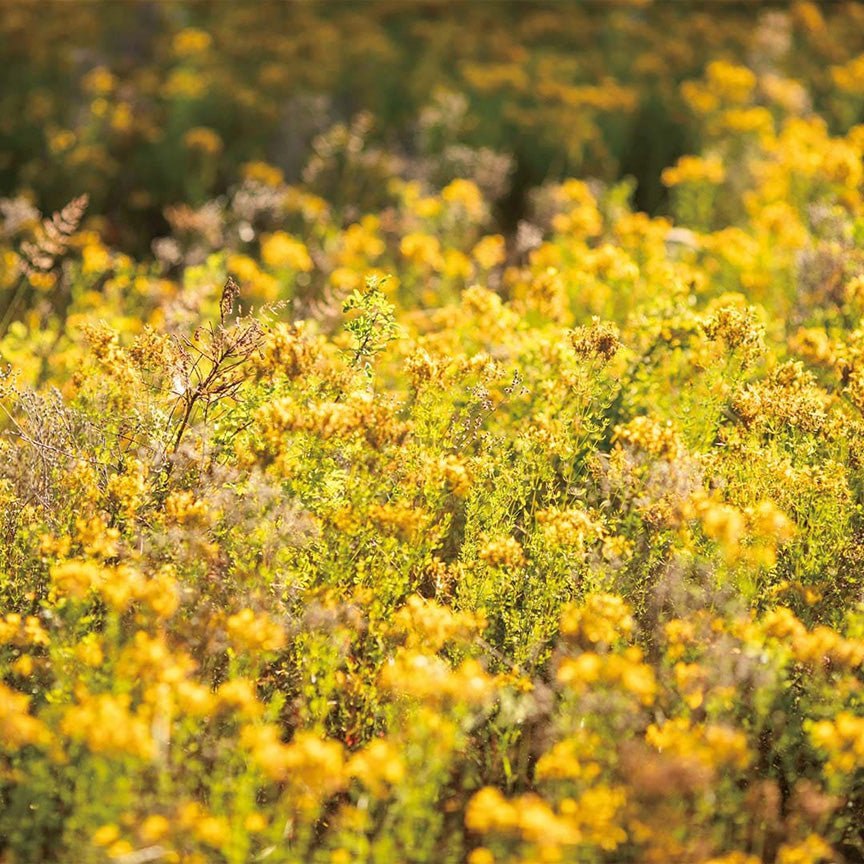
- Plant part
- Flowers
- Method
- Hot maceration
- Vietnamese name
- Cỏ ban
- Scent family
- Floral
- Plant family
- Hypericaceae
- Lots published
- —
 Flowers
Composition profile
The published composition from the article, read as structure: 4 compounds adding up to about 82 % of the sample. Figures are printed as the source gives them — one sample, not a species average.
| Compound | Level | Class | Note |
|---|---|---|---|
| α-Pinene EU | 3.7–36.5 % | Monoterpenes | Top |
| Caryophyllene oxide | 3.3–17.7 % | Oxides | Base |
| 2-Methyloctane | 1.1–15.5 % | — | — |
| β-Caryophyllene EU | 1.2–12.4 % | Sesquiterpenes | Base |
By chemical class
- Monoterpenes36.5 %
- Oxides17.7 %
- Unclassified15.5 %
- Sesquiterpenes12.4 %
By note
- Top36.5 %
- Base30.1 %
- Unclassified15.5 %
Group totals use the upper bound of each range and only the compounds the article lists; bars are relative to the identified total.
Compare with the 2 chemically closest oils Which other oils are rich in α-Pinene?
What St John’s wort essential oil is
St John’s wort essential oil is steam- or hydrodistilled from the flowering tops of Hypericum perforatum. According to a 2009 assessment report from the European Medicines Agency (EMA), the herb contains only about 0.1–0.25% essential oil, so very little oil is obtained. This product is quite different from the familiar red “St John’s wort oil”, which is the flowers macerated in vegetable oil.
Composition: very wide variation
| Compound | Kosovo, 5 wild populations (2014) | Bulgaria, flowers (2024) | Montana, leaves (2020) |
|---|---|---|---|
| α-Pinene | 3.7–36.5% | 27.52% | 4.9% |
| 2-Methyloctane | 1.1–15.5% | – | – |
| β-Caryophyllene | 1.2–12.4% | 6.77% | 9.5% |
| Germacrene D | – | 6.37% | 25.7% |
| Caryophyllene oxide | 3.3–17.7% | 4.48% | 1.2% |
A dash means it was not reported. The Kosovo samples were aerial parts, steam-distilled; we read only the abstract, which also reports n-tetradecanol at 3.6–10.4%. The Bulgarian sample also had β-pinene at 10.08%. In Montana, the study distilled flowers and leaves separately: the flower oil had only 2.2% α-pinene and no germacrene D detected, while the leaf oil had 25.7% germacrene D.
The EMA notes that the essential oil of the dried flowering tops has 2-methyloctane (16%) and α-pinene (10.6%) as its main compounds. A 2005 study in Sardinia recorded 2-methyloctane 21.1%, germacrene D 17.6% and α-pinene 15.8% in the inflorescence oil.
Reading the table
A 2022 review of Hypericum essential oils adds further cases: one Albanian sample with 31.0% caryophyllene oxide, one Iranian study in which decane made up 59.6%. The authors conclude that, because of this variability, essential-oil composition should not be used as a classification marker. For a buyer, it means two bottles of St John’s wort essential oil can smell very different; the batch analysis is what to look at.
Essential oil and the red macerate
Red St John’s wort oil (Hyperici oleum) is a liquid extract of the flowers in vegetable oil. The EMA report states that this macerate “does not contain hypericin”: its red colour comes from lipophilic breakdown products formed while the flowers steep in sunlight. The distilled essential oil does not have that red colour. So a bottle labelled “essential oil” that is deep red is almost certainly a macerate.
Hypericin and light
Hypericin is the constituent of the plant that the EMA identifies as the main phototoxic one. The EMA’s 2021 draft monograph for St John’s wort oil used on the skin advises avoiding intense UV exposure of the treated skin. That note applies to the macerate; we have not read any source assessing the photosensitivity of the distilled essential oil specifically.
Its smell
α-Pinene gives a bright pine-resin note; β-caryophyllene and germacrene D give a woody, slightly spicy one; 2-methyloctane is almost odourless. Overall it is a dry, green, slightly resinous grassy smell, with no single note standing out.
Safety
We have not read any IFRA standard or EU rule specific to St John’s wort essential oil. Always dilute and test on a small patch of skin before use.
Sources
- Hajdari A., Mustafa B., Nebija D. et al. (2014). Essential oil composition and variability of Hypericum perforatum L. from wild population in Kosovo. Current Issues in Pharmacy and Medical Sciences 27(1), 51–54. doi:10.2478/cipms-2014-0013
- Tumbarski Y., Ivanov I., Todorova M. et al. (2024). Chemical Composition and Biological Activities of St John’s Wort (Hypericum perforatum L.) Essential Oil from Bulgaria. Applied Sciences 14(24), 11754. doi:10.3390/app142411754
- Schepetkin I.A., Ozek G., Ozek T. et al. (2020). Chemical Composition and Immunomodulatory Activity of Hypericum perforatum Essential Oils. Biomolecules 10(6), 916. doi:10.3390/biom10060916
- Pintore G.A.M., Chessa M., Boatto G. et al. (2005). Essential oil composition of Hypericum perforatum L. var. angustifolium DC growing wild in Sardinia (Italy). Journal of Essential Oil Research 17(5), 533–535. doi:10.1080/10412905.2005.9698986
- Grafakou M.-E., Barda C., Karikas G.A. et al. (2022). Hypericum Essential Oils — Composition and Bioactivities: An Update (2012–2022). Molecules 27(16), 5246.
- EMA/HMPC (2009). Assessment report on Hypericum perforatum L., herba, EMA/HMPC/101303/2008.
- EMA/HMPC (2021). Draft monograph on Hypericum perforatum L., herba (traditional use), EMA/HMPC/7695/2021.
Buy St John’s wort
St John’s wort oil: no lot has been brought in yet, so it is not on sale. Message us if you need it.
Where you may already have smelled it
According to the analyses cited above, this oil contains up to 36.5 % α-pinene. It is also the leading compound in the scenes below from the scent dictionary. Smelling one of those scenes again is a way to get to know it without opening a bottle. A shared compound does not mean the oil smells exactly like the scene.
Chemically close
The oils whose published composition is closest to this one, compared across every compound we could read. Close in composition does not mean the scent is identical or that one can replace the other.
- Frankincense sacra Boswellia sacra shared: α-Pinene · closeness 0.81 · compare
- Mastic Pistacia lentiscus shared: α-Pinene, β-Caryophyllene · closeness 0.80 · compare
- Pinyon pine Pinus edulis shared: α-Pinene · closeness 0.79 · compare
Further reading
Close to St John’s wort
Also from the flowers Everlasting Madagascar · Hops · Immortelle Madagascar · Jasmine sambac · Lavender · Moroccan blue chamomile · Night jasmine · Tuberose
Same method: hot maceration Saffron
Quick answers
What does St John’s wort essential oil smell like?
Dry, green grass, slightly resinous and a little sweet like straw. It is light, with no single note standing out.
What is the botanical name of St John’s wort oil?
The plant is Hypericum perforatum, in the Hypericaceae family. In Vietnamese it is called cỏ ban.
How is St John’s wort oil produced?
From the flowers of the plant, by hot maceration. See the method for what that does to the oil.
What are the main compounds of St John’s wort oil?
From the composition data on this page, the oil is led by α-Pinene, Caryophyllene oxide and β-Caryophyllene. Proportions vary with origin, harvest and method; a lot analysis is the only answer for a given bottle.
Is there anything to watch out for with St John’s wort oil?
Photosensitising. Avoid sunlight after applying to skin.
Last updated