Essential oils · Medicinal family
German chamomile essential oil
Matricaria chamomilla
Cúc Đức · Asteraceae
Sweet hay, herbs, with a little tobacco and ripe fruit underneath. It is much deeper and denser than Roman chamomile, and has no apple note.
The oil is ink-blue, and that colour does not exist in the flower. The pigment is chamazulene, formed inside the still when a colourless compound in the flower meets heat and steam. In other words, the blue is a trace of distillation itself.
Because the colour is made in the still, the amount of chamazulene and the depth of blue vary with the raw material and the distillation. Two lots of the same cultivar can differ in how blue they are.
- Plant part
- Flowers
- Vietnamese name
- Cúc Đức
- Scent family
- Medicinal
- Plant family
- Asteraceae
- Lots published
- —
 Flowers
Blue made in the still
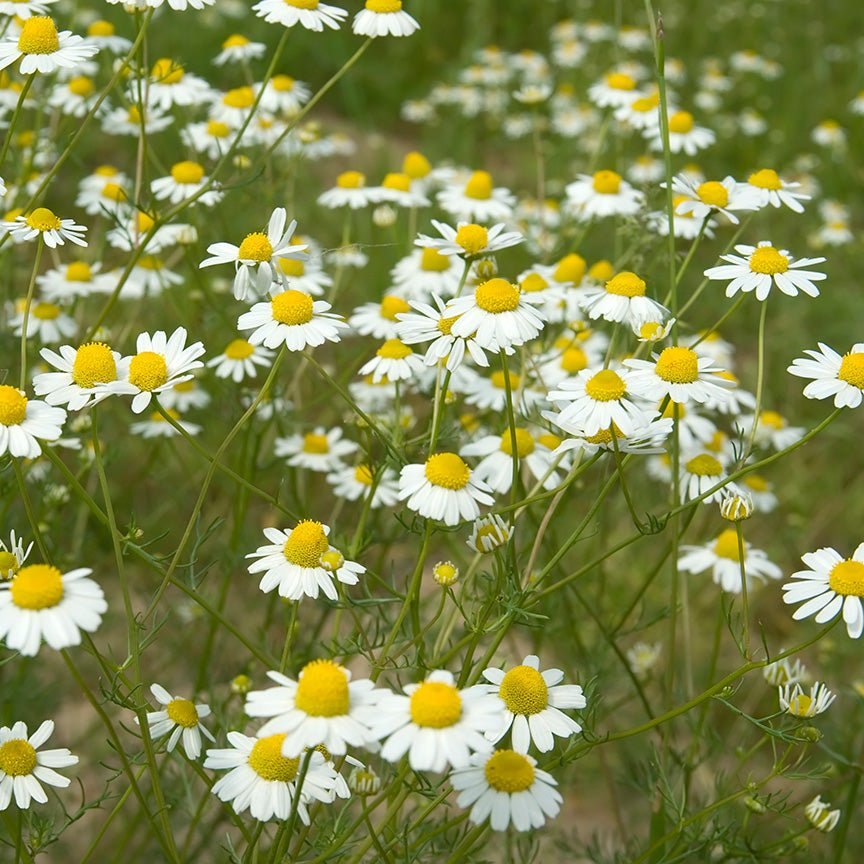
The German chamomile flower (Matricaria chamomilla, also given as M. recutita) is not blue. The ink-blue colour of the oil comes from chamazulene, and according to a 2020 study in Planta Medica International Open, chamazulene is an artefact of the distillation process, formed from matricin, a non-volatile sesquiterpene lactone present in the flower. The European Medicines Agency’s (EMA) 2015 assessment report likewise records that matricin is “at least partially” converted into chamazulene during steam distillation.
So the amount of chamazulene in the oil depends on both the raw material and the distillation, and two lots of the same cultivar can differ in depth of colour. According to the EMA, the literature gives azulenes, mainly chamazulene, at 2–18% of the oil.
Chemotype: bisabolol or bisabolol oxide
The European Pharmacopoeia, as reported by the EMA, recognises two types of German chamomile oil: rich in bisabolol oxides, or rich in (−)-α-bisabolol. A 2003 study in Ars Pharmaceutica distilled dried flowers bought in pharmacies in four countries, plus flowers grown in Tartu (Estonia) from UK seed, by the European Pharmacopoeia method:
| Origin | Oxide A | Oxide B | α-Bisabolol |
|---|---|---|---|
| Estonia | 43.2% | 15.6% | 0.5% |
| France | 54.6% | 6.2% | 2.6% |
| Hungary | 12.6% | 12.2% | 23.6% |
| Belgium | 47.3% | 5.7% | 1.2% |
| Grown in Tartu | 19.7% | 24.8% | 0.4% |
Oxide A and oxide B are α-bisabolol oxides A and B. Chamazulene was only 1.2–4.8% in the four pharmacy samples, but 13.8% in the sample grown in Tartu. Every sample also had cis-en-yn-dicycloether at 13.0–22.2% and (E)-β-farnesene at 2.2–7.1%; oil content was 4.2–6.6 mg per gram of dried flowers. Only the Hungarian sample was of the α-bisabolol-rich type; the other four leaned towards the bisabolol oxides.
The 2020 study analysed six German chamomile oils: four commercial, one from cultivation and one wild-collected. Their compositions differed so much that they could be assigned to several chemotypes:
| Sample group | Dominant compounds |
|---|---|
| Three samples (A, C, D) | Sesquiterpene hydrocarbons, notably (E)-β-farnesene |
| Two samples (B, F) | α-Bisabolol oxides A and B, α-bisabolone oxide A |
| One sample (E) | α-Bisabolol |
Sample E, from Hungary, also had 21.8% azulenes and 16.9% spiroethers, far above the other samples (under 10%). All four commercial samples were unusually high in trans-β-farnesene compared with the other two. The study does not conclude that this was adulteration; the authors note that high farnesene may also come from early harvesting or from distilling stems and leaves.
α-Bisabolol is the compound the cosmetics industry values most in German chamomile oil. So for this oil, the question to ask is not only “is it German chamomile?” but “which type?”. A label saying “German chamomile” without an analysis cannot answer that.
Storage and safety
Store the oil airtight, dark and cool. The EMA herbal monograph on German chamomile oil contraindicates it for people hypersensitive to plants of the daisy family (Asteraceae), records that hypersensitivity reactions can occur, states that safety in children under 12 has not been established, and does not recommend use in pregnancy or breastfeeding for lack of data. Always dilute before use on skin.
German chamomile is not Roman chamomile
Roman chamomile belongs to another genus, Chamaemelum, and its oil is mainly esters of angelic acid, with no blue colour. Both carry the word “chamomile” but they are not interchangeable.
Sources
- Hoferl M., Wanner J., Tabanca N. et al. (2020). Biological Activity of Matricaria chamomilla Essential Oils of Various Chemotypes. Planta Medica International Open 7(3), e114–e121. doi:10.1055/a-1186-2400
- Raal A., Arak E., Orav A., Ivask K. (2003). Comparison of essential oil content of Matricaria recutita L. from different origins. Ars Pharmaceutica 44(2), 159–165. ugr.es
- EMA/HMPC/55837/2011. Assessment report on Matricaria recutita L., flos and Matricaria recutita L., aetheroleum (2015).
- EMA/HMPC/278814/2010. European Union herbal monograph on Matricaria recutita L., aetheroleum (2015).
Buy German chamomile
German chamomile oil: no lot has been brought in yet, so it is not on sale. Message us if you need it.
Further reading
Close to German chamomile
Same plant family: Asteraceae Blue tansy · Davana · Everlasting Madagascar · Immortelle Madagascar · Moroccan blue chamomile · Tagetes
Also from the flowers Champaca · Everlasting Madagascar · Immortelle Madagascar · Neroli · Night jasmine · St John’s wort · Tagetes · Ylang ylang
Same method: direct steam distillation Atlas cedarwood · East Indian lemongrass · Frankincense serrata · Haitian vetiver · Lemon verbena · Rosemary ct verbenone · Thyme ct linalool · White fir
Quick answers
What does German chamomile essential oil smell like?
Sweet hay, herbs, with a little tobacco and ripe fruit underneath. It is much deeper and denser than Roman chamomile, and has no apple note.
What is the botanical name of German chamomile oil?
The plant is Matricaria chamomilla, in the Asteraceae family. In Vietnamese it is called cúc đức.
How is German chamomile oil produced?
From the flowers of the plant, by direct steam distillation. See the method for what that does to the oil.
Last updated