Essential oils · Citrus family
King mandarin peel essential oil
Citrus reticulata × sinensis
Vỏ cam sành · Rutaceae
Green citrus, moderately sweet, with a light bitter edge from the thick peel. It sits between mandarin and sweet orange, and is greener than both.
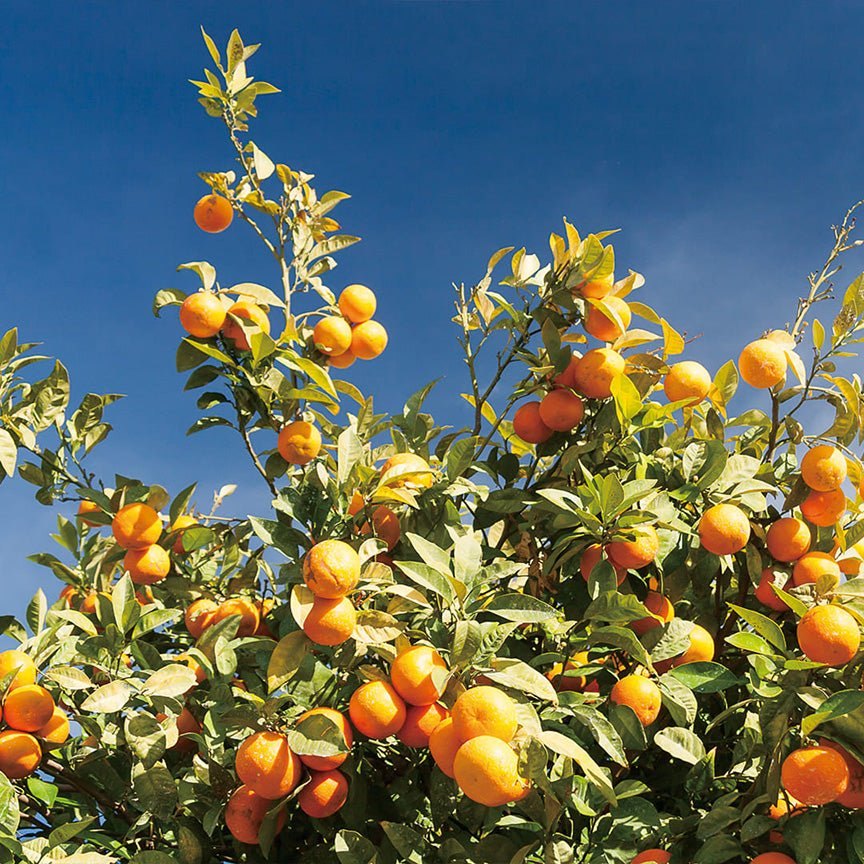
King mandarin (cam sành) is a cross between mandarin and orange, and its smell carries traces of both. The peel is thick, knobbly and green even when the fruit is ripe, so oil pressed from it keeps a green note that yellow oranges lack.
This is the smell of the glass of orange juice at almost every drinks stall in Vietnam, because what is squeezed there is nearly always king mandarin. Like every cold-pressed peel oil, it fades quickly on a smelling strip.
- Plant part
 Fruit peel
- Method
- Cold pressing
- Vietnamese name
- Vỏ cam sành
- Scent family
- Citrus
- Plant family
- Rutaceae
- Lots published
- —
What king mandarin is
Cam sành is a thick-skinned, bumpy citrus that stays green even when ripe, grown widely in the Mekong Delta and northern Vietnam. Botanically it is usually classed as Citrus nobilis, king mandarin in English, and is thought to be a mandarin–orange hybrid. It is what gets squeezed into a glass of orange juice at almost every Vietnamese drinks stall. See the king mandarin peel entry in the scent dictionary.
A Vietnamese study
A 2025 study in the Journal of Science and Technology – University of Da Nang steam-distilled king mandarin peel bought at a Da Nang market and analysed it by GC-MS:
The study identified only five compounds, making up 99.77% of the oil, and did not report a yield. Notably, there was no γ-terpinene, a compound usually abundant in mandarin oil. This is a single small study on one sample, not enough to conclude that king mandarin oil is always like this.
A 2010 study in the International Journal of Food Properties on Citrus nobilis peel oil found limonene at 76.8% by one GC measurement and 86.2% by GC-FID, with 14 components. The gap between the two figures shows how percentages depend on the method, as the article on area percentage explains.
Where the king mandarin smell lies
With over 96% limonene, most of king mandarin oil is practically the same as sweet orange oil. What makes it smell of king mandarin, greener and with a slight bitter edge from the thick peel, lies in the small remainder. A steam-distilled oil like the one in the study loses most of the light aldehydes and esters, so cold-pressed oil is usually closer to the smell of freshly peeled fruit.
Use and storage
Limonene-rich oils oxidise readily, and according to the IFRA Standard for limonene, its oxidation products are potent sensitisers. Keep tightly closed, cool and out of the light, and dilute before use on skin. The Da Nang study used king mandarin oil to scent soap, an application well suited to this cheap and abundant oil.
Sources
- Study of king mandarin peel essential oil and its use in soap formulation (2025). Journal of Science and Technology – University of Da Nang 23(5A), 102–105. doi:10.31130/ud-jst.2025.076
- Gursoy N., Tepe B., Sokmen M. (2010). Evaluation of the chemical composition and antioxidant activity of the peel oil of Citrus nobilis. International Journal of Food Properties 13(5), 983–991. doi:10.1080/10942910902927136
- IFRA Standard: Limonene. ifrafragrance.org
Buy King mandarin peel
King mandarin peel oil: no lot has been brought in yet, so it is not on sale. Message us if you need it.
In the scent dictionary: Vỏ cam sành — a description of the smell, the compounds behind it, and how to smell it for yourself.
Further reading
Close to King mandarin peel
Same plant family: Rutaceae Blood orange · Cold-pressed lemon peel · Grapefruit · Lime peel · Mandarin peel · Petitgrain · Yuzu
Also from the fruit peel Bergamot · Cold-pressed lemon peel · Lemon · Lime peel · Mandarin peel · Yuzu
Same method: cold pressing Bergamot · Cold-pressed lemon peel · Lemon · Lime peel · Mandarin peel · Yuzu