Essential oils · Citrus family
Yuzu essential oil
Citrus junos
Yuzu · Rutaceae
Sour and bright, between grapefruit and mandarin, with a floral, slightly herbal note. It is sharper than orange and rounder than lemon.
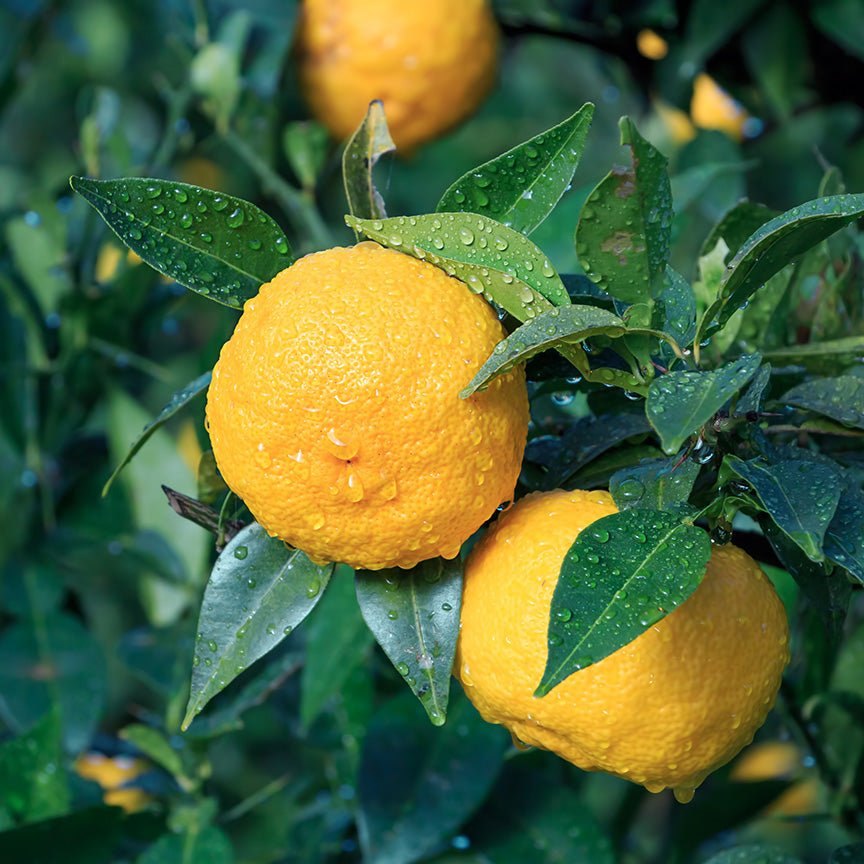
Yuzu (Citrus junos) is a citrus fruit of Japan and East Asia, rarely eaten fresh but used for its peel and juice. The cold-pressed peel oil has limonene and γ-terpinene as its two main compounds, with a group of trace compounds that contribute much of its character.
The fruit is small and expensive, so yuzu oil costs far more than other citrus oils. A cheap bottle of yuzu deserves questions about its source and analysis.
- Plant part
- Fruit peel
- Method
- Cold pressing
- Vietnamese name
- Yuzu
- Scent family
- Citrus
- Plant family
- Rutaceae
- Lots published
- —
 Fruit peel
Composition profile
The published composition from the article, read as structure: 5 compounds adding up to about 91 % of the sample. Figures are printed as the source gives them — one sample, not a species average.
| Compound | Level | Class | Note |
|---|---|---|---|
| Limonene EU | 62.62–67.32 % | Monoterpenes | Top |
| γ-Terpinene | 10.95–14.24 % | Monoterpenes | Middle |
| Linalool EU | 3.16–3.46 % | Alcohols | Middle |
| α-Pinene EU | 2.42–3.27 % | Monoterpenes | Top |
| Myrcene | 1.56–2.24 % | Monoterpenes | Top |
By chemical class
- Monoterpenes87.1 %
- Alcohols3.5 %
By note
- Top72.8 %
- Middle17.7 %
Group totals use the upper bound of each range and only the compounds the article lists; bars are relative to the identified total.
Compare with the 2 chemically closest oils Which other oils are rich in Limonene?
What yuzu is
Yuzu (Citrus junos) is an East Asian citrus fruit, best known in Japan and Korea. The fruit is small, bumpy-skinned, low in juice and full of seeds, so it is rarely eaten fresh; the peel and juice are used to season food, make ponzu, and for yuzu baths at the winter solstice. The essential oil is pressed or distilled from the peel.
Main composition
A 2026 study in Processes analysed the peel oil of yuzu grown in Greece across harvest months and summarised data from Japanese and Korean studies:
| Compound | Greek yuzu (2025) | Range from Japanese and Korean literature |
|---|---|---|
| Limonene | 62.62–67.32% | 56.3–78.1% |
| γ-Terpinene | 10.95–14.24% | 7.6–13.9% |
| Linalool | 3.16–3.46% | 1.56–4.7% |
| α-Pinene | 2.42–3.27% | 1.7–3.14% |
| Myrcene | 1.56–2.24% | 1.1–3.2% |
| β-Phellandrene | not detected | 1.6–5.4% |
On paper yuzu is close to mandarin: limonene and γ-terpinene are the two main compounds. Linalool is slightly higher than in other citrus oils, which is part of yuzu’s floral side.
Yuzu’s smell lives in trace amounts
What makes yuzu smell like yuzu is not in the table above. A 2009 study in the Journal of Agricultural and Food Chemistry identified a group of character-impact compounds present in very small amounts in yuzu peel oil, including two new compounds named after the fruit: yuzunone ((6Z,8E)-undeca-6,8,10-trien-3-one) and yuzuol ((6Z,8E)-undeca-6,8,10-trien-4-ol). The same group includes oct-1-en-3-one (mushroom, metallic), (E)-non-4-enal, (E)-dec-4-enal and 4-methyl-4-mercaptopentan-2-one, a sulfur compound.
A 2022 study also identified two aldehydes, 6-methyloctanal and 8-methyldecanal, each below 0.001% of the oil, as contributors to yuzu’s aroma.
That is why a “yuzu” blended from limonene, γ-terpinene and linalool smells more like mandarin than yuzu: the characteristic part lies in compounds at parts per million, hard to fake.
Expensive and often imitated
The fruit is small, yields little oil and is grown mostly in Japan, so yuzu oil costs far more than other citrus oils. A cheap bottle of yuzu deserves questions about origin and analysis. Like every limonene-rich peel oil, yuzu oxidises readily; keep it tightly closed and cool, and dilute before use on skin.
Sources
- Xenikaki G., Panou E., Ziogas V., Chinou I. (2026). The Volatile Profile and Seasonal Shifts of Greek-Grown Yuzu (Citrus junos) Peels and Leaves. Processes 14(17), 2844. doi:10.3390/pr14172844
- Miyazawa N., Tomita N., Kurobayashi Y. et al. (2009). Novel Character Impact Compounds in Yuzu (Citrus junos Sieb. ex Tanaka) Peel Oil. Journal of Agricultural and Food Chemistry 57(5), 1990–1996. doi:10.1021/jf803257x
- Ohkubo Y., Tomita N., Ogura Y. et al. (2022). Enantioselective synthesis of 6-methyloctanal and 8-methyldecanal, the characteristic aroma components in yuzu Citrus junos, and the analysis of their enantiomeric compositions in yuzu essential oil. Bioscience, Biotechnology, and Biochemistry 86(2), 170–176. doi:10.1093/bbb/zbab196
Buy Yuzu
Yuzu oil: no lot has been brought in yet, so it is not on sale. Message us if you need it.
Where you may already have smelled it
According to the analyses cited above, this oil contains up to 67.3 % limonene. It is also the leading compound in the scenes below from the scent dictionary. Smelling one of those scenes again is a way to get to know it without opening a bottle. A shared compound does not mean the oil smells exactly like the scene.
- King orange peelSqueeze a piece of dark-green, knobbly king orange peel
- Buddha’s handTake a ripe yellow Buddha’s hand and lightly scratch the peel with a fingernail
- Vietnamese lime peelSqueeze a Vietnamese lime and smell the peel, not the juice
- Ripe kumquat peelLightly squeeze the peel of a ripe yellow kumquat
Chemically close
The oils whose published composition is closest to this one, compared across every compound we could read. Close in composition does not mean the scent is identical or that one can replace the other.
- Pomelo peel Citrus maxima shared: Limonene, γ-Terpinene · closeness 1.00 · compare
- Red mandarin Citrus reticulata shared: Limonene, γ-Terpinene · closeness 1.00 · compare
- Mandarin peel Citrus reticulata shared: Limonene, γ-Terpinene · closeness 1.00 · compare
Further reading
Close to Yuzu
Same plant family: Rutaceae Bergamot · Blood orange · Grapefruit · King mandarin peel · Lemon · Petitgrain · Sweet orange
Also from the fruit peel Bergamot · Blood orange · Grapefruit · Lime peel · Red mandarin · Sweet orange
Same method: cold pressing Bergamot · Blood orange · Grapefruit · Lime peel · Red mandarin · Sweet orange
Quick answers
What does yuzu essential oil smell like?
Sour and bright, between grapefruit and mandarin, with a floral, slightly herbal note. It is sharper than orange and rounder than lemon.
What is the botanical name of yuzu oil?
The plant is Citrus junos, in the Rutaceae family. In Vietnamese it is called yuzu.
How is yuzu oil produced?
From the fruit peel of the plant, by cold pressing. See the method for what that does to the oil.
What are the main compounds of yuzu oil?
From the composition data on this page, the oil is led by Limonene, γ-Terpinene and Linalool. Proportions vary with origin, harvest and method; a lot analysis is the only answer for a given bottle.
Last updated