Essential oils · Citrus family
Bergamot essential oil
Citrus bergamia
Cam bergamot · Rutaceae
Citrus, but with flowers in it. The opening is sour and green, then very quickly turns into a soft sweetness that orange and lemon do not have.
That layer comes from linalyl acetate and linalool — exactly the two main compounds of lavender. In other words, bergamot is a citrus fruit carrying half the formula of a flower, and that is why it can bridge two scent families.
If you have ever drunk Earl Grey tea, you already know this smell, because what makes Earl Grey different from ordinary black tea is bergamot. Smelling the oil and then the tea tin is the quickest way to fix it in memory.
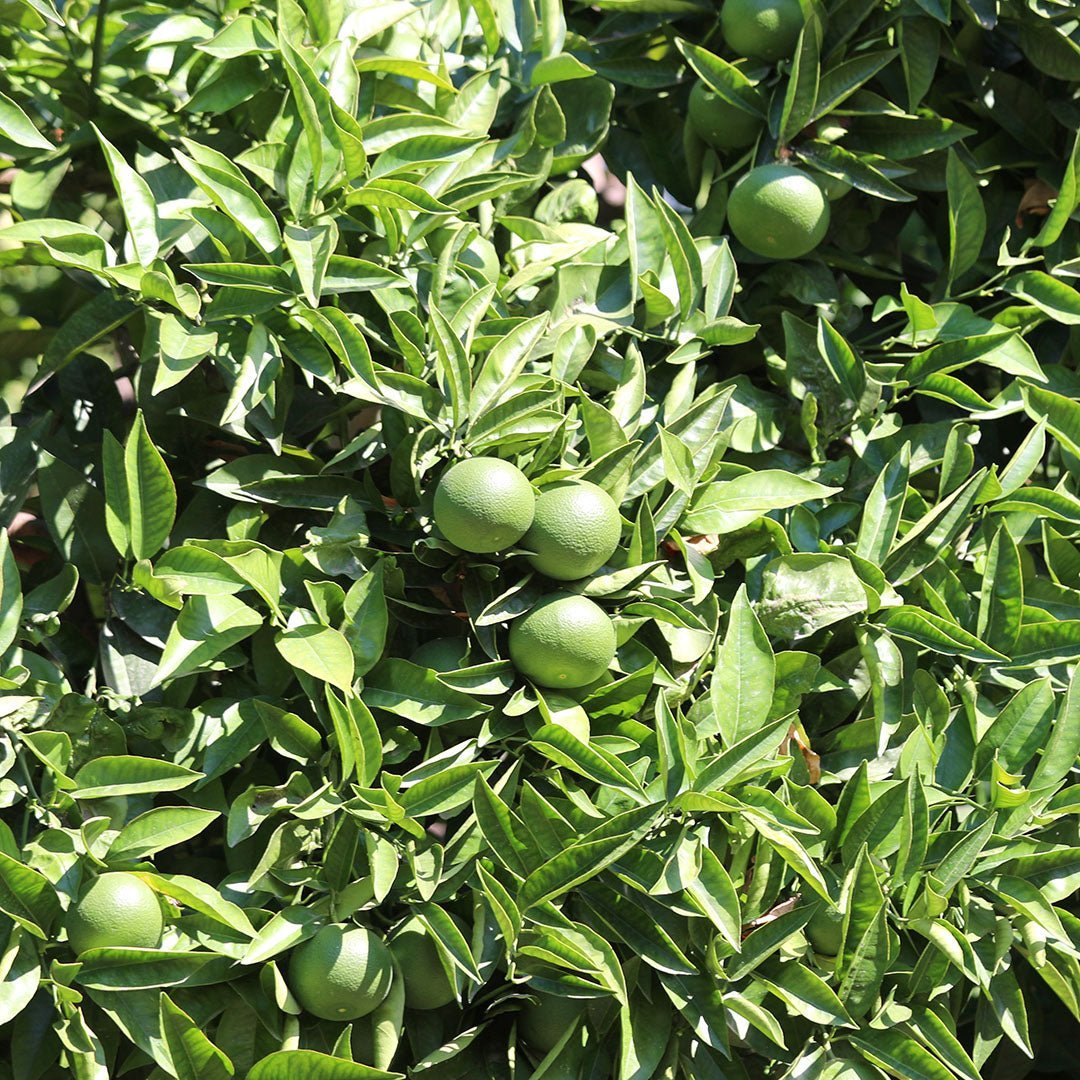
- Plant part
- Fruit peel
- Method
- Cold pressing
- Vietnamese name
- Cam bergamot
- Scent family
- Citrus
- Plant family
- Rutaceae
- Lots published
- —
 Fruit peel
Also made another way
The “Method” field above gives the usual commercial method. The lines below are other documented methods, each giving a different product.
- Terpeneless bergamot oil · Deterpenation and folding Source: US Patent 7,250,185 (2007)
- Bergamot FCF · Furocoumarin removal Pressed oil holds about 0.11–0.40 % bergapten; alkaline treatment brings it down to a trace. Source: F. Gionfriddo et al. (2004), Perfumer & Flavorist 29: 48–52
Composition profile
The published composition from the article, read as structure: 4 compounds adding up to about 91 % of the sample. Figures are printed as the source gives them — one sample, not a species average.
| Compound | Level | Class | Note |
|---|---|---|---|
| Linalyl acetate EU | 40.51 % | Esters | Middle |
| Limonene EU | 25.58 % | Monoterpenes | Top |
| Linalool EU | 15.33 % | Alcohols | Middle |
| γ-Terpinene | 10.04 % | Monoterpenes | Middle |
By chemical class
- Esters40.5 %
- Monoterpenes35.6 %
- Alcohols15.3 %
By note
- Top25.6 %
- Middle65.9 %
Group totals use the upper bound of each range and only the compounds the article lists; bars are relative to the identified total.
Compare with the 2 chemically closest oils Which other oils are rich in Linalyl acetate?
A fruit grown almost only in Calabria
Bergamot (Citrus bergamia) is grown almost exclusively along a strip of coast in southern Calabria, Italy. According to a 2015 review in Frontiers in Pharmacology, more than 90% of the world’s bergamot comes from this region. The fruit’s main value lies in the essential oil in its peel.
The oil is obtained by rasping and cold pressing the peel, not by distillation. So the bottle holds two parts: a volatile part and a non-volatile part.
Composition: the two parts of a bottle
According to the 2015 review:
| Part | Contains |
|---|---|
| Volatile (93–96%) | Limonene 25–53%, linalyl acetate 15–40%, linalool 2–20%, and other compounds |
| Non-volatile (4–7%) | Pigments, waxes, coumarins and psoralens such as bergapten (given as about 0.2%) and bergamottin |
Cold-pressed and distilled: same peel, two oils
A 2009 study in Molecules took bergamot peel grown on Kefalonia (Greece) over two seasons, 2007–2008, and both cold-pressed and hydrodistilled it. The table compares the sample taken on 15 January:
| Compound | Cold-pressed | Hydrodistilled |
|---|---|---|
| Linalyl acetate | 40.51% | 10.72% |
| Linalool | 15.33% | 31.76% |
| Limonene | 25.58% | 31.66% |
| γ-Terpinene | 10.04% | 10.32% |
Over the two seasons, the cold-pressed oil ranged as follows: linalyl acetate 30.33–40.51%, limonene 10.54–34.88%, linalool 14.50–20.18%. Oil yield reached 1.8% of the weight of fresh peel.
The ratio of linalool to linalyl acetate rose from 0.38 in the cold-pressed oil to 2.96 in the distilled oil. The authors attribute the lower quality of the distilled oil to decomposition of linalyl acetate and isomerisation of linalool under heat; chiral analysis confirmed this through the appearance of (+)-linalool. In other words, from the same peel, hydrodistillation gives an oil that has lost most of its linalyl acetate.
Bergapten and FCF oil
Bergapten (5-methoxypsoralen) makes skin sensitive to sunlight: oil applied to skin that is then exposed to the sun can cause burns or long-lasting dark marks. The 2015 review notes that, because of this, a furocoumarin-free oil has been prepared for perfumery and cosmetics, usually labelled FCF (furocoumarin-free) or “bergaptene-free”. According to the same review, vacuum distillation of the peel gives an oil completely free of bergapten, with a composition comparable to cold-pressed oil.
The IFRA Standards (Amendment 49, 2020) set two layers of limits:
- Expressed bergamot oil: at most 0.40% in the finished product for most leave-on categories, including fine fragrance (category 4) and body lotion (category 5A). If the furocoumarin content of the oil is unknown, this limit applies.
- Total bergapten in products applied to skin exposed to UV light: no more than 0.0015% (15 ppm). Rinse-off products are not covered by this limit.
What this means for the buyer:
- Cold-pressed bergamot oil usually contains bergapten. Do not apply it to skin that will be exposed to the sun.
- FCF oil is safer in this respect, but the label must say so, with a bergapten measurement. If it does not, treat it as ordinary oil.
- Bergapten belongs to the non-volatile part; knowing how much is present needs a separate test beyond a standard GC/MS analysis.
Storage
According to the 2015 review, the limonene and pinene in the oil are relatively unstable when exposed to heat and light. In the EU, limonene is on the list of fragrance allergens that must be labelled, with a required peroxide value below 20 mmol/L, because oxidised limonene sensitises skin more readily. Bergamot oil, like most citrus peel oils, has a short shelf life. Close the bottle straight after use, keep it cool and dark, and decant into a smaller bottle once it is half empty.
Sources
- Navarra M., Mannucci C., Delbo M., Calapai G. (2015). Citrus bergamia essential oil: from basic research to clinical application. Frontiers in Pharmacology 6, 36. doi:10.3389/fphar.2015.00036
- Melliou E., Michaelakis A., Koliopoulos G., Skaltsounis A.-L., Magiatis P. (2009). High quality bergamot oil from Greece: chemical analysis using chiral gas chromatography and larvicidal activity against the West Nile virus vector. Molecules 14(2), 839–849. doi:10.3390/molecules14020839
- IFRA Standard: Bergamot oil expressed, Amendment 49 (2020).
- IFRA Standard: Citrus oils and other furocoumarins containing essential oils, Amendment 49 (2020).
- Regulation (EU) 2023/1545 on the labelling of fragrance allergens.
Buy Bergamot
Bergamot oil: no lot has been brought in yet, so it is not on sale. Message us if you need it.
Where you may already have smelled it
According to the analyses cited above, this oil contains up to 25.6 % limonene. It is also the leading compound in the scenes below from the scent dictionary. Smelling one of those scenes again is a way to get to know it without opening a bottle. A shared compound does not mean the oil smells exactly like the scene.
- King orange peelSqueeze a piece of dark-green, knobbly king orange peel
- Crushed pomelo peelSqueeze a piece of Nam Roi pomelo peel hard, so the oil sprays out
- Ripe kumquat peelLightly squeeze the peel of a ripe yellow kumquat
- Buddha’s handTake a ripe yellow Buddha’s hand and lightly scratch the peel with a fingernail
Chemically close
The oils whose published composition is closest to this one, compared across every compound we could read. Close in composition does not mean the scent is identical or that one can replace the other.
- Petitgrain Citrus aurantium var. amara shared: Linalyl acetate, Linalool · closeness 0.85 · compare
- Clary sage Salvia sclarea shared: Linalyl acetate, Linalool · closeness 0.83 · compare
- Lavender Lavandula angustifolia shared: Linalyl acetate, Linalool · closeness 0.78 · compare
Further reading
Close to Bergamot
Same plant family: Rutaceae Blood orange · Cold-pressed lemon peel · Lemon · Neroli · Pomelo blossom · Red mandarin · Sweet orange
Also from the fruit peel Blood orange · King mandarin peel · Lemon · Mandarin peel · Red mandarin · Sweet orange
Same method: cold pressing Blood orange · King mandarin peel · Lemon · Mandarin peel · Red mandarin · Sweet orange
Quick answers
What is bergamot?
Bergamot (Citrus bergamia) is a sour citrus grown almost only on a strip of coast in southern Calabria, Italy, which produces more than 90% of the world crop. The fruit is valued mainly for the oil in its peel, obtained by cold pressing.
What does bergamot oil smell like?
Citrus with a flower in it: a sour, green opening that quickly turns into a soft sweetness orange and lemon do not have. That sweetness comes from linalyl acetate and linalool, the two main compounds of lavender. It is the smell of Earl Grey tea.
What does bergamot FCF mean?
FCF means furocoumarin-free. Cold-pressed oil usually contains bergapten, which makes skin sensitive to sunlight; the FCF grade has these compounds removed. IFRA limits cold-pressed bergamot oil to 0.40% in most leave-on products, and total bergapten to 0.0015% in skin products exposed to UV.
Is bergamot the same as bergamot mint?
Different species entirely. Bergamot is a citrus fruit and its oil is pressed from the peel. Bergamot mint (Mentha citrata) is a mint whose oil smells close to bergamot because it is also rich in linalool and linalyl acetate. See bergamot mint.
How does cold-pressed bergamot differ from distilled?
From the same peel, a 2009 study measured 40.51% linalyl acetate in the cold-pressed oil but only 10.72% in the water-distilled oil, because heat breaks this ester down. The distilled oil loses most of the soft sweetness that defines bergamot.
What does bergamot essential oil smell like?
Citrus, but with flowers in it. The opening is sour and green, then very quickly turns into a soft sweetness that orange and lemon do not have.
What is the botanical name of bergamot oil?
The plant is Citrus bergamia, in the Rutaceae family. In Vietnamese it is called cam bergamot.
How is bergamot oil produced?
From the fruit peel of the plant, by cold pressing. See the method for what that does to the oil.
Last updated