Essential oils · Citrus family
Blood orange essential oil
Citrus sinensis
Cam đỏ · Rutaceae
Sweet orange with an extra dark, slightly sour berry note, like orange juice with a dash of redcurrant.
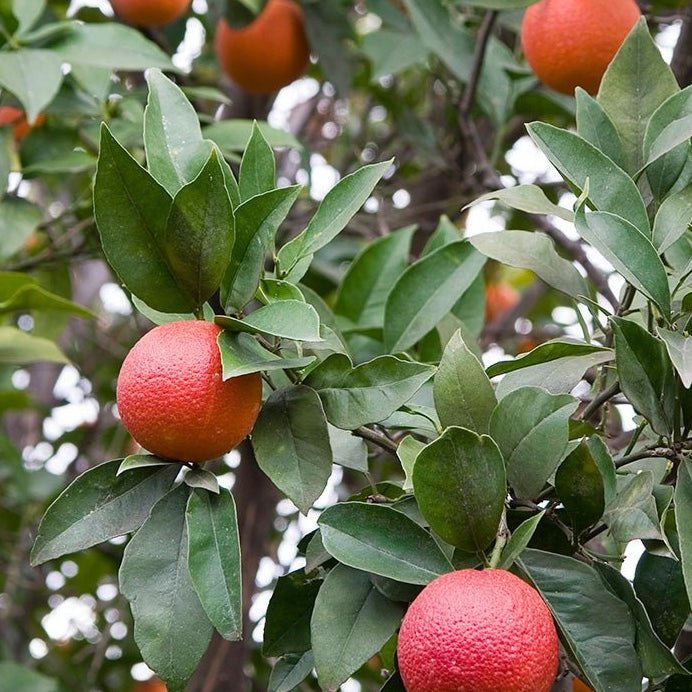
Blood orange is a group of Citrus sinensis cultivars whose flesh is red from anthocyanin pigments. Its peel oil is about 95% limonene, close to sweet orange oil; the differences lie in the minor compounds.
Like every cold-pressed orange oil, blood orange oxidises easily: an old bottle loses its freshness and turns resinous. Keep it tightly closed, cool and dark.
- Plant part
- Fruit peel
- Method
- Cold pressing
- Vietnamese name
- Cam đỏ
- Scent family
- Citrus
- Plant family
- Rutaceae
- Lots published
- —
 Fruit peel
Composition profile
The published composition from the article, read as structure: 7 compounds adding up to about 99 % of the sample. Figures are printed as the source gives them — one sample, not a species average.
| Compound | Level | Class | Note |
|---|---|---|---|
| Limonene EU | 94.9–95.2 % | Monoterpenes | Top |
| Myrcene | 2.0 % | Monoterpenes | Top |
| Sabinene | 0.6–0.7 % | Monoterpenes | Top |
| α-Pinene EU | 0.5–0.6 % | Monoterpenes | Top |
| Linalool EU | 0.3–0.5 % | Alcohols | Middle |
| Octanal | 0.1–0.2 % | — | — |
| Decanal | 0.1–0.2 % | Aldehydes | Middle |
By chemical class
- Monoterpenes98.5 %
- Alcohols0.5 %
- Unclassified0.2 %
- Aldehydes0.2 %
By note
- Top98.5 %
- Middle0.7 %
- Unclassified0.2 %
Group totals use the upper bound of each range and only the compounds the article lists; bars are relative to the identified total.
Compare with the 2 chemically closest oils Which other oils are rich in Limonene?
What blood orange oil is
Blood orange is a group of Citrus sinensis cultivars with anthocyanin pigments, including Moro. The essential oil comes from the peel, mainly by cold pressing, like sweet orange. In composition, blood orange oil is close to sweet orange oil; the differences lie in the minor compounds.
Composition: Moro oranges in Turkey
A 2025 study took the peel of Moro oranges in Antalya at four harvests (from early January to early March), obtained the oil both by cold pressing and by hydrodistillation, and analysed it by GC-MS:
| Compound | Cold-pressed | Hydrodistilled |
|---|---|---|
| Limonene | 94.9–95.2% | 94.9–95.2% |
| Myrcene | 2.0% | 2.0% |
| Sabinene | 0.6–0.7% | 0.6–0.7% |
| α-Pinene | 0.5–0.6% | 0.6% |
| Linalool | 0.3–0.5% | 0.4–0.6% |
| Octanal | 0.1–0.2% | 0.1–0.3% |
| Decanal | 0.1–0.2% | 0.1–0.2% |
Compared with sweet orange
The same study compared five cultivars. Moro’s mean limonene was 95.09%, the lowest of the five; the blond cultivars Navelina, Batem Fatihi, Valencia Late and Washington Navel were at 95.59–96.24%. Myrcene was about 2.0% in all five.
A 1994 study of 190 industrial Italian orange oils (1991–92 season) found that blood orange oils “had more monoterpenes and fewer alcohols and aldehydes than blond oils”. Octanal and decanal were the most important oxygenated compounds in both.
Where the anthocyanins are
The red colour of blood oranges comes from anthocyanins. A 2023 study of eight blood orange varieties measured anthocyanins in the peel as well, highest in Moro at 650.67 mg/kg dry weight. We have not read any study measuring anthocyanins in the peel oil, so we do not claim either way whether the oil contains them.
Its smell
With limonene at around 95%, the oil is first of all an orange smell. Octanal and decanal give the sharp, slightly waxy peel note; linalool adds a touch of flowers.
Safety
- Oxidation: limonene-rich oils oxidise easily. IFRA requires limonene and natural products containing substantial amounts of it to have a peroxide value below 20 mmol/L, and recommends adding 0.1% of an antioxidant such as BHT or α-tocopherol. Keep the bottle tightly closed, cool and dark, and store it properly.
- Furocoumarins: the IFRA standard on citrus oils containing furocoumarins lists expressed bitter orange oil as restricted, while cold-pressed sweet orange oil is not listed. A 2022 study measured total furocoumarins of 140 ppm in Navel orange oil and 69 ppm in Valencia orange oil; blood orange was not tested. We have not read furocoumarin data specific to blood orange oil.
Always dilute before use on skin.
Sources
- Bozova B., Golukcu M., Tokgoz H. et al. (2025). The physico-chemical characteristics of peel essential oils of sweet orange with respect to cultivars, harvesting times and isolation methods. AIMS Agriculture and Food 10(1), 40–57. doi:10.3934/agrfood.2025003
- Dugo G., Verzera A., Stagno d’Alcontres I. et al. (1994). On the Genuineness of Citrus Essential Oils. Part XLIII. Italian Sweet Orange Oils. Journal of Essential Oil Research 6(2), 101–137. doi:10.1080/10412905.1994.9698342
- Melgarejo P., Ballesta-de los Santos M., Martinez-Nicolas J.J. et al. (2023). Comparative Analysis of Primary and Secondary Metabolites in the Peel of Eight Blood Orange Varieties. AgriEngineering 5(3), 1259–1279. doi:10.3390/agriengineering5030080
- Dosoky N.S., Satyal P., Setzer W.N. (2022). Authentication of Citrus spp. Cold-Pressed Essential Oils by Their Oxygenated Heterocyclic Components. Molecules 27(19), 6277. doi:10.3390/molecules27196277
- IFRA Standard: Citrus oils and other furocoumarins containing essential oils, Amendment 49 (2020).
- IFRA Standard: Limonene.
Buy Blood orange
Blood orange oil: no lot has been brought in yet, so it is not on sale. Message us if you need it.
Where you may already have smelled it
According to the analyses cited above, this oil contains up to 95.2 % limonene. It is also the leading compound in the scenes below from the scent dictionary. Smelling one of those scenes again is a way to get to know it without opening a bottle. A shared compound does not mean the oil smells exactly like the scene.
- Ripe kumquat peelLightly squeeze the peel of a ripe yellow kumquat
- Vietnamese lime peelSqueeze a Vietnamese lime and smell the peel, not the juice
- King orange peelSqueeze a piece of dark-green, knobbly king orange peel
- Crushed pomelo peelSqueeze a piece of Nam Roi pomelo peel hard, so the oil sprays out
Chemically close
The oils whose published composition is closest to this one, compared across every compound we could read. Close in composition does not mean the scent is identical or that one can replace the other.
- King mandarin peel Citrus reticulata × sinensis shared: Limonene, Myrcene · closeness 1.00 · compare
- Pomelo peel Citrus maxima shared: Limonene, Myrcene · closeness 0.98 · compare
- Red mandarin Citrus reticulata shared: Limonene · closeness 0.98 · compare
Further reading
Close to Blood orange
Same plant family: Rutaceae Kaffir lime leaf · King mandarin peel · Lemon · Neroli · Petitgrain · Pomelo blossom · Yuzu
Also from the fruit peel Cold-pressed lemon peel · Grapefruit · King mandarin peel · Lemon · Pomelo peel · Red mandarin
Same method: cold pressing Cold-pressed lemon peel · Grapefruit · King mandarin peel · Lemon · Pomelo peel · Red mandarin
Quick answers
What does blood orange essential oil smell like?
Sweet orange with an extra dark, slightly sour berry note, like orange juice with a dash of redcurrant.
What is the botanical name of blood orange oil?
The plant is Citrus sinensis, in the Rutaceae family. In Vietnamese it is called cam đỏ.
How is blood orange oil produced?
From the fruit peel of the plant, by cold pressing. See the method for what that does to the oil.
What are the main compounds of blood orange oil?
Is there anything to watch out for with blood orange oil?
Cold-pressed from the peel, so it still contains furocoumarins — compounds that make skin sensitive to sunlight.
Last updated