Essential oils · Earthy family
Angelica root essential oil
Angelica archangelica
Angelica · Apiaceae
Damp earth, white pepper and a soft musk right at the bottom. It opens slightly sharp, like a root just pulled from the ground, then settles into a warm layer that feels almost like skin.
That musk comes from a group of large-ring lactones present in tiny amounts in the root, the same family as the musks used in perfumery. The rest of the bottle is light monoterpenes, so the opening is brighter than you would expect from a root.
Angelica root oil can make skin sensitive to sunlight, so do not apply it to skin that will be exposed to the sun. It is also one to smell on a strip first, because a single drop is already strong.
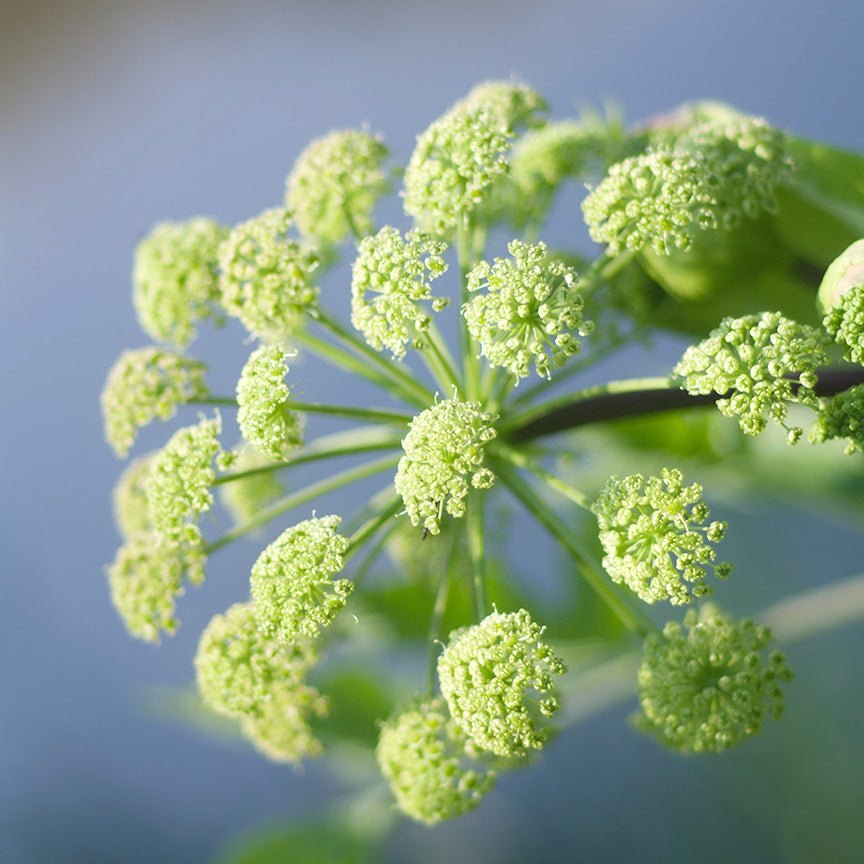
- Plant part
- Roots
- Vietnamese name
- Angelica
- Scent family
- Earthy
- Plant family
- Apiaceae
- Lots published
- —
 Roots
Composition profile
The published composition from the article, read as structure: 7 compounds adding up to about 100 % of the sample. Figures are printed as the source gives them — one sample, not a species average.
| Compound | Level | Class | Note |
|---|---|---|---|
| β-Phellandrene | 30.5 % | Monoterpenes | Top |
| α-Pinene EU | 21.3 % | Monoterpenes | Top |
| δ-3-Carene | 15.4–17.2 % | Monoterpenes | Top |
| Limonene EU | 16.4 % | Monoterpenes | Top |
| 15-Pentadecanolide | 7.2–14.9 % | — | — |
| 13-Tridecanolide | 5.4–6.1 % | — | — |
| Myrcene | 5.5 % | Monoterpenes | Top |
By chemical class
- Monoterpenes90.9 %
- Unclassified21.0 %
By note
- Top90.9 %
- Unclassified21.0 %
Group totals use the upper bound of each range and only the compounds the article lists; bars are relative to the identified total.
Put it beside another oil in the Compare tool Which other oils are rich in β-Phellandrene?
What angelica is
Angelica (Angelica archangelica) is a large plant of the carrot family from northern Europe, with thick, aromatic roots. The root oil is used in perfumery and in liqueurs and spirits such as gin and some European herbal liqueurs. It is not the same as the Angelica species used in Chinese medicine, such as bai zhi or dang gui, though they share a genus.
Composition: it changes with region and distillation
A 2021 review in Molecules brought together analyses of angelica root oil from many regions:
| Compound | Range (region) |
|---|---|
| α-Pinene | 21.3% (Italy); 15.7–19.4% (Lithuania); 22.2–28.1% (France) |
| δ-3-Carene | 15.4–17.2% (Italy, Lithuania, France) |
| Limonene | 16.4% (Italy); 8.1–8.8% (Lithuania) |
| β-Phellandrene | 30.5% (Siberia); 13.2–14.5% (Brazil) |
| Myrcene | 5.5% (Italy); 9.4–11.8% (Brazil) |
| 15-Pentadecanolide | 7.2–14.9% (stored roots, Lithuania) |
| 13-Tridecanolide | 5.4–6.1% (same Lithuanian samples) |
The review notes that composition varies with how long the roots were stored, the harvest year, the plant part, distillation time and growing region.
The bright part and the musky part
Most of angelica oil is light monoterpenes such as α-pinene, δ-3-carene and β-phellandrene, so the top note is bright, sharp and slightly peppery, like a freshly pulled root. What makes angelica special is the two compounds at the bottom of the table: 15-pentadecanolide and 13-tridecanolide are macrocyclic lactones, the same chemical family as the musks used in perfumery. They evaporate very slowly, so once the bright part has gone, angelica leaves a warm, soft, almost skin-like layer.
We have not read a study that directly shows these two lactones create angelica’s musky note; this is an interpretation based on their chemical family.
Phototoxicity: the IFRA limit
Angelica root oil contains furocoumarins. The IFRA Standard for angelica root oil (49th Amendment, 2020) is a restriction due to phototoxic effects: a maximum of 0.80% in many leave-on product categories, fine fragrance included, when furocoumarin levels are unknown. Used together with other furocoumarin-containing materials, the sum of their proportions relative to each one’s limit must not exceed 100%.
Do not apply angelica oil to skin that will be exposed to sun; always dilute before use.
Sources
- Lunz K., Stappen I. (2021). Back to the Roots—An Overview of the Chemical Composition and Bioactivity of Selected Root-Essential Oils. Molecules 26(11), 3155. doi:10.3390/molecules26113155
- IFRA Standard: Angelica root oil. Amendment 49, 2020.
Buy Angelica root
Angelica root oil: no lot has been brought in yet, so it is not on sale. Message us if you need it.
Where you may already have smelled it
According to the analyses cited above, this oil contains up to 21.3 % α-pinene. It is also the leading compound in the scenes below from the scent dictionary. Smelling one of those scenes again is a way to get to know it without opening a bottle. A shared compound does not mean the oil smells exactly like the scene.
Further reading
Close to Angelica root
Same plant family: Apiaceae Carrot seed · Coriander seed · Sweet fennel
Also from the roots Haitian vetiver · Vetiver
Same method: direct steam distillation Bee balm · Blue cypress · Blue tansy · Camphor ct camphor · Honey myrtle · Juniper berry · Palo santo · Ravintsara ct 1,8-cineole
Quick answers
What does angelica root essential oil smell like?
Damp earth, white pepper and a soft musk right at the bottom. It opens slightly sharp, like a root just pulled from the ground, then settles into a warm layer that feels almost like skin.
What is the botanical name of angelica root oil?
The plant is Angelica archangelica, in the Apiaceae family. In Vietnamese it is called angelica.
How is angelica root oil produced?
From the roots of the plant, by direct steam distillation. See the method for what that does to the oil.
What are the main compounds of angelica root oil?
From the composition data on this page, the oil is led by β-Phellandrene, α-Pinene and δ-3-Carene. Proportions vary with origin, harvest and method; a lot analysis is the only answer for a given bottle.
Last updated