Essential oils · Citrus family
Honey myrtle essential oil
Melaleuca teretifolia
Honey myrtle · Myrtaceae
Bright, sweet lemon, close to lemongrass but with a honeyed, floral note. It is fresh and evaporates fairly quickly.
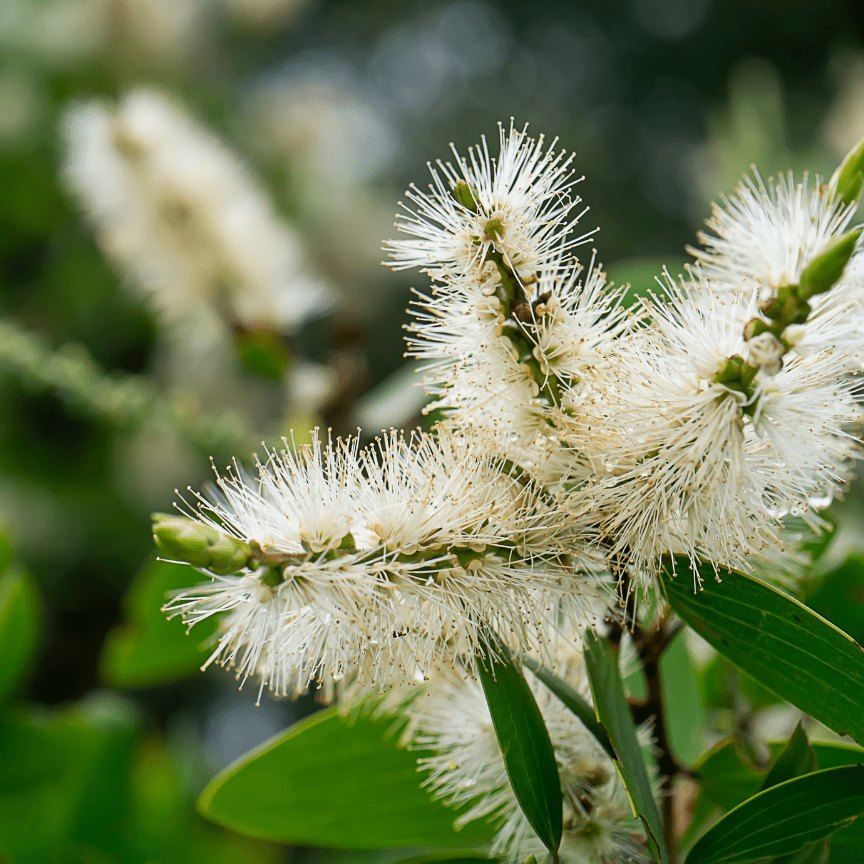
Honey myrtle (Melaleuca teretifolia) is a paperbark from Western Australia. Unlike cajeput or tea tree, the oil on the market is the lemon type, rich in citral (about two thirds of the oil), which places it among the lemon oils rather than the cineole oils.
It shows that the genus Melaleuca says nothing about smell: the same genus includes cineole-rich species, terpinen-4-ol-rich species, and citral-rich ones like this.
- Plant part
- Leaves
- Vietnamese name
- Honey myrtle
- Scent family
- Citrus
- Plant family
- Myrtaceae
- Lots published
- —
 Leaves
Composition profile
The published composition from the article, read as structure: 6 compounds adding up to about 94 % of the sample. Figures are printed as the source gives them — one sample, not a species average.
| Compound | Level | Class | Note |
|---|---|---|---|
| 1,8-Cineole | 84.0 % | Oxides | Top |
| α-Terpineol EU | 3.3 % | Alcohols | Middle |
| Limonene EU | 3.1 % | Monoterpenes | Top |
| Terpinen-4-ol | 1.8 % | Alcohols | Middle |
| α-Pinene EU | 1.8 % | Monoterpenes | Top |
| Oil yield | 0.2 % | — | — |
By chemical class
- Oxides84.0 %
- Alcohols5.1 %
- Monoterpenes4.9 %
- Unclassified0.2 %
By note
- Top88.9 %
- Middle5.1 %
- Unclassified0.2 %
Group totals use the upper bound of each range and only the compounds the article lists; bars are relative to the identified total.
Compare with the 2 chemically closest oils Which other oils are rich in 1,8-Cineole?
What honey myrtle is
Honey myrtle (Melaleuca teretifolia) is a paperbark that grows wild in Western Australia. The species has two very different oil types: a lemon type rich in citral and a 1,8-cineole type. The lemon-scented oil sold as honey myrtle is the first.
Two chemotypes
A 2005 study of wild plants in Western Australia describes both types:
| Compound | Lemon type | 1,8-Cineole type |
|---|---|---|
| Geranial | 38.8% | – |
| Neral | 29.1% | – |
| Myrcene | 9.8% | – |
| Terpinen-4-ol | 3.4% | 1.8% |
| Geraniol | 2.1% | – |
| Limonene | 1.0% | 3.1% |
| 1,8-Cineole | – | 84.0% |
| α-Terpineol | – | 3.3% |
| α-Pinene | – | 1.8% |
| Oil yield | 1.5% | 0.2% |
The lemon type also had E- and Z-isocitral at 2.4% and 1.6%, nerol 1.1% and citronellal 1.0%; the cineole type had β-pinene 1.2%. Yields are on a fresh-weight basis. A dash means it was not reported. We have read only the abstract, which does not describe the distillation.
Reading the table
Geranial and neral are the two forms of citral; together the lemon type has about 67.9% citral (our sum). That is close to lemongrass: the annex to the IFRA citral standard gives lemongrass about 73%. The cineole type is almost a pure 1,8-cineole oil, closer in smell to cajeput than to lemon. The lemon type also gives about seven times as much oil.
So the word paperbark (Melaleuca) says nothing about smell, and even a single species can have two different smells.
Its smell
Geranial and neral give a bright, sweet lemon smell. Myrcene adds a green, slightly resinous note. It is close to lemongrass but rounder.
Safety
IFRA restricts citral because of dermal sensitisation (Amendment 49, 2020). Some limits in finished products:
- Fine fragrance (category 4): 0.60%.
- Face and body creams (category 5A): 0.15%.
- Rinse-off products such as shampoo (category 9): 1.2%.
For an oil with 67.9% citral, the category 4 limit of 0.60% corresponds to about 0.88% oil in the product (our calculation). In the EU, citral must be named on cosmetic labels as a fragrance allergen. Always dilute before use on skin.
Sources
- Southwell I., Russell M., Smith R.L., Brophy J.J., Day J. (2005). Acta Horticulturae 677, 79–83. doi:10.17660/ActaHortic.2005.677.10
- IFRA Standard: Citral, Amendment 49 (2020).
- Regulation (EU) 2023/1545 on the labelling of fragrance allergens.
Buy Honey myrtle
Honey myrtle oil: no lot has been brought in yet, so it is not on sale. Message us if you need it.
Where you may already have smelled it
According to the analyses cited above, this oil contains up to 84 % 1,8-cineole. It is also the leading compound in the scenes below from the scent dictionary. Smelling one of those scenes again is a way to get to know it without opening a bottle. A shared compound does not mean the oil smells exactly like the scene.
Chemically close
The oils whose published composition is closest to this one, compared across every compound we could read. Close in composition does not mean the scent is identical or that one can replace the other.
Further reading
Close to Honey myrtle
Same plant family: Myrtaceae Cajeput · Guava leaf · Kanuka · Kunzea · Lemon eucalyptus · Lemon myrtle · Red myrtle
Also from the leaves Douglas fir · Engelmann spruce · Geranium · Guava leaf · Indian patchouli · Kunzea · Lemon myrtle · Patchouli
Same method: direct steam distillation Basil ct linalool · Cupressus · Eucalyptus dives · Indian patchouli · Myrrh · Nutmeg · Patchouli · Scots pine
Quick answers
What does honey myrtle essential oil smell like?
Bright, sweet lemon, close to lemongrass but with a honeyed, floral note. It is fresh and evaporates fairly quickly.
What is the botanical name of honey myrtle oil?
The plant is Melaleuca teretifolia, in the Myrtaceae family. In Vietnamese it is called honey myrtle.
How is honey myrtle oil produced?
From the leaves of the plant, by direct steam distillation. See the method for what that does to the oil.
What are the main compounds of honey myrtle oil?
From the composition data on this page, the oil is led by 1,8-Cineole, α-Terpineol and Limonene. Proportions vary with origin, harvest and method; a lot analysis is the only answer for a given bottle.
Last updated