Sweet fennel essential oil
Foeniculum vulgare
Thì là ngọt · Apiaceae
Sweet like anise, but greener and lighter, with a little earth underneath. Where star anise is round and dense, sweet fennel is airier and has an added vegetable edge.
Both are rich in trans-anethole. The difference is in the companions: sweet fennel also has fenchone, which brings a thin camphor note and a slight bitterness star anise lacks.
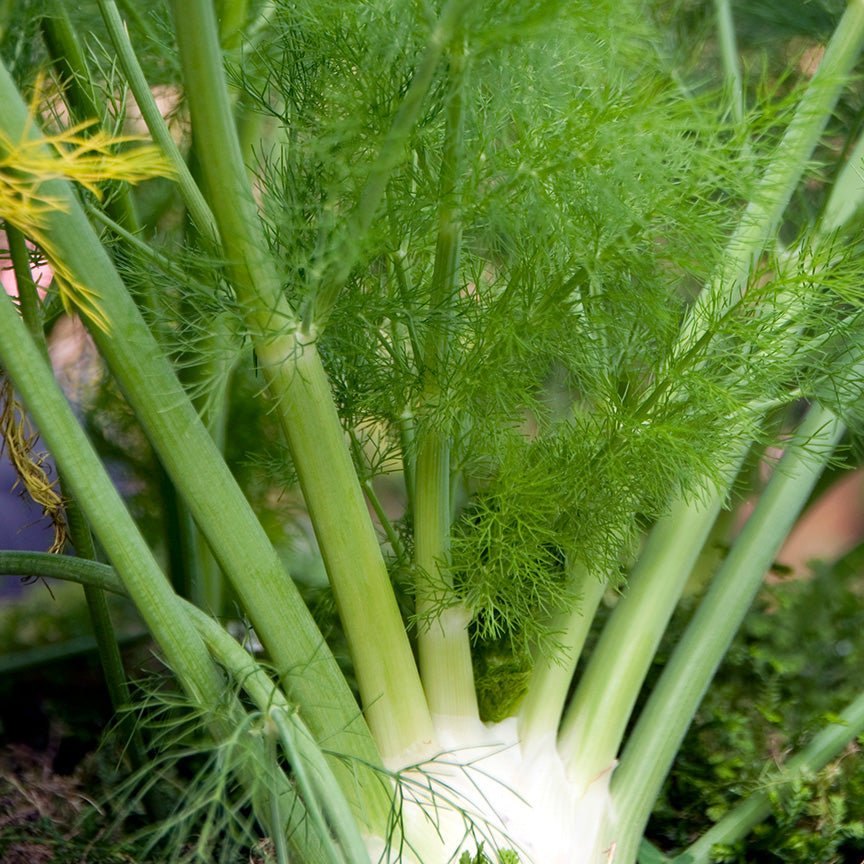
The common name is confusing. The thì là used in fish soup is dill — a different plant with a different smell. This one is tiểu hồi hương in the traditional medicine cabinet, and the botanical name Foeniculum vulgare is the surest way to tell them apart.
- Plant part
- Seeds
- Vietnamese name
- Thì là ngọt
- Scent family
- Spicy
- Plant family
- Apiaceae
- Lots published
- —
 Seeds
Composition profile
The published composition from the article, read as structure: 3 compounds adding up to about 100 % of the sample. Figures are printed as the source gives them — one sample, not a species average.
| Compound | Level | Class | Note |
|---|---|---|---|
| (E)-Anethole | 92.04–95.81 % | — | — |
| Estragole | 7.89 % | Other compounds | Middle |
| Limonene EU | 5.96 % | Monoterpenes | Top |
By chemical class
- Unclassified95.8 %
- Other compounds7.9 %
- Monoterpenes6.0 %
By note
- Top6.0 %
- Middle7.9 %
- Unclassified95.8 %
Group totals use the upper bound of each range and only the compounds the article lists; bars are relative to the identified total.
Sweet fennel and bitter fennel
Foeniculum vulgare gives oil in two forms: sweet fennel (var. dulce) and bitter fennel (var. vulgare). Both oils are rich in trans-anethole, the compound behind the sweet aniseed smell, but they differ in fenchone, which brings a camphoraceous, bitter note. The European Pharmacopoeia, as quoted by the European Medicines Agency (EMA), sets different requirements for the two:
| Requirement | Sweet fennel | Bitter fennel |
|---|---|---|
| Anethole | at least 80% | at least 60% |
| Fenchone | at most 7.5% | at least 15% |
| Estragole | at most 10% | at most 6% |
| Oil content of the fruit | at least 20 ml/kg | at least 40 ml/kg |
In short: sweet fennel has more anethole and little fenchone; bitter fennel is the other way round.
Composition: measured values
| Compound | Sweet fennel | Bitter fennel | Sample |
|---|---|---|---|
| (E)-Anethole | 95.25% | 75.13% | fruit, Turkey (2008) |
| (E)-Anethole | 92.04–95.81% | – | seed, 10 lines, Ankara (2009) |
| (E)-Anethole | 80.56% | – | fruit, North Macedonia (2021) |
| Fenchone | below 1% | about 5% | Turkey (2008) |
| Estragole | 2.87% | 15.51% | Turkey (2008) |
| Estragole | 7.89% | – | North Macedonia (2021) |
| Limonene | 5.96% | – | North Macedonia (2021) |
A dash means the study did not report it. The 2008 Turkish samples show that bitter fennel had not only more fenchone but also far more estragole.
Its smell: aniseed, but airier
With anethole above 90%, sweet fennel is so close to star anise that many people cannot tell them apart at first. The difference lies in the small remainder: limonene adds freshness, and the little fenchone gives a cool, slightly bitter edge that star anise lacks. Bitter fennel, with fenchone above 15%, leans clearly towards camphor and medicine.
Estragole: what to know about safety
Estragole (also called methyl chavicol) is the main compound of tarragon and of methyl chavicol basil, and occurs in small amounts in fennel oil.
- The EU Scientific Committee on Food (SCF) concluded in 2001 that estragole has been shown to be genotoxic and carcinogenic, and that no safe exposure limit could be established.
- The EMA public statement (revised 2021) on herbal medicines containing estragole treats it as a genotoxic carcinogen in rodents, recommends intake “as low as possible”, and sets a guidance value of 0.05 mg per person per day for adults.
These conclusions concern herbal medicines and food, not scent in a room. But they are the reason not to take fennel oil by mouth on your own, and not to use it for children or during pregnancy (see children and pregnancy). On skin, always dilute.
Reading the analysis
For an oil labelled “sweet fennel”, three figures matter: anethole (80% or more), fenchone (no more than 7.5%) and estragole. A “sweet fennel” with fenchone above 15% is really bitter fennel.
Sources
- Cosge B., Kiralan M., Gurbuz B. (2008). Characteristics of fatty acids and essential oil from sweet fennel (Foeniculum vulgare Mill. var. dulce) and bitter fennel fruits (F. vulgare Mill. var. vulgare) growing in Turkey. Natural Product Research 22(12), 1011–1016. doi:10.1080/14786410801980675
- Cosge B., Gurbuz B., Ipek A. (2009). GC-MS Analysis of the Essential Oil from the Seed of Sweet Fennel (Foeniculum vulgare Mill. var. dulce) Grown in Turkey. African Journal of Traditional, Complementary and Alternative Medicines 6, 370.
- Atanasova-Pancevska N., Kungulovski D., Najdoska-Bogdanov M. et al. (2021). Comparative study of essential oils from fennel fruits and anise fruits: chemical composition and in vitro antimicrobial activity. Macedonian Journal of Chemistry and Chemical Engineering 40(2), 241–252. doi:10.20450/mjcce.2021.2418
- EMA/HMPC (2008). Assessment report on Foeniculum vulgare Miller. EMEA/HMPC/137426/2006 (superseded; cited only for the European Pharmacopoeia figures).
- SCF (2001). Opinion on Estragole (1-Allyl-4-methoxybenzene). SCF/CS/FLAV/FLAVOUR/6 ADD2 FINAL.
- EMA/HMPC (2021). Public statement on the use of herbal medicinal products containing estragole. EMA/HMPC/137212/2005 Rev 1.
Buy Sweet fennel
Sweet fennel oil: no lot has been brought in yet, so it is not on sale. Message us if you need it.
Further reading
Close to Sweet fennel
Same plant family: Apiaceae Angelica root · Carrot seed · Coriander seed
Also from the seeds Black pepper · Carrot seed · Juniper berry · May chang · Vanilla · Vanilla CO₂
Same method: direct steam distillation Douglas fir · Japanese mint · Pinyon pine · Ponderosa pine · Red myrtle · Roman chamomile · Scots pine · Tagetes
Quick answers
What does sweet fennel essential oil smell like?
Sweet like anise, but greener and lighter, with a little earth underneath. Where star anise is round and dense, sweet fennel is airier and has an added vegetable edge.
What is the botanical name of sweet fennel oil?
The plant is Foeniculum vulgare, in the Apiaceae family. In Vietnamese it is called thì là ngọt.
How is sweet fennel oil produced?
From the seeds of the plant, by direct steam distillation. See the method for what that does to the oil.
What are the main compounds of sweet fennel oil?
Is there anything to watch out for with sweet fennel oil?
Rich in trans-anethole. Not for use in pregnancy or with young children.
Last updated