Blue tansy essential oil
Tanacetum annuum
Blue tansy · Asteraceae
Sweet and herbal, with a green-apple note and light camphor. The smell is softer than its colour suggests.
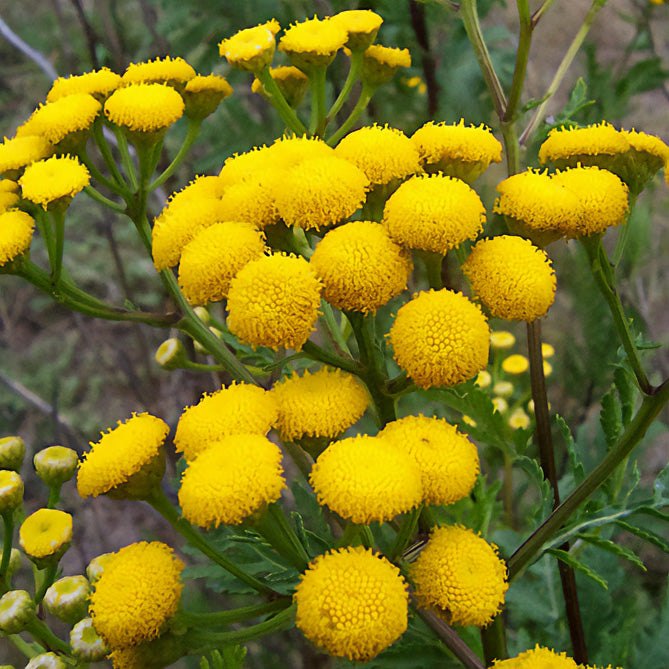
The oil is ink-blue thanks to chamazulene, the same compound that colours German chamomile, and according to the trade it forms during distillation. The main part of the oil is camphor, sabinene and the pinenes, with bornyl acetate and limonene. The plant is a daisy that grows in Morocco.
Blue tansy (Tanacetum annuum) is entirely different from common tansy (Tanacetum vulgare), a species in the same genus whose oil is rich in thujone. The English word “tansy” covers both, so the scientific name on the label is what to check.
- Plant part
- Flowers
- Vietnamese name
- Blue tansy
- Scent family
- Green
- Plant family
- Asteraceae
- Lots published
- —
 Flowers
Composition profile
The published composition from the article, read as structure: 6 compounds adding up to about 62 % of the sample. Figures are printed as the source gives them — one sample, not a species average.
| Compound | Level | Class | Note |
|---|---|---|---|
| Camphor EU | 16.69 % | Ketones | Middle |
| α-Pinene EU | 12.37 % | Monoterpenes | Top |
| Bornyl acetate | 11.97 % | — | — |
| Limonene EU | 11.10 % | Monoterpenes | Top |
| Borneol | 6.33 % | Alcohols | Middle |
| Chamazulene | 3.49 % | — | — |
By chemical class
- Monoterpenes23.5 %
- Ketones16.7 %
- Unclassified15.5 %
- Alcohols6.3 %
By note
- Top23.5 %
- Middle23.0 %
- Unclassified15.5 %
Group totals use the upper bound of each range and only the compounds the article lists; bars are relative to the identified total.
Compare with the 1 chemically closest oil Which other oils are rich in Camphor?
What blue tansy is
Blue tansy (Tanacetum annuum) is an annual daisy of Morocco. The oil is distilled from the aerial parts at flowering, roughly August to October. According to Givaudan, a major fragrance-materials producer, the plant had nearly disappeared through overharvesting in the wild and is now cultivated again in Morocco.
Composition: Moroccan samples
| Compound | North-western Morocco (2023) | Morocco (1999, as cited) |
|---|---|---|
| Camphor | 16.69% | 13.2% |
| Sabinene | – | 22.3% |
| α-Pinene | 12.37% | – |
| Bornyl acetate | 11.97% | – |
| Limonene | 11.10% | – |
| β-Pinene | – | 10.1% |
| Borneol | 6.33% | – |
| Chamazulene | 3.49% | – |
The 2023 sample was aerial parts from north-western Morocco, with a yield of about 0.7% of dry weight and 39 compounds. The 2023 paper also gathers figures from other Moroccan studies: sabinene 9.49–22.3%, camphor 12.67–14.21%, chamazulene up to 17.74%, myrcene 13.67% in one sample. A dash means it was not in the data we read.
Why the oil is blue
The ink-blue colour comes from chamazulene, the same compound that colours German chamomile. According to Givaudan, chamazulene forms during distillation from a sesquiterpene present in the plant (matricin). We have not read a peer-reviewed study confirming this mechanism specifically for T. annuum.
Chamazulene ranges from 3.49% to 17.74% between samples, so the depth of colour also varies from lot to lot.
Its smell
Camphor and borneol give the cool, camphoraceous part; sabinene and the pinenes a green, slightly spicy note; bornyl acetate and limonene make it sweeter and softer. Chamazulene contributes almost nothing to the smell. That is why blue tansy is usually described as sweet, herbal and slightly camphoraceous, much gentler than its colour suggests.
Not to be confused with common tansy
Blue tansy is quite different from common tansy (Tanacetum vulgare), a species in the same genus that also goes by “tansy” in English. The botanical name on the label is the first thing to check.
Safety
Camphor must be labelled above a threshold under EU Regulation 2023/1545. Camphor-rich oils are not suitable for use near the faces of young children (see children and pregnancy). The blue colour can stain fabric and skin. Always dilute before use on skin.
Sources
- Ettakifi H., Abbassi K., Maouni S. et al. (2023). Chemical Characterization and Antifungal Activity of Blue Tansy (Tanacetum annuum) Essential Oil and Crude Extracts against Fusarium oxysporum f. sp. albedinis. Antibiotics 12(9), 1451. doi:10.3390/antibiotics12091451
- Greche H., Ismaili-Alaoui M., Zrira S. et al. (1999). Composition of Tanacetum annuum L. Oil from Morocco. Journal of Essential Oil Research 11(3), 343–348. doi:10.1080/10412905.1999.9701150
- Givaudan. Blue Tansy Oil Morocco (material description page).
Buy Blue tansy
Blue tansy oil: no lot has been brought in yet, so it is not on sale. Message us if you need it.
Where you may already have smelled it
According to the analyses cited above, this oil contains up to 16.7 % camphor and up to 12.4 % α-pinene. Both are also the leading compound in the scenes below from the scent dictionary. Smelling one of those scenes again is a way to get to know them without opening a bottle. A shared compound does not mean the oil smells exactly like the scene.
- CamphorTake a camphor block from an old wardrobe, hold it in your palm and smell
- Camphor woodOpen an old camphor-wood chest and smell inside
- AmomumShell a dried amomum pod and smell the seeds inside
- Canarium resinScrape a fresh drop of resin oozing from a Canarium trunk and smell it on the knife tip
Chemically close
The oils whose published composition is closest to this one, compared across every compound we could read. Close in composition does not mean the scent is identical or that one can replace the other.
- Utah juniper Juniperus osteosperma shared: Camphor, Bornyl acetate · closeness 0.75 · compare
Further reading
Close to Blue tansy
Same plant family: Asteraceae Davana · German chamomile · Helichrysum · Immortelle Madagascar · Roman chamomile · Tagetes
Also from the flowers Everlasting Madagascar · German chamomile · Helichrysum · Lotus · Pomelo blossom · Roman chamomile · Rose otto · St John’s wort
Same method: direct steam distillation Bergamot mint · Blue cypress · Juniper berry · Kaffir lime leaf · Patchouli · Rosalina · Utah juniper · Wild ginger
Quick answers
What does blue tansy essential oil smell like?
Sweet and herbal, with a green-apple note and light camphor. The smell is softer than its colour suggests.
What is the botanical name of blue tansy oil?
The plant is Tanacetum annuum, in the Asteraceae family. In Vietnamese it is called blue tansy.
How is blue tansy oil produced?
From the flowers of the plant, by direct steam distillation. See the method for what that does to the oil.
Last updated